


Asian markets on Friday were mixed as fears that the global recovery would fire inflation continued to niggle investor sentiment as they faced up to the fact that interest rates would not be kept at record lows forever.
The rollout of vaccines, falling infection rates and the prospect of another mammoth US stimulus have sent equity markets to all-time or multiyear highs in the past few weeks, with focus firmly on the long-term outlook.
The rally has been underpinned by vast financial support from central banks around the world, particularly the US Federal Reserve, as well as huge government spending.
However, while there is light at the end of the tunnel and people look forward to the easing of social restrictions and a return to some level of normality, the recovery has its downsides.
Focus has turned from the optimistic view of an economy back on track to the expected ramp-up in prices that is likely to force central bankers to tighten ultra-loose monetary policies, including hiking interest rates. US Treasury yields have rallied to their highest level in about a year as inflation expectations surge.
“With large-scale stimulus amid recovery from the COVID-19 shock, investor attention has focused on potential impacts from rising rates and inflation,” AxiCorp Financial Services Pty chief global markets strategist Stephen Innes said. “Stocks are at the brink of moving from the sweet zone into the danger zone as Fed rate hikes start nudging towards 2022 and the taper tantrum drum keeps beating in the distance.”
“For now, the Fed has been able to keep the taper genie in the bottle. Still, in a world quick to normalize due to the vaccine with additional fiscal stimulus providing rocket fuel to the inflationary fire, higher rates are on the verge of becoming a consensus view,” he said.
With much of the equity rally fired by expectations that borrowing costs would be kept low for the foreseeable future, markets are beginning to wobble, with unease about frothy valuations adding to the selling pressure. Several observers have warned a steep, but necessary, correction is possibly on the way.
In Taipei on Friday, the TAIEX ended down 83.13 points, or 0.51 percent, at 16,341.38 on turnover of NT$346.820 billion (US$12.24 billion). It was up 3.41 percent for the week.
In Hong Kong, the Hang Seng rose for a third week, ending 0.16 percent firmer at 30,644.73. It increased 1.56 percent from a week earlier
The Shanghai Composite Index rose 0.57 percent to 3,696.17, with a weekly gain of 1.12 percent.
In South Korea, the KOSPI gained 0.68 percent to 3,107.62, rising 0.23 percent for the week.
Japan’s TOPIX dropped 0.67 percent to 1,928.95, and declined 0.25 percent from a week earlier. The Nikkei 225 also lost ground, dropping 0.72 percent to 30,017.92, but posted a weekly gain of 1.69 percent.
Australia’s S&P ASX 200 declined 1.34 percent to 6,793.8, losing 0.19 percent from a week earlier.
Additional reporting by staff writer

Nanya Technology Corp (南亞科技) yesterday said the DRAM supply crunch could extend through 2028, as the artificial intelligence (AI) boom has led the world’s major memory makers to dramatically reduce production of standard DRAM and allocate a significant portion of their capacity for high-bandwidth memory (HBM) chips. The most severe supply constraints would stretch to the first half of next year due to “very limited” increases in new DRAM capacity worldwide, Nanya Technology president Lee Pei-ing (李培瑛) told a news briefing. The company plans to increase monthly 12-inch wafer capacity to 20,000 in the first half of 2028 after a

Taiwan has enough crude oil reserves for more than 100 days and sufficient natural gas reserves for more than 11 days, both above the regulatory safety requirement, Minister of Economic Affairs Kung Ming-hsin (龔明鑫) said yesterday, adding that the government would prioritize domestic price stability as conflicts in the Middle East continue. Overall, energy supply for this month is secure, and the government is continuing efforts to ensure sufficient supply for next month, Kung told reporters after meeting with representatives from business groups at the ministry in Taipei. The ministry has been holding daily cross-ministry meetings at the Executive Yuan to ensure
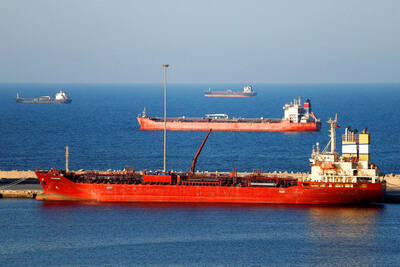
HORMUZ ISSUE: The US president said he expected crude prices to drop at the end of the war, which he called a ‘minor excursion’ that could continue ‘for a little while’ The United Arab Emirates (UAE) and Kuwait started reducing oil production, as the near-closure of the crucial Strait of Hormuz ripples through energy markets and affects global supply. Abu Dhabi National Oil Co (ADNOC) is “managing offshore production levels to address storage requirements,” the company said in a statement, without giving details. Kuwait Petroleum Corp said it was lowering production at its oil fields and refineries after “Iranian threats against safe passage of ships through the Strait of Hormuz.” The war in the Middle East has all but closed Hormuz, the narrow waterway linking the Persian Gulf to the open seas,
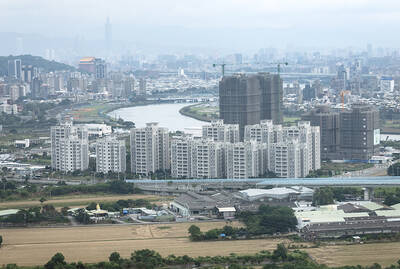
Property transactions in the nation’s six special municipalities plunged last month, as a lengthy Lunar New Year holiday combined with ongoing credit tightening dampened housing market activity, data compiled by local land administration offices released on Monday showed. The six cities recorded a total of 10,480 property transfers last month, down 42.5 percent from January and marking the second-lowest monthly level on record, the data showed. “The sharp drop largely reflected seasonal factors and tighter credit conditions,” Evertrust Rehouse Co (永慶房屋) deputy research manager Chen Chin-ping (陳金萍) said. The nine-day Lunar New Year holiday fell in February this year, reducing


 RSS
RSS