


Whether people want them or not, automakers are rolling out new electric vehicle models as the industry responds to stricter pollution regulations and calls to reduce emissions to fight climate change.
The latest offering comes from General Motors (GM), which unveiled a Chevrolet Bolt compact SUV on Sunday. It comes with an estimated range per charge of 250 miles (400km) and a US$33,995 starting price tag.
The Bolt Electric Utility Vehicle is to go on sale early this summer as a 2022 model. Sales are to start with a small number of early versions priced at US$43,495.
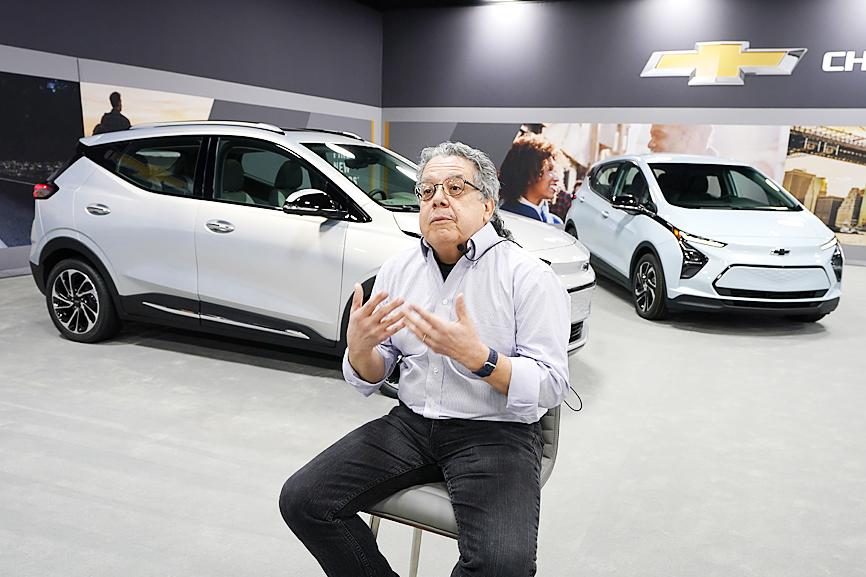
Photo: AP
It will bring the total number of EVs on sale in the US to at least 23, and Edmunds.com expects that figure to reach 30 this year. About 2.5 million electric vehicles were sold worldwide last year.
IHS Markit predicts that will increase by 70 percent this year alone.
However, the changeover has a long way to go. Fully electric vehicles accounted for less than 2 percent of US new vehicle sales last year, and Americans continue to spend record amounts on larger gas-powered trucks and SUVs. EVs make up 3 percent of sales worldwide, GM says.
The new Bolt is part of GM’s pledge to bring 30 new EVs to market worldwide by 2035, and its goal of producing only electric passenger vehicles in 14 years. It will sit taller and have more rear-seat legroom than the current Bolt electric hatchback, which is being updated, and will compete in one of the hottest segments of the US market. Buyers can also opt for GM’s “Super Cruise” partially automated driver-assist system.
IHS Markit analyst Stephanie Brinley said the new SUV is another step toward wider adoption of fully electric vehicles, but it will take many more.
“At least one element of mainstreaming EVs must be consumer choice and availability of usable EVs in a variety of segments and price points,” she said. “Some will have more impact than others, but there isn’t one vehicle alone that can turn the tide.”
The Bolt SUV will come out when GM is at a price disadvantage to most competitors due to a US$7,500 federal EV tax credit. The credit is phased out after manufacturers hit 200,000 in electric vehicle sales, and GM and Tesla have both passed that level. A bill from Democrats on the House Ways and Means Committee would raise the cap to 600,000 and cut the credit to US$7,000.
A White House spokesman said President Joe Biden favors restoring the full tax credit, prioritizing US-made vehicles and targeting middle-class consumers.
The spokesman would not comment on the sales cap.
GM CEO Mary Barra said last week that the company would like to see the credit expanded so “first movers” with the new technology are not penalized.
Chevrolet marketing director Steve Majoros said he would love to have the tax credit back to spur sales. He said GM is talking with the Biden administration about the credit.
“For right now we’re very pleased with the price point we have and we’re going to make a good run with it,” Majoros said.
GM said it was able to use economies of scale to cut the price of the updated Bolt hatchback by over US$5,000 to US$31,995.
Sweeping policy changes under US Secretary of Health and Human Services Robert F. Kennedy Jr are having a chilling effect on vaccine makers as anti-vaccine rhetoric has turned into concrete changes in inoculation schedules and recommendations, investors and executives said. The administration of US President Donald Trump has in the past year upended vaccine recommendations, with the country last month ending its longstanding guidance that all children receive inoculations against flu, hepatitis A and other diseases. The unprecedented changes have led to diminished vaccine usage, hurt the investment case for some biotechs, and created a drag that would likely dent revenues and

Global semiconductor stocks advanced yesterday, as comments by Nvidia Corp chief executive officer Jensen Huang (黃仁勳) at Davos, Switzerland, helped reinforce investor enthusiasm for artificial intelligence (AI). Samsung Electronics Co gained as much as 5 percent to an all-time high, helping drive South Korea’s benchmark KOSPI above 5,000 for the first time. That came after the Philadelphia Semiconductor Index rose more than 3 percent to a fresh record on Wednesday, with a boost from Nvidia. The gains came amid broad risk-on trade after US President Donald Trump withdrew his threat of tariffs on some European nations over backing for Greenland. Huang further

Macronix International Co (旺宏), the world’s biggest NOR flash memory supplier, yesterday said it would spend NT$22 billion (US$699.1 million) on capacity expansion this year to increase its production of mid-to-low-density memory chips as the world’s major memorychip suppliers are phasing out the market. The company said its planned capital expenditures are about 11 times higher than the NT$1.8 billion it spent on new facilities and equipment last year. A majority of this year’s outlay would be allocated to step up capacity of multi-level cell (MLC) NAND flash memory chips, which are used in embedded multimedia cards (eMMC), a managed

CULPRITS: Factors that affected the slip included falling global crude oil prices, wait-and-see consumer attitudes due to US tariffs and a different Lunar New Year holiday schedule Taiwan’s retail sales ended a nine-year growth streak last year, slipping 0.2 percent from a year earlier as uncertainty over US tariff policies affected demand for durable goods, data released on Friday by the Ministry of Economic Affairs showed. Last year’s retail sales totaled NT$4.84 trillion (US$153.27 billion), down about NT$9.5 billion, or 0.2 percent, from 2024. Despite the decline, the figure was still the second-highest annual sales total on record. Ministry statistics department deputy head Chen Yu-fang (陳玉芳) said sales of cars, motorcycles and related products, which accounted for 17.4 percent of total retail rales last year, fell NT$68.1 billion, or


 RSS
RSS