


Strong demand from US consumers ahead of Valentine’s Day is bringing Colombia’s flower industry back from the brink of collapse.
Exports have been picking up since September, boding well for Feb. 14, the biggest day in the calendar for florists. Strong sales this weekend would set the seal on the industry’s comeback.
Colombian growers were getting ready for Mother’s Day when the pandemic tore through the US last spring. With massive markets such as New York and California locked down, Colombia’s flower producers destroyed thousands of tonnes of roses, carnations and chrysanthemums.
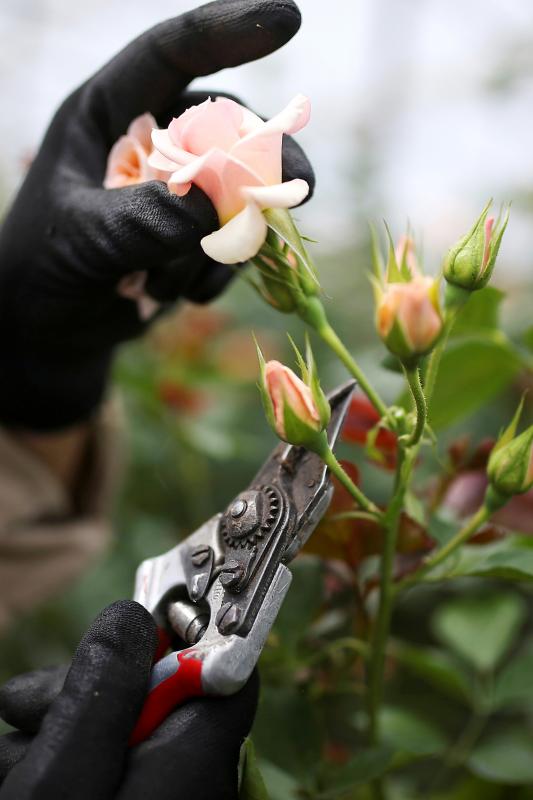
Photo: Reuters
There was more bad news to come. When summer arrived, US couples started canceling their weddings. Even funeral sales were not good, due to restrictions on gatherings. Most of the cut flowers sold in the US come from Colombia, and the sector looked set for mass bankruptcies and job losses.
Instead, it saw a major recovery. As the pandemic progressed, people in the US got into the habit of sending each other flowers when they could not meet face to face, and also bought more blooms to brighten up their homes, Kate Penn, chief executive officer of the Society of American Florists, said in a phone interview.
And since they could not easily spend their money on vacations, restaurants or concerts, some households found themselves with more disposable income than normal.
“I’ve definitely talked to florists whose event work, which basically was almost nothing, was more than offset by the everyday interest in flowers,” Penn said.
After crashing 25 percent in June, when the wedding season starts, Colombian flower exports rebounded in late summer, which is normally a slow period.
For the whole of last year, exports fell just 4 percent, despite the slump earlier in the year.
“Normally, summer is bad, because countries in the northern hemisphere grow their own flowers, but, despite that, exports continued very well, and now they’re doing well, and there’s good demand for Valentine’s day,” said Augusto Solano, head of the Colombian Flower Growers’ Association.
Flowers accounted for US$1.4 billion of the nation’s US$31 billion in exports last year, ranking behind oil, coal, coffee and gold. About 80 percent of Colombian flower exports go to the US.
Large flower companies were relatively unscathed by the downturn, while small ones fared much worse. With contracts to supply retailers such as Walmart Inc, big producers typically sell more than 100 percent of their output, making up the difference with purchases from smaller growers.
Faced with last year’s crisis, they continued to sell their own flowers, but slashed orders from small growers like Carmen Bravo.
Her company, Belen de los Tejares, has 27 employees and grows roses in the heart of Colombia’s flower-producing area in the Andean plain known as the Bogota Savanna. Last year, she saw sales slump by 40 percent.
“Between March 20 and April 20, we had to throw away more or less 220,000 flowers,” Bravo said. “Mother’s Day is the second Sunday of May, but flower shipments are normally three or four weeks earlier, so that was the time of peak production, and there was no market for them.”
Fortunately, Valentine’s Day last year fell before the mass shutdowns and Colombian flower exports in February last year were the strongest ever for the month. Bravo said the money she made then allowed her to weather the crisis, and that sales this year have also been strong.
“Valentine’s day is the key to having a good year. We’ve started the year on a sound footing,” Bravo said.

Cairo’s new monorail slices across the city skyline, running above the familiar chaos of blaring horns and aging buses’ exhaust fumes that mark rush hour below. The US$4.5 billion monorail, opened this month, is among Egypt’s most prominent new transport projects, part of a debt-funded infrastructure drive criticized for sapping state finances while bringing limited benefits to most of the country’s 109 million people. “It feels like you’re in a different country,” said Ramy Sayed, a restaurant manager, aboard a driverless Innovia 300 train. “No noise, no traffic, we’re not used to this.” The eastern line runs 56km from the bustling middle-class

Taiwanese firms have increased investment in the Philippines in recent years as Manila’s ties with Washington deepen and global supply chains continue to shift away from China, an expert at the Chung-Hua Institution for Economic Research (CIER, 中華經濟研究院) said yesterday. The Philippines had not been among Taiwanese investors’ top choices in Southeast Asia, CIER Taiwan ASEAN Studies Center director Kristy Hsu (徐遵慈) said at a seminar in Taipei. However, Taiwan’s investment in the country has grown significantly since the COVID-19 pandemic, reaching US $257 million last year, a high in recent years, she said. Although Taiwan’s total investment in the Philippines still lags

Intel Corp regards Taiwan Semiconductor Manufacturing Co (TSMC, 台積電) as a longstanding partner, as the US chipmaker would continue outsourcing production of advanced chips to TSMC, Intel chief executive officer Lip-Bu Tan (陳立武) said yesterday. “I don’t look at people as competitors. I look at the collaboration... Nvidia is also, you know, a good friend,” Tan told a news conference following his keynote speech at the Computex trade show in Taipei. “It’s a very trusted partnership for us... We are a big, top customer for them, and we’re going to continue doing that,” he said, referring to TSMC, the world’s largest foundry

Artificial intelligence (AI) agents would supplant smartphones as the center of people’s digital lives, fundamentally reshaping personal devices and driving a major computing upgrade cycle, Qualcomm Inc CEO Cristiano Amon said yesterday. In his keynote speech for this year’s Computex trade show in Taipei, Amon said that the rise of "agentic AI" — AI systems capable of reasoning, planning and carrying out tasks autonomously — would transform how people interact with technology across phones, PCs, vehicles and wearable devices. Describing the technology as the next major evolution in computing, Amon said that "2026 is the year of agents.” For decades, smartphones have sat


 RSS
RSS