


In his waders, Stefan Astner checks on the albino sturgeon: Almost two decades after they hatched, they are ready to be gutted for their caviar to be shipped out for New Year’s celebrations.
“The fish have already been through the ultrasound, so we saw that they are full [of roe] and they will go into production soon,” Astner said, dipping his net into a small pond teeming with the rare, white sturgeon.
Deemed the most expensive food in the world, demand for caviar — essentially, salted roe — has driven most sturgeon species to the brink of extinction in the wild.
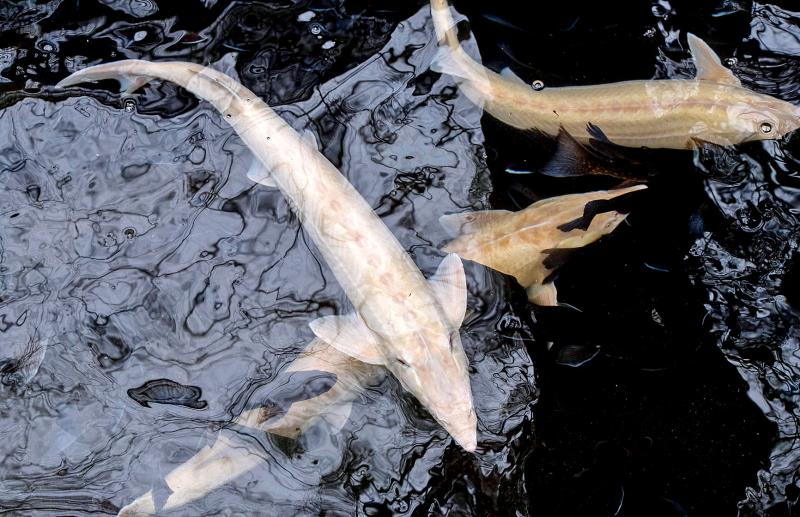
Photo: AFP
Yet fish farms like the one where Astner works in the village of Groedig, near the Austrian city of Salzburg, offer a more sustainable alternative.
Owner Walter Gruell is one of about 2,500 sturgeon farmers worldwide that produce a combined 415 tonnes of caviar a year, the World Sturgeon Conservation Society’s most recent figures dating from 2018 showed.
However, patience is imperative for producers.
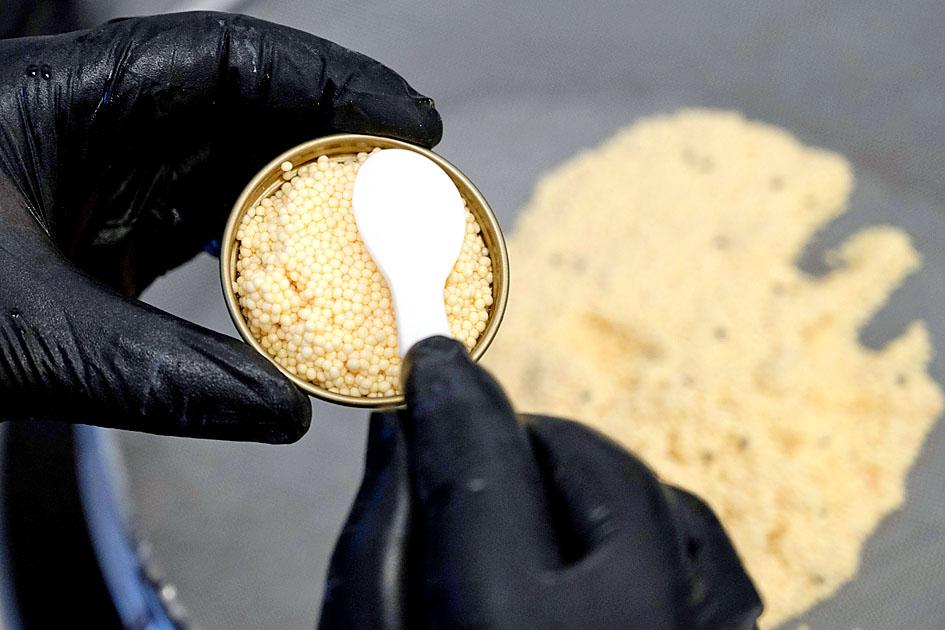
Photo: AFP
The required investment is high and does not pay off for years until the sturgeon begin carrying roe — that is if they are not stolen by gangs hoping to skip the arduous breeding process.
The albino female that Gruell slices with surgical precision is 16 years old. Slowly, he removes, rinses and weighs the cream-colored roe, which, like the fish, lacks pigmentation.
There are no more than 40 sturgeon breeders specializing in albinos worldwide, said Thomas Friedrich, an expert on sturgeon at the University of Natural Resources and Life Sciences in Vienna.
Although there is no research suggesting that lack of pigmentation affects caviar’s taste, Gruell is convinced of its superiority, asserting that “it’s even sweeter, even smoother than the traditionally black one.”
Consumers are willing to pay for the difference.
The female that Gruell just cut yields 600g, worth 8,000 euros (US$9,708) — more than three times the price that black caviar fetches.
The COVID-19 pandemic has curbed demand as upscale restaurants, like all eateries in Austria, have been closed, but retail is booming, partly because people still want to treat themselves, Gruell said.
“People want to savor the present moment,” he said, between the many telephone calls ahead of end-of-year celebrations, when he makes close to 40 percent of his annual turnover.
While reporters visited his farm, Gruell spoke to a luxury automaker, and shortly before had been in contact with an airline hoping to serve first-class travelers caviar “Made in Austria.”
Demand for caviar remains high, and not just from paying customers, but sturgeon rustlers, too.
A year ago, 400kg of sturgeon were stolen from a farm less than two hours away from Groedig.
The eviscerated fish were later found in a reservoir. A year before that, 400 individual sturgeon worth 50,000 euros were stolen from another farm.
At Gruell’s farm, the fish, which include sturgeon native to the Danube, are protected by surveillance cameras and high fences with heavy padlocks.
Although sturgeon breeding in countries like China, France and Italy started as a purely financial venture, it is now also seen as a sustainable alternative to wild sturgeon. Having survived the demise of the dinosaurs, some sturgeon species have recently gone extinct, while others are on the brink.
In Russia and Iran, production of wild caviar collapsed in the 1980s due to overfishing as well as pollution in the Caspian Sea.
Most countries along the Danube now protect the local sturgeon species, although experts worry that conservation might have come too late.
Official government data in Romania, where the Danube empties into the Black Sea, show that catches of Russian sturgeon plummeted from 3,725kg in 2002 to just 37kg in 2005, indicating that overfishing had gravely diminished their numbers.
Although the country issued a moratorium in 2006, impoverished fishermen continue to try to catch the fish, as the roe that one sturgeon can carry are worth as much as a fisherman’s annual income.
Some fans of the delicacy still believe that the taste of wild caviar eclipses that extracted from farmed sturgeon — although Gruell said that his albinos are in a taste category of their own.

The domestic unit of the Chinese-owned, Dutch-headquartered chipmaker Nexperia BV will soon be able to produce semiconductors locally within China, according to two company sources. Nexperia is at the center of a global tug-of-war over critical semiconductor technology, with a Dutch court in February ordering a probe into alleged mismanagement at the company. The geopolitical tussle has disrupted supply chains, with some carmakers reportedly forced to cut production due to chip shortages. Local production would allow Nexperia’s domestic arm, Nexperia Semiconductors (China) Ltd (安世半導體中國), to bypass restrictions in place since October on the supply of silicon wafers — etched with tiny components to

Singapore-based ride-hailing and delivery giant Grab Holdings Ltd has applied for regulatory approval to acquire the Taiwan operations of Germany-based Delivery Hero SE's Foodpanda in a deal valued at about US$600 million. Grab submitted the filing to the Fair Trade Commission on Friday last week, with the transaction subject to regulatory review and approval, the company said in a statement yesterday. Its independent governance structure would help foster a healthy and competitive market in Taiwan if the deal is approved, Grab said. Grab, which is listed on the NASDAQ, said in the filing that US-based Uber Technologies Inc holds about 13 percent of

Taiwan Semiconductor Manufacturing Co (TSMC, 台積電) yesterday received government approval to deploy its advanced 3-nanometer (3nm) process at its second fab currently under construction in Japan, the Ministry of Economic Affairs said in a news release. The ministry green-lit the plan for the facility in Kumamoto, which is scheduled to start installing equipment and come online in 2028 with a monthly production capacity of 15,000 12-inch wafers, the ministry said. The Department of Investment Review in June 2024 authorized a US$5.26 billion investment for the facility, slated to manufacture 6- to 12nm chips, significantly less advanced than 3nm process. At a meeting with

Taiwan’s food delivery market could undergo a major shift if Singapore-based Grab Holdings Ltd completes its planned acquisition of Delivery Hero SE’s Foodpanda business in Taiwan, industry experts said. Grab on Monday last week announced it would acquire Foodpanda’s Taiwan operations for US$600 million. The deal is expected to be finalized in the second half of this year, with Grab aiming to complete user migration to its platform by the first half of next year. A duopoly between Uber Eats and Foodpanda dominates Taiwan’s delivery market, a structure that has remained intact since the Fair Trade Commission (FTC) blocked Uber Technologies Inc’s


 RSS
RSS