

The Financial Supervisory Commission (FSC) yesterday fined KGI Securities Ltd (凱基證券) NT$3.36 million (US$117,676) for poor internal control and lax management after a stock broker, surnamed Lai (賴), allegedly committed suicide in August in Taipei due to huge investment losses.
Lai’s death has sparked public concern over KGI Securities’ management, with his family accusing the company of putting undue pressure on its brokers, including encouraging Lai to illegally trade futures for his clients, which resulted in huge investment losses.
The commission announced the penalty after releasing its long-awaited investigative report on the incident, three-and-a-half months after it launched a probe.
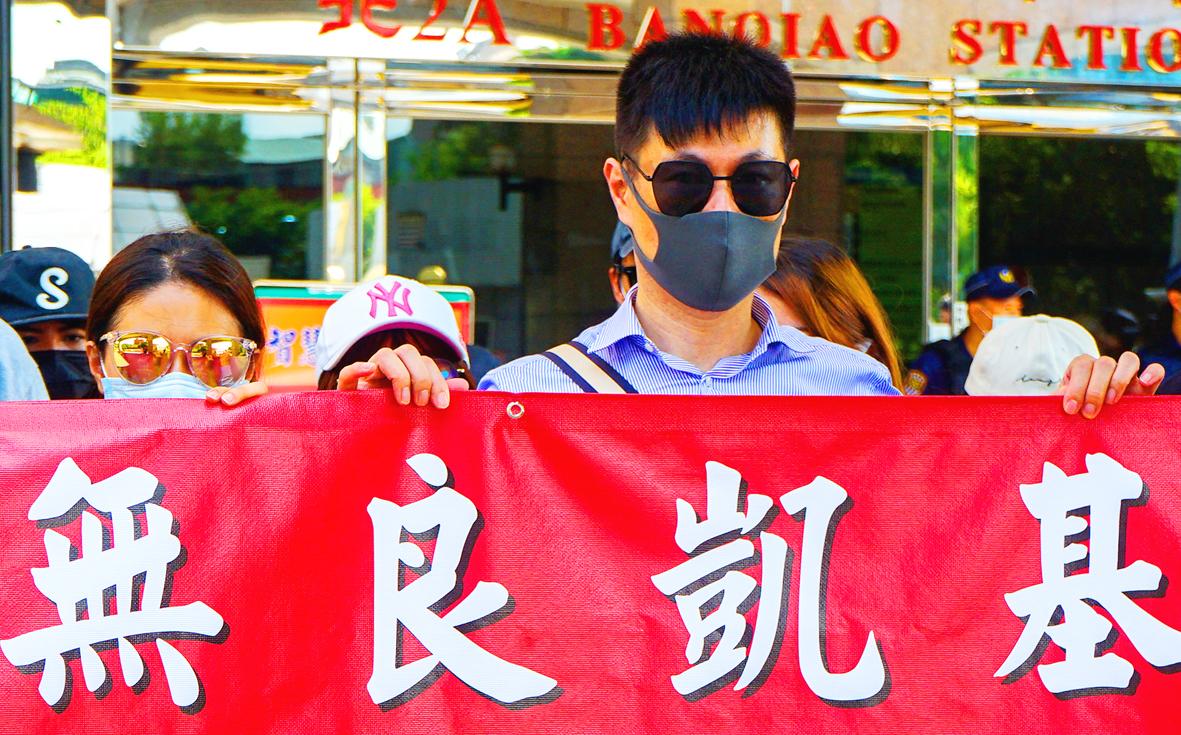
Photo: CNA
Lai had secretly managed at least 12 clients’ funds with their approval since 2018, helping operate their discretionary accounts, which means he decided which futures to buy or sell without their orders, an illegal behavior for a broker, Securities and Futures Bureau Deputy Director Kuo Chia-chun (郭佳君) told a news conference in New Taipei City.
At least NT$9.53 million was involved, Kuo said.
Lai’s manager, surnamed Chiu (邱), knew that he was trading futures using his own accounts at KGI Securities, but Chiu did not clarify the sources of funds, although Lai’s cumulative transactions totaled millions of New Taiwan dollars, Kuo said.
Given that Chiu had access to information about all of Lai’s transactions, as he had been using his own accounts at the firm, she should have questioned if it was reasonable that Lai would have so much money to invest and looked into why he did not use the firm’s intranet when placing orders, Kuo said.
When Lai applied to reduce the handling fee for futures transactions so he could pay less, Chiu approved it with no questions asked, nor did she stop him when he continuously suffered losses from the investments, she said.
“These indicated that Chiu did not supervise her staff well and KGI Securities did not exercise solid internal controls,” she said.
“Although Lai’s clients were willing to let him operate their funds, it was still an illegal practice and KGI should have caught it,” she added.
As for the complaint of Lai’s family’s that KGI Securities sets unreasonable sales targets, the commission found that the firm’s reward mechanism is similar to those of its peers, and that it did not threaten Lai with dismissal if he missed the target, Kuo said.
The commission did not find a laptop that was reportedly used by Lai in the office to secretly execute orders, adding that it was possible he used his mobile devices to place orders.
The penalty is the highest-ever levied against a securities firm in a single case, as KGI Securities had breached the Securities and Exchange Act (證券交易法) and the Futures Trading Act (期貨交易法), Kuo said.
Chiu has been suspended for six months from engaging in any securities or futures transactions, the commission said.
The commission would ask the Taiwan Stock Exchange and the Taipei Exchange to enhance their monitoring of securities firms and demand that they strengthen their internal controls, she said.

Bankers in Hong Kong skipped the summer break as an artificial intelligence (AI)-fueled rush for capital sent share sales to a record, defying a bruising selloff in the city’s stocks. Initial public offerings (IPOs), placements and block trades raised US$47.5 billion in July to last month, the biggest haul ever for the period, data compiled by Bloomberg showed. That pushed fundraising this year above US$92 billion and within reach of the US$112.5 billion record set in 2021. AI has been at the heart of Hong Kong’s deal revival, but this summer brought a new level of intensity. Chinese companies raised ever-larger sums

BOOMING BUSINESS: Memory supply constraints would be even more severe in 2027 and 2028, prompting customers to sign long-term supply agreements, Micron said Micron Memory Taiwan Co (台灣美光) yesterday said it is accelerating memorychip capacity expansion amid growing artificial intelligence (AI)-driven demand, with its accumulated investment in Taiwan reaching NT$1.6 trillion (US$50.2 billion) as of June. The company’s investment in Taiwan has surged over the past four years, with recent spending equaling the total invested over the past 25 years, Micron Taiwan chairman Donghui Lu (盧東暉) told a media briefing in Taipei. “The launch of ChatGPT and the outbreak of COVID triggered increasing demand for memory chips. Since then, demand has gathered pace rapidly, with only a brief pause in 2023 when a major downturn”
Taiwan ranked fifth worldwide in net financial assets per capita at the end of last year, averaging 164,470 euros (US$186,219), a report released this week by Germany-based Allianz Research said. Taiwan's ranking remained unchanged from the previous year, trailing only the US, Switzerland, Denmark and Singapore, Allianz’s Global Wealth Report said. In the report, Allianz assessed household assets and liabilities in nearly 60 countries, finding that global household wealth reached a record high last year, while the rise of artificial intelligence and market gains made asset ownership increasingly important in determining who benefits from wealth creation. Global financial assets reached a record 268.4

Apple Inc is set to sell about 6 million units of the iPhone Duo this year, Counterpoint Research said, offering the first estimate for how the company’s inaugural foldable device would fare. The figure, more typical of the niche foldable segment than Apple’s usual smartphone sales, is contingent on how well the company ramps up production of the new hardware, Counterpoint senior analyst Ivan Lam (林科宇) said. Priced at US$1,999 and set for a release this month, the iPhone Duo sits atop the Apple lineup and carries industry wide hopes for stoking greater interest and sales of foldables. Market researcher IDC Corp


 RSS
RSS