


Next year would still be a challenging year for airlines as passenger business is not likely to rebound until the fourth quarter, so EVA Airways Corp (長榮航空) plans to offer special charter flights and enhance its cargo business to weather the COVID-19 crisis, company officials said yesterday.
The International Air Transport Association (IATA) has predicted that passenger demand is not going to resume until the second half of next year, while the company believes demand for regional flights would increase before that of international routes, EVA executive vice president Liao Chi-wei (廖至維) told an investors’ conference.
EVA reported a net loss of NT$1.8 billion (US$63.2 million) in the third quarter, which led to a cumulative net loss of NT$3.64 billion for the first three quarters, or a loss per share of NT$0.75, corporate data showed.
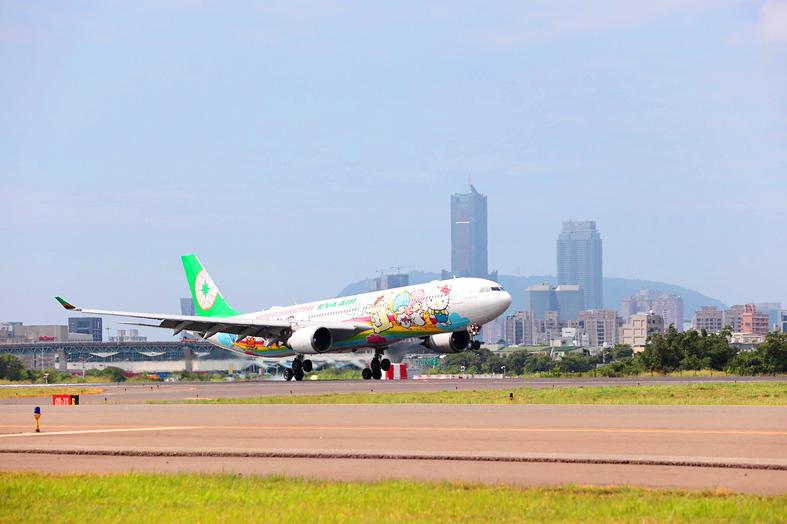
Photo courtesy of EVA Airways Corp
EVA is comparatively resilient, given that 40 foreign airlines have shut down, or filed for bankruptcy or debt restructuring during the pandemic, president Clay Sun (孫嘉明) said.
As strict border controls restrict people from flying, EVA hopes Taiwan’s government would consider replacing its mandatory quarantine period for arrivals with scientific testing or to create travel bubbles with other nations, Sun said.
Passenger revenue sank 73.8 percent annually to NT$23.92 billion for the first 11 months of the year, with passenger numbers diving 80 percent to 2.29 million and its load factor falling by 28.7 percentage points to 53 percent, EVA data showed.
However, its yield, or the average amount of revenue it earned per paying passenger flown 1 mile, gained 9.9 percent to NT$2.27, due to an increase in fares, Liao said.
The Ministry of Transportation and Communications is going to allow airlines to launch more flights-to-nowhere programs next year, and EVA is planning special charter flights for the public or custom-made flights for corporate clients, Liao said.
Given the small size of its pre-pandemic cargo fleet of just five Boeing Co 777 planes, it has turned 12 Boeing 777 passenger jets into cargo aircraft by removing the passenger seats to meet rising orders, he said.
EVA expects to receive the first two of the three 777F cargo aircraft it ordered in October and December next year respectively, and the third in February 2022, Sun said.
The new planes would be used for cargo operations on the North American routes, its biggest cargo market where revenue made up 63 percent of the total, Sun said.
With its cargo revenue growing 91 percent to NT$44.11 billion so far this year due to rising freight rates, EVA expects to maintain a high air cargo rate as cargo space availability is unlikely to increase anytime, Liao said.
Total cargo tonnes grew 13.8 percent year-on-year to 630,000, with cargo load factor rising by 8.8 percentage points to 87.1 percent and yield jumping 71.8 percent to NT$12.65, the data showed.

Cairo’s new monorail slices across the city skyline, running above the familiar chaos of blaring horns and aging buses’ exhaust fumes that mark rush hour below. The US$4.5 billion monorail, opened this month, is among Egypt’s most prominent new transport projects, part of a debt-funded infrastructure drive criticized for sapping state finances while bringing limited benefits to most of the country’s 109 million people. “It feels like you’re in a different country,” said Ramy Sayed, a restaurant manager, aboard a driverless Innovia 300 train. “No noise, no traffic, we’re not used to this.” The eastern line runs 56km from the bustling middle-class

Starlux Airlines Co (星宇航空) today unveiled a long-haul network expansion plan at a shareholders’ meeting in Taipei, including direct flights to Barcelona, Spain, and Zurich, Switzerland, as well as a service connecting Taipei, Sydney and New Zealand. Starlux is to become the first Taiwanese carrier to offer non-stop services to the two European cities, while the inaugural oceanic route is expected to expand transit opportunities within the Australia-New Zealand market, Starlux said. Flight services to Chicago, Dallas, Washington and New York are under evaluation, the airline added. Prior to the shareholders’ meeting, the airline earlier this year announced that it would be

Taiwanese firms have increased investment in the Philippines in recent years as Manila’s ties with Washington deepen and global supply chains continue to shift away from China, an expert at the Chung-Hua Institution for Economic Research (CIER, 中華經濟研究院) said yesterday. The Philippines had not been among Taiwanese investors’ top choices in Southeast Asia, CIER Taiwan ASEAN Studies Center director Kristy Hsu (徐遵慈) said at a seminar in Taipei. However, Taiwan’s investment in the country has grown significantly since the COVID-19 pandemic, reaching US $257 million last year, a high in recent years, she said. Although Taiwan’s total investment in the Philippines still lags

Taiwanese prosecutors suspect that three people successfully smuggled at least one shipment of Nvidia Corp artificial intelligence (AI) chips to China after first exporting them to Japan, people familiar with the matter said. The trio was detained last week by the Keelung District Prosecutors’ Office for allegedly falsifying documents related to exports of Super Micro Computer Inc servers containing advanced Nvidia chips, which the US has barred from sale to China without a license from Washington. The move marked Taiwan’s first public crackdown on AI chip diversion after years of pressure from the US to take a more active role in curtailing


 RSS
RSS