


Oil stocks on Friday lifted European shares, with London’s blue-chip index hitting nine-month highs, while disappointing jobs growth in the US strengthened hopes for fiscal stimulus.
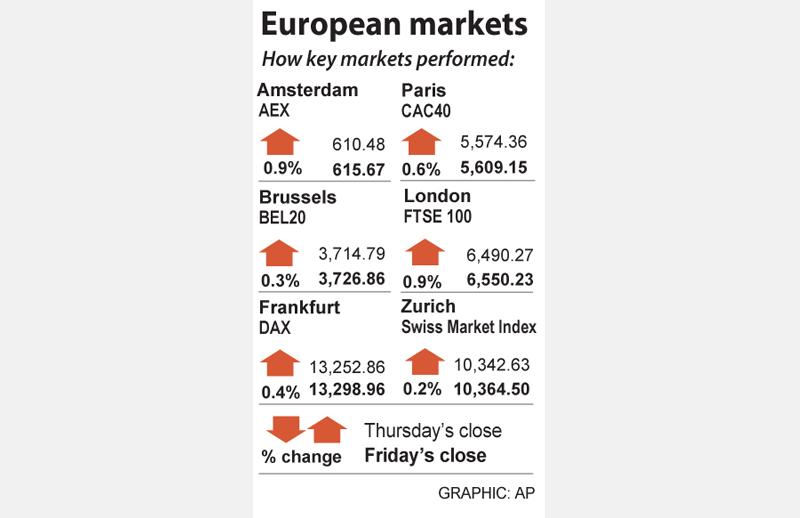
London’s FTSE 100 rose 0.92 percent to 6,550.23 as crude prices gained after a compromise between OPEC+ members to continue to increase output slightly from January but continue the bulk of existing supply curbs.
The index rose 2.87 percent from a week earlier.
Europe’s oil and gas index on Friday jumped 3.1 percent.
In the US, data showed the economy added the fewest number of workers in six months last month, but markets quickly recovered as the report raised hopes of the US Congress pushing through a US$908 billion aid package.
“Vaccines, the restart of talks about stimulus and the new [US] administration, and a less confrontational international background, are still going to be the themes that drive the market,” said Marvin Loh, senior global macro strategist at State Street Global Markets in Boston.
The pan-European STOXX 600 index rose 0.59 percent, which helped it edge up 0.21 percent for the week — its fifth straight week in the black.
Disappointing economic data and uncertainty regarding the UK’s departure from the EU had weighed on it this week. Progress on a trade deal still remained uncertain.
EU officials said that a deal could finally be clinched this weekend, but London insisted that negotiations were still “very difficult.”
Germany’s DAX climbed 0.35 percent to 13,298.96, but ended 0.28 percent lower on the week, having underperformed its peers for most of the week.
The index has risen about 60 percent from its March lows compared with a nearly 46 percent rise for the STOXX 600 over the same period.
Data on Friday showed that German industrial orders rose more than expected on the month in October, raising hopes the manufacturing sector in Europe’s biggest economy started the fourth quarter on a solid footing.
Basic material stocks rose 1.4 percent and were the biggest gainers this week, up 6.8 percent in its best weekly performance in six months, as copper and iron ore prices soared.
Sweden’s Investment AB Latour dropped 12.7 percent and was the worst performer in the STOXX 600 after its majority shareholder trimmed its stake in the company.
All eyes are likely to be on the European Central Bank meeting on Thursday next week when it is expected to keep its policy rate on hold, but increase bond buying.
Additional reporting by staff writer

Among the rows of vibrators, rubber torsos and leather harnesses at a Chinese sex toys exhibition in Shanghai this weekend, the beginnings of an artificial intelligence (AI)-driven shift in the industry quietly pulsed. China manufactures about 70 percent of the world’s sex toys, most of it the “hardware” on display at the fair — whether that be technicolor tentacled dildos or hyper-realistic personalized silicone dolls. Yet smart toys have been rising in popularity for some time. Many major European and US brands already offer tech-enhanced products that can enable long-distance love, monitor well-being and even bring people one step closer to

Malaysia’s leader yesterday announced plans to build a massive semiconductor design park, aiming to boost the Southeast Asian nation’s role in the global chip industry. A prominent player in the semiconductor industry for decades, Malaysia accounts for an estimated 13 percent of global back-end manufacturing, according to German tech giant Bosch. Now it wants to go beyond production and emerge as a chip design powerhouse too, Malaysian Prime Minister Anwar Ibrahim said. “I am pleased to announce the largest IC (integrated circuit) Design Park in Southeast Asia, that will house world-class anchor tenants and collaborate with global companies such as Arm [Holdings PLC],”

Sales in the retail, and food and beverage sectors last month continued to rise, increasing 0.7 percent and 13.6 percent respectively from a year earlier, setting record highs for the month of March, the Ministry of Economic Affairs said yesterday. Sales in the wholesale sector also grew last month by 4.6 annually, mainly due to the business opportunities for emerging applications related to artificial intelligence (AI) and high-performance computing technologies, the ministry said in a report. The ministry forecast that retail, and food and beverage sales this month would retain their growth momentum as the former would benefit from Tomb Sweeping Day

Thousands of parents in Singapore are furious after a Cordlife Group Ltd (康盛人生集團), a major operator of cord blood banks in Asia, irreparably damaged their children’s samples through improper handling, with some now pursuing legal action. The ongoing case, one of the worst to hit the largely untested industry, has renewed concerns over companies marketing themselves to anxious parents with mostly unproven assurances. This has implications across the region, given Cordlife’s operations in Hong Kong, Macau, Indonesia, the Philippines and India. The parents paid for years to have their infants’ cord blood stored, with the understanding that the stem cells they contained


 RSS
RSS