


The government is considering building three reservoirs to help address water shortages, which are expected to become more severe in the coming years, the Water Resources Agency (WRA) said yesterday.
The planned facilities are Shuangsi Reservoir (雙溪水庫) in New Taipei City, Tianhuahu Reservoir (天花湖水庫) in Miaoli County and Nanhua Second Reservoir (南化第二水庫) in Tainan, WRA Deputy Director-General Wang Yi-feng (王藝峰) said.
Although the reservoirs are needed to prepare for potential droughts, there is no timetable for their construction, which requires environmental impact assessments and communicating with residents in the areas they would be built, Wang said.
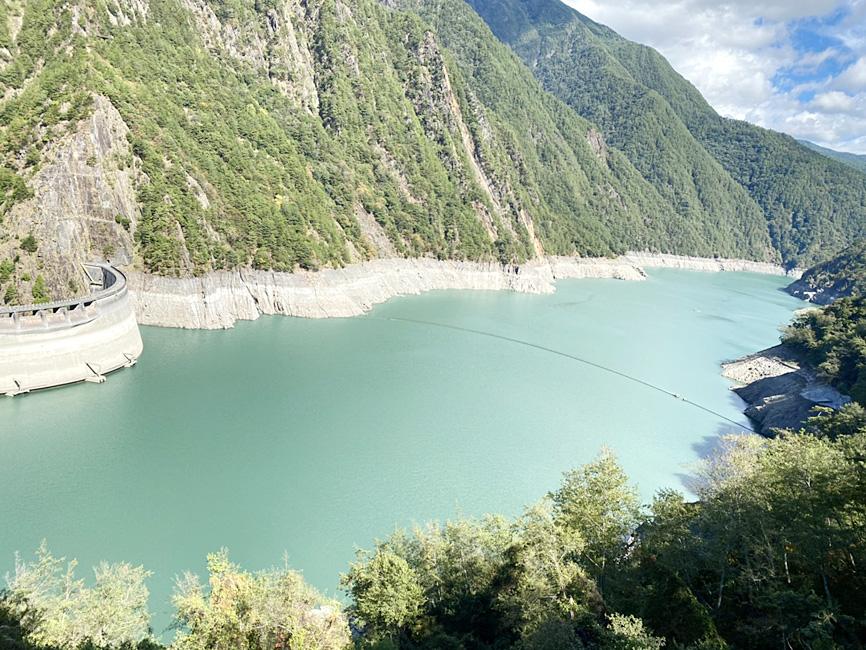
Photo: Chang Hsuan-che, Taipei Times
Upon completion, the three reservoirs could boost the daily water supply by 126,000 tonnes, 260,000 tonnes and 170,000 tonnes respectively, he said.
Taiwan has experienced intensifying water shortages over the past few months, prompting the government last week to suspend farm irrigation on the Chianan Plain (嘉南平原) in southern Taiwan next spring.
The restrictions would affect 19,000 hectares of rice paddies, the Council of Agriculture announced on Wednesday.
The council is also considering similar suspensions in areas in Taichung and Taoyuan, and Hsinchu and Miaoli counties, affecting the first rice harvest of the year. A decision is expected next month.
The government is working to improve some reservoirs in Taiwan, such as increasing the capacity of Chiayi County’s Zengwen Reservoir (曾文水庫), the nation’s largest reservoir, Wang said.
After related work on seven reservoirs is completed, they could provide an extra 180 million tonnes of water per year, he said.
Separately, science-based parks and industrial zones are gearing up for water shortages as the nation faces the dry season, with falling water levels in reservoirs, the Ministry of Economic Affairs said.
At a meeting on Wednesday, the ministry decided to ask science-based parks and industrial zones, which are perceived as two of the largest water consumers in the nation, to save more water to help assuage the pressure caused by low rainfall.
These users aim to curtail their water consumption by 7 percent from an earlier 5 percent to meet the ministry’s request.
Taiwan Semiconductor Manufacturing Co (TSMC, 台積電) and United Microelectronics Corp (UMC, 聯電), the nation’s top two contract chipmakers, have expressed willingness to cooperate with the ministry.
TSMC and UMC are headquartered in the Hsinchu Science Park (新竹科學園區) and run sophisticated wafer plants in other science-based parks in central and southern Taiwan.
UMC said it already has standard operating procedures to adjust or even stop water consumption for nonproduction operations such as watering plants or fire drills.
The request for additional conservation is not expected to have an adverse effect on its production, UMC said.
The company has signed an agreement with its suppliers to ensure emergency water supplies are available if the dry season worsens, it said.
TSMC said it would continue to reduce water usage on nonproduction operations, and continue to tout the importance of water conservation to its employees.
The dry season has had no impact on its operations, the company said.

SECOND-RATE: Models distilled from US products do not perform the same as the original and undo measures that ensure the systems are neutral, the US’ cable said The US Department of State has ordered a global push to bring attention to what it said are widespread efforts by Chinese companies, including artificial intelligence (AI) start-up DeepSeek (深度求索), to steal intellectual property from US AI labs, according to a diplomatic cable. The cable, dated Friday and sent to diplomatic and consular posts around the world, instructs diplomatic staff to speak to their foreign counterparts about “concerns over adversaries’ extraction and distillation of US AI models.” Distillation is the process of training smaller AI models using output from larger, more expensive ones to lower the costs of training a powerful new
Shares of Taiwan Semiconductor Manufacturing Co (TSMC, 台積電) have repeatedly hit new highs, but an equity analyst said the stock’s valuation remains within a reasonable range and any pullback would likely be technical. The contract chipmaker’s historical price-to-earnings (P/E) ratio has ranged between 20 and 30, Cathay Futures Consultant Co (國泰證期) analyst Tsai Ming-han (蔡明翰) told Central News Agency. With market consensus projecting that TSMC would post earnings per share of about NT$100 (US$3.17) this year, supported by strong global demand for artificial intelligence (AI) applications, and the stock currently trading at a P/E ratio of below 25, Tsai said the valuation
The artificial intelligence (AI) boom has triggered a seismic reshuffling of global equity markets, with Taiwan and South Korea muscling past European nations one by one. With its stock market now valued at nearly US$4.3 trillion, Taiwan surpassed the UK, Europe’s biggest market, earlier this month, data compiled by Bloomberg showed. South Korea is about US$140 billion away from doing the same. The tech-heavy Asian markets have shot past Germany and France in the past seven months. The shift is largely down to massive gains in shares of three companies that provide essential hardware for AI: Taiwan Semiconductor Manufacturing Co (TSMC, 台積電),
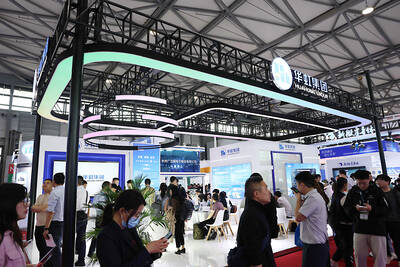
The US Department of Commerce last week ordered multiple chip equipment companies to halt shipments of certain tools to China’s second-largest chipmaker, Hua Hong Semiconductor Ltd (華虹半導體), its latest action to slow the country’s development of advanced chips, two people familiar with the matter said. The department sent letters to at least a handful of companies informing them of restrictions on tools and other materials destined for two Hua Hong facilities US officials believe make China’s most sophisticated chips, the people said. Top US chip equipment companies Lam Research Corp, Applied Materials Inc and KLA Corp, each of which has significant


 RSS
RSS