


The TAIEX yesterday rose 2.1 percent to close at 13,551.83, a record high, despite Taiwan not being included in a regional trade deal signed by 15 Asia-Pacific nations on Sunday.
It was the first time the benchmark index surpassed 13,500 points, Taiwan Stock Exchange data showed.
Turnover was NT$234.691 billion (US$8.15 billion), slightly up from last week’s average of NT$225 billion, while foreign institutional investors bought a net NT$22.87 billion of shares, the data showed.
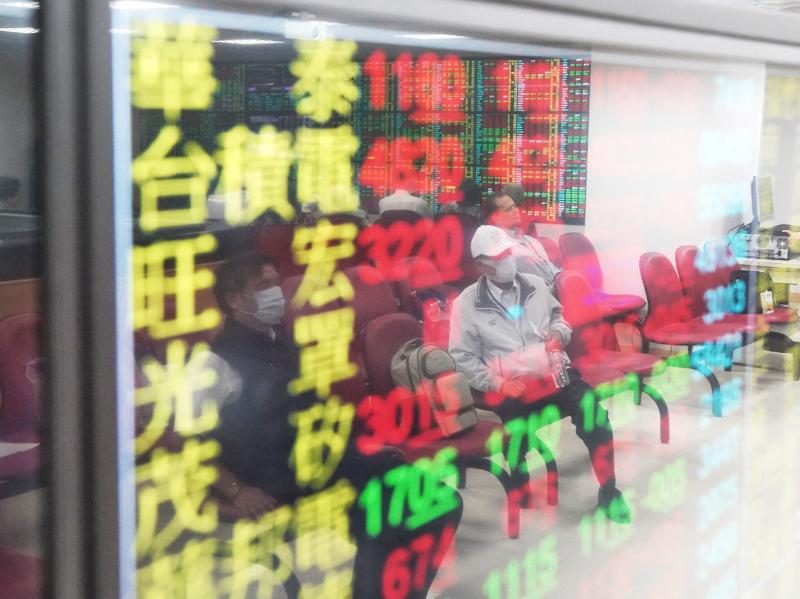
Photo: CNA
Other Asian markets also advanced after the 15 nations signed the world’s largest regional free-trade agreement, the Regional Comprehensive Economic Partnership (RCEP).
Local shares rose, as they are sensitive to US markets, which rallied on Friday last week, Hua Nan Securities Investment Management Co (華南投顧) chairman David Chu (儲祥生) told the Taipei Times by telephone.
“Taiwan will actually be hurt by the signing of the Regional Comprehensive Economic Partnership on Sunday, as we are not included in the trade agreement, whereas major countries including China, Japan and South Korea are. However, that the TAIEX did not fall indicated that investors did not mind,” Chu said.
A reduction in trade barriers between the 15 RCEP members would not be implemented immediately and it therefore does not pose a short-term threat to Taiwan’s economy, he said.
The growth of the nation’s economy, especially the strength of the local technology sector, also helped relieve some of the anxiety, he added.
As the local stock market is sensitive to Wall Street, the TAIEX’s rise reflected the latest gains in New York, where the Dow Jones Industrial Average rose 1.4 percent on Friday last week, Chu said.
“I was not surprised at all to see a bull market... To put it simply, there is too much money in the system due to easing monetary and fiscal policies worldwide. The question is when the winning streak will end,” he said.
Almost all of the subindices rose, except for the food, textile and rubber sectors, while the electronics, semiconductor and financial sectors reported the largest increases, the data showed.
Taiwan Semiconductor Manufacturing Co (TSMC, 台積電), the most heavily weighted stock in the TAIEX, rose 4.76 percent to close at a new high of NT$484 and a record capitalization of NT$12.55 trillion.
“Thanks to TSMC, the TAIEX steamed ahead today,” Mega International Investment Services Corp (兆豐國際投顧) analyst Alex Huang (黃國偉) said. “I suspect buying largely came from foreign institutional investors, as they simply boosted the spot market to profit in futures.”
November futures contracts are scheduled to be settled tomorrow, so it was no surprise that foreign institutional investors, who are holding a large number of positive futures contracts, scrambled to buy in the spot market, Huang said.
“Further rises are possible until Wednesday, the futures settlement date, but after that I expect the TAIEX to fall into consolidation mode for some time,” he said.
Additional reporting by CNA
Sweeping policy changes under US Secretary of Health and Human Services Robert F. Kennedy Jr are having a chilling effect on vaccine makers as anti-vaccine rhetoric has turned into concrete changes in inoculation schedules and recommendations, investors and executives said. The administration of US President Donald Trump has in the past year upended vaccine recommendations, with the country last month ending its longstanding guidance that all children receive inoculations against flu, hepatitis A and other diseases. The unprecedented changes have led to diminished vaccine usage, hurt the investment case for some biotechs, and created a drag that would likely dent revenues and

Macronix International Co (旺宏), the world’s biggest NOR flash memory supplier, yesterday said it would spend NT$22 billion (US$699.1 million) on capacity expansion this year to increase its production of mid-to-low-density memory chips as the world’s major memorychip suppliers are phasing out the market. The company said its planned capital expenditures are about 11 times higher than the NT$1.8 billion it spent on new facilities and equipment last year. A majority of this year’s outlay would be allocated to step up capacity of multi-level cell (MLC) NAND flash memory chips, which are used in embedded multimedia cards (eMMC), a managed

CULPRITS: Factors that affected the slip included falling global crude oil prices, wait-and-see consumer attitudes due to US tariffs and a different Lunar New Year holiday schedule Taiwan’s retail sales ended a nine-year growth streak last year, slipping 0.2 percent from a year earlier as uncertainty over US tariff policies affected demand for durable goods, data released on Friday by the Ministry of Economic Affairs showed. Last year’s retail sales totaled NT$4.84 trillion (US$153.27 billion), down about NT$9.5 billion, or 0.2 percent, from 2024. Despite the decline, the figure was still the second-highest annual sales total on record. Ministry statistics department deputy head Chen Yu-fang (陳玉芳) said sales of cars, motorcycles and related products, which accounted for 17.4 percent of total retail rales last year, fell NT$68.1 billion, or

In the wake of strong global demand for AI applications, Taiwan’s export-oriented economy accelerated with the composite index of economic indicators flashing the first “red” light in December for one year, indicating the economy is in booming mode, the National Development Council (NDC) said yesterday. Moreover, the index of leading indicators, which gauges the potential state of the economy over the next six months, also moved higher in December amid growing optimism over the outlook, the NDC said. In December, the index of economic indicators rose one point from a month earlier to 38, at the lower end of the “red” light.


 RSS
RSS