


Authorities might need to take action to prevent cash flows generated by global COVID-19 pandemic support measures causing a local property-market bubble, central bank Deputy Governor Chen Nan-kuang (陳南光) said.
Writing in this month’s edition of The Taiwan Banker magazine, Chen warned that small, open economies such as Taiwan’s are vulnerable to easing measures by the world’s leading central banks.
Citing South Korea’s struggle to rein in soaring prices, he said it would be difficult to counteract bullish sentiment with policy measures if property buyers are convinced that prices will only continue to rise.
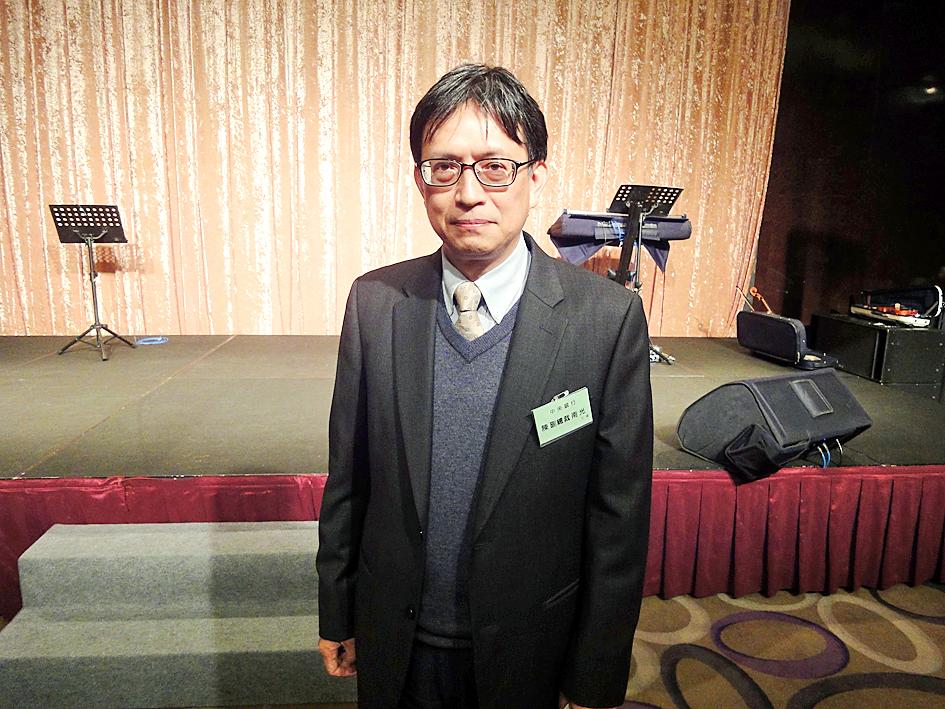
Photo: Lu Kuan-cheng, Taipei Times
“Taiwan’s central bank should put macro-prudential policies in place early to stabilize the market and the financial system and prevent medium-term risk before expectations of large increases in property prices take hold,” Chen wrote.
He said that imposing loan-to-value and debt-to-income limits on mortgages for second or third properties would be the easiest option open to the central bank, rather than additional taxation, which could require legislation.
The only restriction currently enforced by the central bank is limiting loans on high-end residences to 60 percent of the property’s value.
Banks are not particularly optimistic about the residential property market, but are more positive than they were previously, central bank Governor Yang Chin-long (楊金龍) told reporters last month.
They are more reserved on the high-end sector, Yang said.
Chen Shiu-sheng (陳旭昇), a member of the bank’s board, on Saturday told reporters that directors are divided over the issue of property prices, with some viewing the market as healthy, while others are increasingly concerned about the concentration of capital in real-estate assets.
Chen Shiu-sheng, who is also a professor of economics at National Taiwan University, said that the bank should do more to clearly define the criteria it intends to use to gauge whether the market has overheated and implement selective credit restrictions.
“I hope the central bank can be more proactive in considering how to establish the information we need to take preventative measures as early as possible,” he said. “Once bubble sentiment has flared up, it’s difficult to put out.”

The domestic unit of the Chinese-owned, Dutch-headquartered chipmaker Nexperia BV will soon be able to produce semiconductors locally within China, according to two company sources. Nexperia is at the center of a global tug-of-war over critical semiconductor technology, with a Dutch court in February ordering a probe into alleged mismanagement at the company. The geopolitical tussle has disrupted supply chains, with some carmakers reportedly forced to cut production due to chip shortages. Local production would allow Nexperia’s domestic arm, Nexperia Semiconductors (China) Ltd (安世半導體中國), to bypass restrictions in place since October on the supply of silicon wafers — etched with tiny components to

Singapore-based ride-hailing and delivery giant Grab Holdings Ltd has applied for regulatory approval to acquire the Taiwan operations of Germany-based Delivery Hero SE's Foodpanda in a deal valued at about US$600 million. Grab submitted the filing to the Fair Trade Commission on Friday last week, with the transaction subject to regulatory review and approval, the company said in a statement yesterday. Its independent governance structure would help foster a healthy and competitive market in Taiwan if the deal is approved, Grab said. Grab, which is listed on the NASDAQ, said in the filing that US-based Uber Technologies Inc holds about 13 percent of

Taiwan Semiconductor Manufacturing Co (TSMC, 台積電) yesterday received government approval to deploy its advanced 3-nanometer (3nm) process at its second fab currently under construction in Japan, the Ministry of Economic Affairs said in a news release. The ministry green-lit the plan for the facility in Kumamoto, which is scheduled to start installing equipment and come online in 2028 with a monthly production capacity of 15,000 12-inch wafers, the ministry said. The Department of Investment Review in June 2024 authorized a US$5.26 billion investment for the facility, slated to manufacture 6- to 12nm chips, significantly less advanced than 3nm process. At a meeting with

Taiwan’s food delivery market could undergo a major shift if Singapore-based Grab Holdings Ltd completes its planned acquisition of Delivery Hero SE’s Foodpanda business in Taiwan, industry experts said. Grab on Monday last week announced it would acquire Foodpanda’s Taiwan operations for US$600 million. The deal is expected to be finalized in the second half of this year, with Grab aiming to complete user migration to its platform by the first half of next year. A duopoly between Uber Eats and Foodpanda dominates Taiwan’s delivery market, a structure that has remained intact since the Fair Trade Commission (FTC) blocked Uber Technologies Inc’s


 RSS
RSS