


CTBC Financial Holding Co (中信金控) was on Tuesday last week awarded the 2020 Clean Energy Ministerial (CEM) Award of Excellence in Energy Management by the UN Industrial Development Organization, becoming the first financial institution in the world to receive the award.
The award was conferred at a digital conference held during the CEM11 meeting in Saudi Arabia, with Indian Minister of New and Renewable Energy Raj Kumar Singh presenting the award to CTBC president Daniel Wu (吳一揆).
CTBC said it has always been dedicated to sustainable development, being the first firm in Taiwan’s financial industry to adopt the ISO 50001 standard for energy management in 2012.
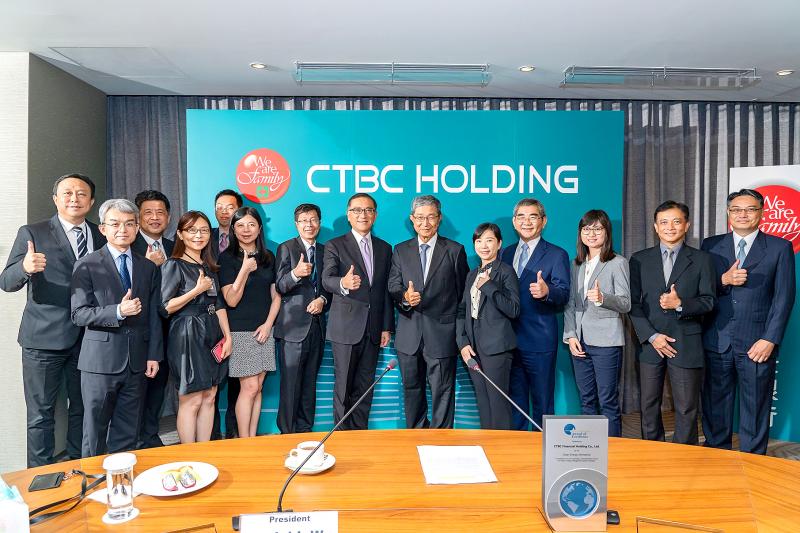
Photo courtesy of CTBC Financial Holding Co
Wu said CTBC was greatly aided by the Ministry of Economic Affairs and the Taiwan Green Productivity Foundation during the crucial year of 2011, when the company implemented measures to meet the standard.
CTBC is adhering to the standard across all 194 branches in Taiwan, helping the company to manage even the most minute energy consumption, a CEM statement said, adding that CTBC is leading in the field of energy management and reduction of carbon emissions.
CTBC has also met two other standards by the British Standards Institution, a CEM statement said, adding that the firm’s energy management efficacy has increased 16 percent, saving 5,316 tonnes of carbon emissions.
“CTBC Financial would like to thank the CEM for drawing global attention to the company’s achievements,” Wu said, adding that the amount of carbon emissions saved equals 13.7 times the amount that all vegetation in Taipei’s Daan Forest Park (大安森林公園) absorbs in a year.
To meet the ISO standard, the company has installed two sets of solar panels at its headquarters in Taipei’s Nangang District (南港), the company said.
The panels, covering 699m2, provided 63,865 kilowatts (kW) of energy last year and covered the energy usage of its public facilities, it said.
All lighting outside CTBC branches is equipped with daylight sensors, and the air-conditioning at less frequently used facilities automatically switches off 30 minutes before closure of the branch, it said, adding that branch offices hold monthly meetings on energy conservation targets.
Other energy saving measures include motion-sensor lights installed on aisles inside office buildings and water-saving wash basins inside restrooms, CTBC said.
Last year, the company conserved 2.03 million kW of energy and saved 1,085 tonnes of greenhouse gases.

Among the rows of vibrators, rubber torsos and leather harnesses at a Chinese sex toys exhibition in Shanghai this weekend, the beginnings of an artificial intelligence (AI)-driven shift in the industry quietly pulsed. China manufactures about 70 percent of the world’s sex toys, most of it the “hardware” on display at the fair — whether that be technicolor tentacled dildos or hyper-realistic personalized silicone dolls. Yet smart toys have been rising in popularity for some time. Many major European and US brands already offer tech-enhanced products that can enable long-distance love, monitor well-being and even bring people one step closer to

Malaysia’s leader yesterday announced plans to build a massive semiconductor design park, aiming to boost the Southeast Asian nation’s role in the global chip industry. A prominent player in the semiconductor industry for decades, Malaysia accounts for an estimated 13 percent of global back-end manufacturing, according to German tech giant Bosch. Now it wants to go beyond production and emerge as a chip design powerhouse too, Malaysian Prime Minister Anwar Ibrahim said. “I am pleased to announce the largest IC (integrated circuit) Design Park in Southeast Asia, that will house world-class anchor tenants and collaborate with global companies such as Arm [Holdings PLC],”

TRANSFORMATION: Taiwan is now home to the largest Google hardware research and development center outside of the US, thanks to the nation’s economic policies President Tsai Ing-wen (蔡英文) yesterday attended an event marking the opening of Google’s second hardware research and development (R&D) office in Taiwan, which was held at New Taipei City’s Banciao District (板橋). This signals Taiwan’s transformation into the world’s largest Google hardware research and development center outside of the US, validating the nation’s economic policy in the past eight years, she said. The “five plus two” innovative industries policy, “six core strategic industries” initiative and infrastructure projects have grown the national industry and established resilient supply chains that withstood the COVID-19 pandemic, Tsai said. Taiwan has improved investment conditions of the domestic economy

MAJOR BENEFICIARY: The company benefits from TSMC’s advanced packaging scarcity, given robust demand for Nvidia AI chips, analysts said ASE Technology Holding Co (ASE, 日月光投控), the world’s biggest chip packaging and testing service provider, yesterday said it is raising its equipment capital expenditure budget by 10 percent this year to expand leading-edge and advanced packing and testing capacity amid strong artificial intelligence (AI) and high-performance computing chip demand. This is on top of the 40 to 50 percent annual increase in its capital spending budget to more than the US$1.7 billion to announced in February. About half of the equipment capital expenditure would be spent on leading-edge and advanced packaging and testing technology, the company said. ASE is considered by analysts


 RSS
RSS