


The consumer price index (CPI) last month declined 0.33 percent from a year earlier, dragged by lower transportation and recreation costs attributable to the COVID-19 pandemic, the Directorate-General of Budget, Accounting and Statistics (DGBAS) said yesterday.
It was the seventh straight month that consumer prices had declined, but the retreat has been tapering off as shopping, dining and domestic tourism pick up, the statistics agency said.
“The inflationary gauge might return to the positive zone if international oil prices stabilize, as the virus outbreak’s effects on consumer activity have wound down,” DGBAS Senior Executive Officer Chiou Shwu-chwen (邱淑純) told a media briefing.

Photo: CNA
The trend shows that there is no need to worry about deflation, given that the pace of contraction is slowing, Chiou said.
The revised CPI dropped 0.52 percent in July, 0.77 percent in June and 1.21 percent in May.
The index after seasonal adjustments last month picked up by a mild 0.18 percent, the agency’s report showed.
Transportation and communication costs again registered the biggest decline at 3.74 percent due mainly to a 15.03 percent fall in fuel prices and a 3.5 percent drop in telecommunication fees, it said.
Education and entertainment costs softened 1.27 percent, as hotels and recreational facilities cut prices to attract customers, it said.
The prices of admission tickets to entertainment facilities dropped 18.4 percent annually, the steepest decline in 17 years, while hotel rooms were on average 10.4 percent cheaper, Chiou said.
Airfares shrank 2.23 percent, while group tour charges fell a fractional 0.6 percent, indicating that the tourism sector is returning to normal, Chiou said.
Food costs increased 0.17 percent, as the cost of meat and dining out rose slightly, the agency said.
Prices for clothing gained 1.65 percent and miscellaneous items picked up 1.36 percent on the back of stronger demand for gold and jewelry, it said.
Bullion is in great demand due to robust global investment, the Ministry of Finance said on Monday after bullion exports surged fourfold last month.
Core CPI, a more reliable tracker of consumer prices because it excludes volatile items, rose 0.31 percent, it said.
The wholesale price index (WPI), a measure of production costs, dropped 9.09 percent, easing from a revised 9.18 percent tumble a month earlier, the DGBAS said.
For the first eight months of the year, the CPI edged down 0.27 percent, while the WPI fell 8.43 percent, the agency said.

Cairo’s new monorail slices across the city skyline, running above the familiar chaos of blaring horns and aging buses’ exhaust fumes that mark rush hour below. The US$4.5 billion monorail, opened this month, is among Egypt’s most prominent new transport projects, part of a debt-funded infrastructure drive criticized for sapping state finances while bringing limited benefits to most of the country’s 109 million people. “It feels like you’re in a different country,” said Ramy Sayed, a restaurant manager, aboard a driverless Innovia 300 train. “No noise, no traffic, we’re not used to this.” The eastern line runs 56km from the bustling middle-class
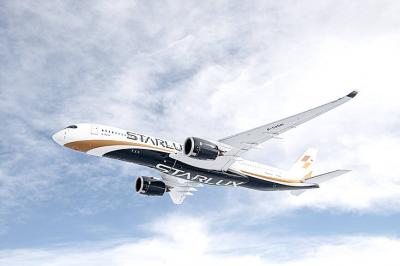
Starlux Airlines Co (星宇航空) today unveiled a long-haul network expansion plan at a shareholders’ meeting in Taipei, including direct flights to Barcelona, Spain, and Zurich, Switzerland, as well as a service connecting Taipei, Sydney and New Zealand. Starlux is to become the first Taiwanese carrier to offer non-stop services to the two European cities, while the inaugural oceanic route is expected to expand transit opportunities within the Australia-New Zealand market, Starlux said. Flight services to Chicago, Dallas, Washington and New York are under evaluation, the airline added. Prior to the shareholders’ meeting, the airline earlier this year announced that it would be

Taiwanese prosecutors suspect that three people successfully smuggled at least one shipment of Nvidia Corp artificial intelligence (AI) chips to China after first exporting them to Japan, people familiar with the matter said. The trio was detained last week by the Keelung District Prosecutors’ Office for allegedly falsifying documents related to exports of Super Micro Computer Inc servers containing advanced Nvidia chips, which the US has barred from sale to China without a license from Washington. The move marked Taiwan’s first public crackdown on AI chip diversion after years of pressure from the US to take a more active role in curtailing
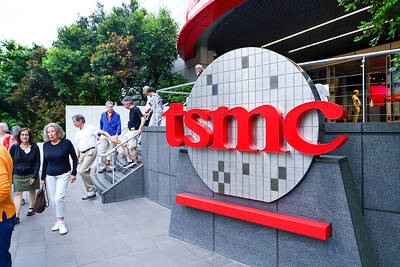
Taiwan Semiconductor Manufacturing Co (TSMC, 台積電) employee bonuses are likely to grow more than 30 percent this year, in line with the past few years as the company’s profits continue to set new records, an anonymous source cited TSMC chairman C.C. Wei (魏哲家) as saying yesterday. TSMC, the world’s largest contract chipmaker, is committed to taking care of its workers, the source said, citing Wei’s meeting with employees yesterday morning. Wei also expressed gratitude to employees for their contribution to the company’s improving bottom line, the source added. Since 2023, TSMC’s employee bonuses have grown at an annual rate of


 RSS
RSS