


The Ministry of Economic Affairs (MOEA) yesterday introduced a new 5G “open lab” in collaboration with US-based information technology and networking giant Cisco Systems Inc to address the rapidly growing “white box” 5G networking equipment market.
The open lab will be a platform where Taiwanese manufacturers can access Cisco’s cloud-based mobile network to develop their own 5G telecom equipment, such as small-cell base stations, network switches, modems and Internet of things (IoT) devices, a ministry statement said.
The open platform would allow Taiwanese manufacturers to tap into the lucrative 5G telecom equipment market, which was previously monopolized by Nokia Oyj, Ericsson AB and Huawei Technologies Co (華為), Minister of Economic Affairs Wang Mei-hua (王美花) said at the inauguration in Taoyuan.
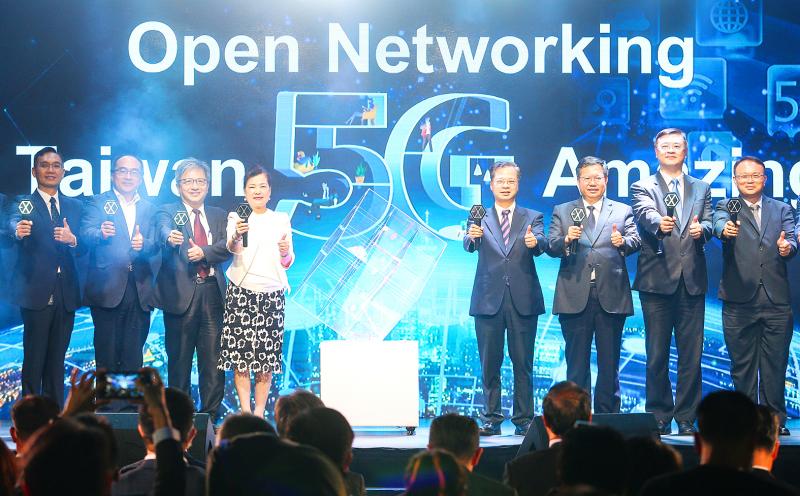
Photo: CNA
“In the 3G and 4G world, telecommunication technology was tied to the manufacturer. It was a closed system,” Wang said. “But with 5G, we have the opportunity to create our own innovative products”
“This open lab does not belong to Cisco,” Cisco managing director of Greater China and Taiwan general manager George Chen (陳志惟) said. “It belongs to everybody, including government authorities and manufacturers.”
“As for maintaining the safety and security of the ecosystem, that is Cisco’s responsibility,” he added.
Taiwanese network equipment manufacturers who attended the event included Ethernet switch maker Accton Technology Corp (智邦科技), communications device maker Alpha Networks Inc (明泰科技), networking firm Arcadyan Technology Corp (智易) and wireless local area network (LAN) equipment maker Askey Computer Corp (亞旭電腦) and more.
In April, Japanese e-commerce giant Rakuten announced that it was working with Cisco and other companies to create a 5G Open RAN (radio access network) that would cover all of Japan. The project uses servers made by Taiwan’s Quanta Cloud Technology (雲達科技) and base stations from Sercomm Corp (中磊).
The Taiwanese government has been aggressively pursuing early adoption of 5G technology, budgeting more than NT$70 billion (US$2.4 billion) for 5G research and development and infrastructure buildout and related research development, National Development Council Minister Kung Ming-hsin (龔明鑫) said at the inauguration.
“This is an essential part of our digital transformation,” Kung said.
Cisco is one of the 30 firms that joined the Open RAN Policy Coalition in May. Other members include Microsoft Corp and Alphabet Inc, as well as US carriers AT&T Inc and Verizon Communications Inc and chipmakers Qualcomm Inc, Intel Corp and Samsung Electronics Co.

Among the rows of vibrators, rubber torsos and leather harnesses at a Chinese sex toys exhibition in Shanghai this weekend, the beginnings of an artificial intelligence (AI)-driven shift in the industry quietly pulsed. China manufactures about 70 percent of the world’s sex toys, most of it the “hardware” on display at the fair — whether that be technicolor tentacled dildos or hyper-realistic personalized silicone dolls. Yet smart toys have been rising in popularity for some time. Many major European and US brands already offer tech-enhanced products that can enable long-distance love, monitor well-being and even bring people one step closer to

Malaysia’s leader yesterday announced plans to build a massive semiconductor design park, aiming to boost the Southeast Asian nation’s role in the global chip industry. A prominent player in the semiconductor industry for decades, Malaysia accounts for an estimated 13 percent of global back-end manufacturing, according to German tech giant Bosch. Now it wants to go beyond production and emerge as a chip design powerhouse too, Malaysian Prime Minister Anwar Ibrahim said. “I am pleased to announce the largest IC (integrated circuit) Design Park in Southeast Asia, that will house world-class anchor tenants and collaborate with global companies such as Arm [Holdings PLC],”

TRANSFORMATION: Taiwan is now home to the largest Google hardware research and development center outside of the US, thanks to the nation’s economic policies President Tsai Ing-wen (蔡英文) yesterday attended an event marking the opening of Google’s second hardware research and development (R&D) office in Taiwan, which was held at New Taipei City’s Banciao District (板橋). This signals Taiwan’s transformation into the world’s largest Google hardware research and development center outside of the US, validating the nation’s economic policy in the past eight years, she said. The “five plus two” innovative industries policy, “six core strategic industries” initiative and infrastructure projects have grown the national industry and established resilient supply chains that withstood the COVID-19 pandemic, Tsai said. Taiwan has improved investment conditions of the domestic economy

Sales in the retail, and food and beverage sectors last month continued to rise, increasing 0.7 percent and 13.6 percent respectively from a year earlier, setting record highs for the month of March, the Ministry of Economic Affairs said yesterday. Sales in the wholesale sector also grew last month by 4.6 annually, mainly due to the business opportunities for emerging applications related to artificial intelligence (AI) and high-performance computing technologies, the ministry said in a report. The ministry forecast that retail, and food and beverage sales this month would retain their growth momentum as the former would benefit from Tomb Sweeping Day


 RSS
RSS