


Wafer probing services provider Chunghwa Precision Test Technology Co (中華精測) yesterday said net profit last quarter reached NT$233 million (US$7.9 million), its highest second-quarter revenue ever, and maintained a cautiously optimistic outlook for the second half of this year.
Net profit almost doubled from NT$118 million from a year earlier and rose 30.17 percent from the previous quarter’s NT$179 million.
Earnings per share jumped to NT$7.11, from NT$3.59 a year earlier and NT$5.46 a quarter earlier.
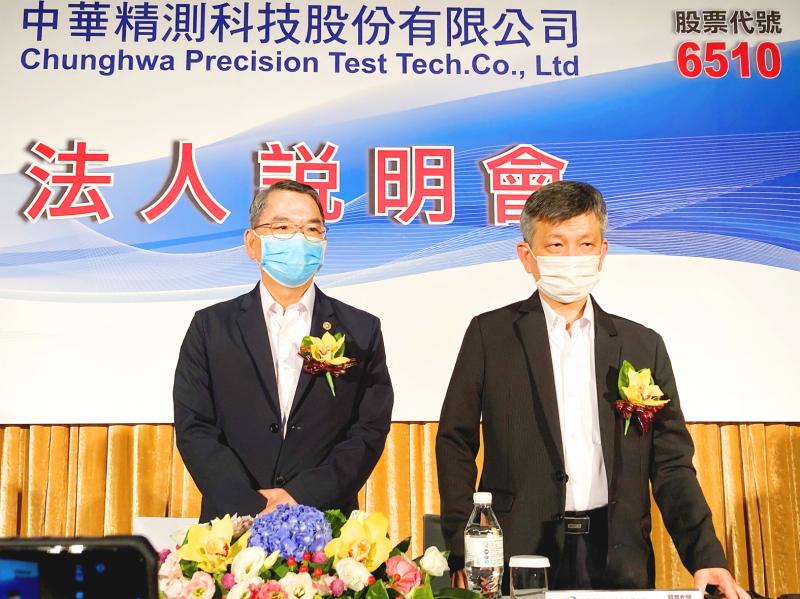
Photo: Lisa Wang, Taipei Times
In the first half of this year, net profit skyrocketed 95 percent year-on-year to NT$409.63 million from NT$212.48 million, with EPS increasing from NT$6.46 to NT$12.57.
Chunghwa Precision attributed the strong growth to resilient demand for its services for a variety of chips used in 5G smartphones.
With prices of 5G smartphones falling rapidly, Chunghwa Precision is optimistic about global 5G smartphone growth, chairman Lin Kuo-fang (林國豐) told an investors’ conference in Taipei.
Some 5G smartphones in China are priced as low as 2,000 yuan (US$288), Lin said.
Global shipments of 5G smartphones are forecast to reach 210 million units this year, making up about 17 percent of overall smartphone shipments, Chunghwa Precision said, citing a forecast by a local market consultancy.
The share of 5G phones is expected to jump to 42 percent next year, it said.
5G-related wafer testing services last quarter began contributing to the company’s revenue and should further expand this year, Lin said.
Growing 5G business should help gross margin stay between 50 and 55 percent this year, the company said, compared with 54.1 percent last quarter.
“We are cautiously optimistic about the [outlook for the] second half,” company president Scott Huang (黃水可) said.
Chunghwa Precision said rising demand for its vertical probe card business contributed to its optimistic outlook.
This business delivers a much higher margin than a tractional type of probing via load boards.
It is to make up 20 to 25 percent of the company’s overall revenue this year, compared with 12 percent last year, it said.
The company plans to introduce its first vertical probe card service for microelectronic mechanical system this quarter, it added.
Chunghwa Precision has been diversifying its product lineup and customers to avoid becoming overly dependent on a single customer after losing orders from Apple Inc two to three years ago.
The firm counts Huawei Technologies Co (華為), Taiwan Semiconductor Manufacturing Co (台積電) and MediaTek Inc (聯發科) among its major customers.
The company said its largest customer contributed less than 30 percent to its revenue in the first half.
The top three customers made up about 60 percent of its total revenue, it said.
In Italy’s storied gold-making hubs, jewelers are reworking their designs to trim gold content as they race to blunt the effect of record prices and appeal to shoppers watching their budgets. Gold prices hit a record high on Thursday, surging near US$5,600 an ounce, more than double a year ago as geopolitical concerns and jitters over trade pushed investors toward the safe-haven asset. The rally is putting undue pressure on small artisans as they face mounting demands from customers, including international brands, to produce cheaper items, from signature pieces to wedding rings, according to interviews with four independent jewelers in Italy’s main

Japanese Prime Minister Sanae Takaichi has talked up the benefits of a weaker yen in a campaign speech, adopting a tone at odds with her finance ministry, which has refused to rule out any options to counter excessive foreign exchange volatility. Takaichi later softened her stance, saying she did not have a preference for the yen’s direction. “People say the weak yen is bad right now, but for export industries, it’s a major opportunity,” Takaichi said on Saturday at a rally for Liberal Democratic Party candidate Daishiro Yamagiwa in Kanagawa Prefecture ahead of a snap election on Sunday. “Whether it’s selling food or

CONCERNS: Tech companies investing in AI businesses that purchase their products have raised questions among investors that they are artificially propping up demand Nvidia Corp chief executive officer Jensen Huang (黃仁勳) on Saturday said that the company would be participating in OpenAI’s latest funding round, describing it as potentially “the largest investment we’ve ever made.” “We will invest a great deal of money,” Huang told reporters while visiting Taipei. “I believe in OpenAI. The work that they do is incredible. They’re one of the most consequential companies of our time.” Huang did not say exactly how much Nvidia might contribute, but described the investment as “huge.” “Let Sam announce how much he’s going to raise — it’s for him to decide,” Huang said, referring to OpenAI

The global server market is expected to grow 12.8 percent annually this year, with artificial intelligence (AI) servers projected to account for 16.5 percent, driven by continued investment in AI infrastructure by major cloud service providers (CSPs), market researcher TrendForce Corp (集邦科技) said yesterday. Global AI server shipments this year are expected to increase 28 percent year-on-year to more than 2.7 million units, driven by sustained demand from CSPs and government sovereign cloud projects, TrendForce analyst Frank Kung (龔明德) told the Taipei Times. Demand for GPU-based AI servers, including Nvidia Corp’s GB and Vera Rubin rack systems, is expected to remain high,


 RSS
RSS