


Softbank Group Corp plans to keep a stake in the chip designer Arm Ltd, even if it sells a partial interest to Nvidia Corp, the Nikkei reported.
The companies are negotiating terms, the newspaper reported, citing sources.
Softbank might take a stake in Nvidia after it buys Arm, the report said.
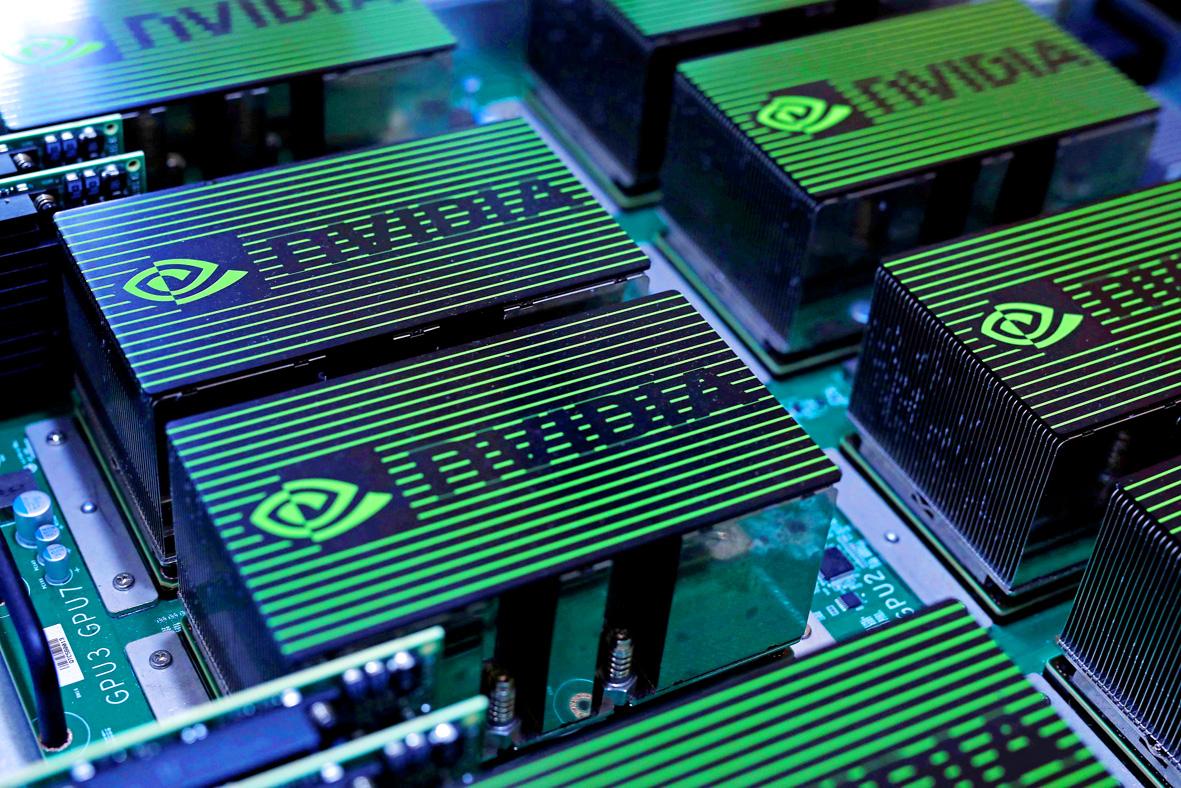
Photo: Reuters
Nvidia and Arm might also merge through a share swap, and Softbank would become a major shareholder in the combined company, it said.
The two parties aim to reach a deal in the next few weeks, the sources said, asking not to be identified because the information is private.
Nvidia is the only suitor in concrete discussions with Softbank, the sources said.
A deal for Arm could be the largest ever in the semiconductor industry, which has been consolidating in the past few years as companies seek to diversify and add scale.
However, any deal with Nvidia, which is a customer of Arm, would likely trigger regulatory scrutiny, as well as a wave of opposition from other users.
Cambridge, England-based Arm’s technology underpins chips that are crucial to most modern electronics, including those that dominate the smartphone market, an area in which Nvidia has failed to gain a foothold.
Customers including Apple Inc, Qualcomm Inc, Advanced Micro Devices Inc (AMD) and Intel Corp could demand assurances that a new owner would continue providing equal access to Arm’s instruction set.
Such concerns resulted in Softbank, a neutral company, buying Arm the last time it was for sale. It bought Arm for US$32 billion four years ago.
No final decisions have been made, and the negotiations could drag on longer or fall apart, the sources said.
Representatives for Nvidia, Softbank and Arm declined to comment.
“With Nvidia’s low-cost fabless model enabling it to focus on R&D, engineering and programming, the fit with Arm would be perfect,” Mirabaud Securities Ltd analyst Neil Campling said.
Nvidia is the largest maker of graphics processing units (GPU) and it is spreading the use of the gaming component into new areas such as artificial intelligence processing in data centers and self-driving vehicles.
Marrying its own capabilities with central processing units (CPU) designed by Arm could enable it to take on Intel and AMD in a more comprehensive way, Rosenblatt Securities Inc analyst Hans Mosesmann said.
He said that Nvidia would have to pay an estimated US$55 billion for Arm.
“You need control of both CPU and GPU roadmaps and this, of course, includes data centers,” he wrote in a note on Friday. “Strategically, Nvidia needs a scalable CPU that can be integrated into its GPU roadmap, as is the case with AMD and Intel.”
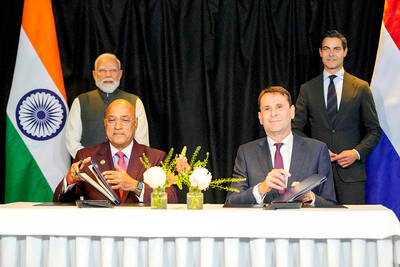
NEW MARKET: The partnership opens up India to the Dutch company, which already has a strong hold in the semiconductor market of South Korea, Taiwan and China ASML Holding NV entered into a partnership agreement with Tata Electronics Pvt Ltd aimed at ramping up India’s goal to develop domestic chip-manufacturing capabilities. The Dutch company’s technology would help power Tata Electronics’ planned 300 millimeter (mm) semiconductor foundry in Gujarat, according to a joint statement from the two companies on Saturday. The signing of a memorandum of understanding coincides with a visit by Indian Prime Minister Narendra Modi to the Netherlands, which is looking to deepen bilateral relations with New Delhi. ASML, whose top customers include Taiwan Semiconductor Manufacturing Co (台積電) and Samsung Electronics Co, makes lithography machines that can print

Tokyo Electron's Taiwan unit today said in a written response that it respects the judicial process, takes the court ruling seriously and would not appeal in the Taiwan Semiconductor Manufacturing Co (TSMC, 台積電) trade secrets case. Last month, a court fined the Taiwan unit of Japan's Tokyo Electron NT$150 million (US$4.74 million) in a case involving trade secrets related to TSMC's sensitive chip technology.
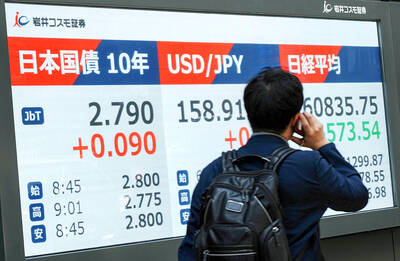
ROUGH RECORDS: Bonds in Japan, as well is in New Zealand, Australia and the US, are seeing the effects of a nervy market as stock exchanges across Asia edge down A deepening slump in Japanese government bonds added fuel to the selloff in global debt markets as rising oil prices stoked inflation fears and pushed yields to multi-decade highs. Japan’s 30-year yield yesterday surged as much as 20 basis points to the highest level since the tenor’s debut in 1999, before paring some of the move. Shorter-maturity Japanese debt was also under pressure, underscored by weak demand at a sale of five-year notes that offered a record-high coupon of 2 percent. Concerns over inflation and government spending rippling through markets including the US, Australia and New Zealand are being amplified in Japan,

Wall Street is licking its chops over an unprecedented slate of massive initial public offerings (IPOs) set to arrive in the coming months, beginning with Elon Musk’s Space Exploration Technologies Corp (SpaceX) next month. That is expected to be followed by artificial intelligence (AI) rivals OpenAI and Anthropic PBC. The trio of mega listings, each eyeing valuations around US$1 trillion or more, constitutes a heady period of elevated risk and reward. SpaceX is targeting an IPO that would raise up to US$80 billion — about double the funds generated from all IPOs last year. OpenAI and Anthropic are eyeing IPOs raising US$60 billion. “We’re


 RSS
RSS