


Starting next month, Starlux Airlines Co (星宇航空) is to increase its number of flights to Macau and Penang, Malaysia, to meet rising air cargo demand and help its pilots build up flight hours, the airline said yesterday.
From Aug. 1, Starlux is to offer four round-trip flights from Taiwan Taoyuan International Airport to Macau International Airport every Tuesday, Wednesday, Friday and Sunday, compared with three per week now, it said in a statement.
It would also operate three round-trip flights per week from Taoyuan to Penang International Airport every Tuesday, Thursday and Saturday, from two at present, it said.
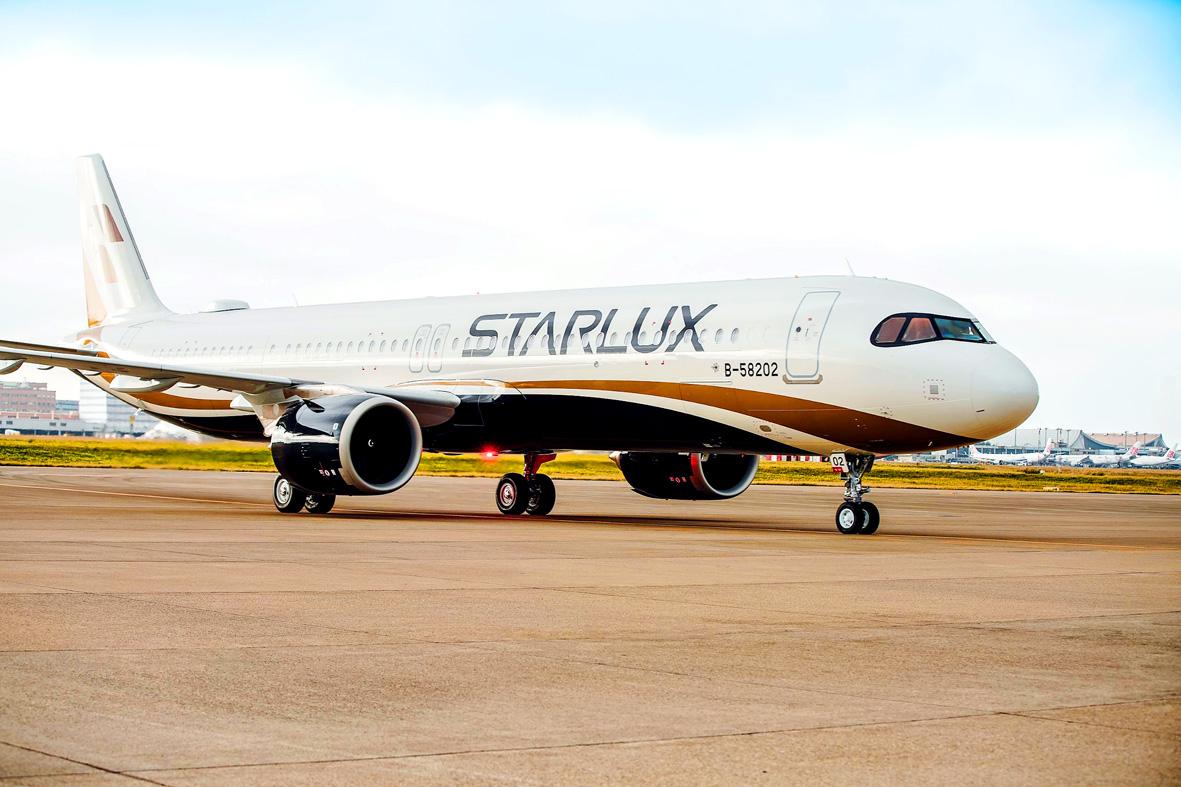
Photo courtesy of StarLux Airlines
Although air travel is unlikely to rebound quickly in the third quarter as the COVID-19 pandemic shows no signs of slowing, Starlux decided to expand its operations on expectations that the air cargo business would remain rosy, spokesman Nieh Kuo-wei (聶國維) told the Taipei Times by telephone.
The airline, which was struck by the pandemic after beginning operations on Jan. 23, has been concentrating on cargo services between Taiwan and Macau and Penang to mitigate the effects of a faltering passenger business amid travel restrictions.
“Frankly speaking, we would operate the flights even without any passenger, as the cargo revenue would be enough to cover variable costs,” Nieh said.
However, Starlux has yet to resume its operations to Da Nang, as Vietnam has not eased its restrictions on air travel and cargo demand is low, he said.
Starlux also wants its pilots to accumulate more flight hours, which would give it an advantage when applying to the Civil Aeronautics Administration to launch new flights, Nieh said.
In related news, EVA Airways Corp (長榮航空) yesterday said it is likely to increase its flights in the third quarter, as many countries ease border controls.
“We adjust our flight schedules on a rolling basis depending on the pandemic, official measures and consumer demand,” it said.
In the short term, domestic air travel would continue to outperform international travel, as a mandatory 14-day quarantine for returning citizens has dampened desire to travel abroad, it said.
As EVA lends its planes to Uni Air (立榮航空), which has been increasing its flights to outlying islands due to high demand, it also benefits from the domestic travel boost, it said.

NEW IDENTITY: Known for its software, India has expanded into hardware, with its semiconductor industry growing from US$38bn in 2023 to US$45bn to US$50bn India on Saturday inaugurated its first semiconductor assembly and test facility, a milestone in the government’s push to reduce dependence on foreign chipmakers and stake a claim in a sector dominated by China. Indian Prime Minister Narendra Modi opened US firm Micron Technology Inc’s semiconductor assembly, test and packaging unit in his home state of Gujarat, hailing the “dawn of a new era” for India’s technology ambitions. “When young Indians look back in the future, they will see this decade as the turning point in our tech future,” Modi told the event, which was broadcast on his YouTube channel. The plant would convert

Nanya Technology Corp (南亞科技) yesterday said the DRAM supply crunch could extend through 2028, as the artificial intelligence (AI) boom has led the world’s major memory makers to dramatically reduce production of standard DRAM and allocate a significant portion of their capacity for high-bandwidth memory (HBM) chips. The most severe supply constraints would stretch to the first half of next year due to “very limited” increases in new DRAM capacity worldwide, Nanya Technology president Lee Pei-ing (李培瑛) told a news briefing. The company plans to increase monthly 12-inch wafer capacity to 20,000 in the first half of 2028 after a

Property transactions in the nation’s six special municipalities plunged last month, as a lengthy Lunar New Year holiday combined with ongoing credit tightening dampened housing market activity, data compiled by local land administration offices released on Monday showed. The six cities recorded a total of 10,480 property transfers last month, down 42.5 percent from January and marking the second-lowest monthly level on record, the data showed. “The sharp drop largely reflected seasonal factors and tighter credit conditions,” Evertrust Rehouse Co (永慶房屋) deputy research manager Chen Chin-ping (陳金萍) said. The nine-day Lunar New Year holiday fell in February this year, reducing

Zimbabwe’s ban on raw lithium exports is forcing Chinese miners to rethink their strategy, speeding up plans to process the metal locally instead of shipping it to China’s vast rechargeable battery industry. The country is Africa’s largest lithium producer and has one of the world’s largest reserves, according to the US Geological Survey (USGS). Zimbabwe already banned the export of lithium ore in 2022 and last year announced it would halt exports of lithium concentrates from January next year. However, on Wednesday it imposed the ban with immediate effect, leaving unclear what the lithium mining sector would do in the


 RSS
RSS