


Taiwan’s economy performed well in the first half of this year thanks to an increase in global demand for technology goods and services amid the COVID-19 pandemic, but technology tensions between the US and China could hurt Taiwan by disrupting the existing supply chain, DBS Bank Ltd said in a report yesterday.
Demand for technology products could be divided into demand for computers and consumer electronics, mobile phones, digitalization, and automation, DBS economist Ma Tieying (馬鐵英) said in the report.
While the purchases of computers and consumer electronics during were likely one-off, demand for digitalization and automation, such as video streaming, e-commerce, online entertainment, as well as the use of robots and drones for the delivery of medical supplies and disinfection, would continue rising after the pandemic, creating sustained opportunities for the electronic components segment, Ma said.
However, in the short term, US-China tensions could negatively affect Taiwan by disrupting the supply chain, she said.
While Taiwanese semiconductor companies rely on the US for upstream integrated chip design, and supplies of semiconductor manufacturing equipment and chemical materials, they also rely heavily on the Chinese market, so they would be susceptible to Beijing’s restrictive measures on market access or the US’ reduction of advanced technology supply, she added.
In the long term, the imperative of the US and China to build their own semiconductor supply chains might add pressure on Taiwan, as both nations have been urging Taiwanese semiconductor firms to move more advanced operations to their country, Ma said.
“While the most advanced semiconductor manufacturing capacity remains in Taiwan, whether the nation’s comparative advantage will weaken as the US and China catch up will be a question for the coming decade,” she said.
Separately yesterday, Citibank Taiwan Ltd (台灣花旗) senior vice president Calvin Tseng (曾慶瑞) told a news conference that global financial markets might witness increased volatility in the third quarter of this year as selling pressure tends to rise.
That is because many investors will likely sell shares after many stock indices hit record highs, despite real economies not fully recovering from the effects of the pandemic, Tseng said.
“We expect real economies to take at least two years to recover from the outbreak, ” he said.
With the US dollar likely to remain weak against other major currencies amid a low-interest environment, Taiwanese investors are advised to exchange some of their US dollars into the euros, British pounds or yen, Tseng said.
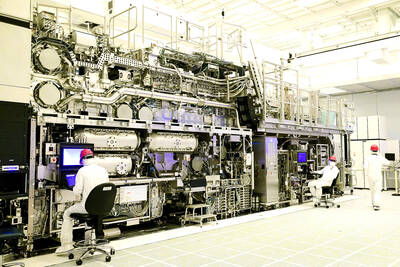
ASML Holding NV’s new advanced chip machines have a daunting price tag, said Taiwan Semiconductor Manufacturing Co (TSMC, 台積電), one of the Dutch company’s biggest clients. “The cost is very high,” TSMC senior vice president Kevin Zhang (張曉強) said at a technology symposium in Amsterdam on Tuesday, referring to ASML’s latest system known as high-NA extreme ultraviolet (EUV). “I like the high-NA EUV’s capability, but I don’t like the sticker price,” Zhang said. ASML’s new chip machine can imprint semiconductors with lines that are just 8 nanometers thick — 1.7 times smaller than the previous generation. The machines cost 350 million euros (US$378 million)
EXPLOSION: A driver who was transporting waste material from the site was hit by a blunt object after an uncontrolled pressure release and thrown 6m from the truck Taiwan Semiconductor Manufacturing Co (TSMC, 台積電) said yesterday there was no damage to its facilities after an incident at its Arizona factory construction site where a waste disposal truck driver was transported to hospital. Firefighters responded to an explosion on Wednesday afternoon at the TSMC plant in Phoenix, the Arizona Republic reported, citing the local fire department. Cesar Anguiano-Guitron, 41, was transporting waste material from the project site and stopped to inspect the tank when he was made aware of a potential problem, a police report seen by Bloomberg News showed. Following an “uncontrolled pressure release,” he was hit by a blunt

Quanta Computer Inc (廣達), which makes servers and laptop computers on a contract basis, yesterday said it expects artificial intelligence (AI) devices to bring explosive growth to Taiwan’s electronics industry, as AI applications are starting to run on edge devices such as AI PCs. Taiwanese electronics manufacturers such as chipmakers, component suppliers and hardware assemblers are likely to benefit from a rapid uptake of AI applications, Mike Yang (楊麒令), president of Quanta Cloud Technology Inc (雲達科技), a server manufacturing arm of Quanta, told reporters on the sidelines of a technology forum in Taipei yesterday. “I believe the growth potential is promising once

‘WORST OVER’: A large portion of Hon Hai’s non-operating loss came from Sharp’s large flat-screen business, but Young Liu said the situation is expected to improve Hon Hai Precision Industry Co (鴻海精密), a major iPhone assembler, yesterday reported annual growth of 72 percent in net profit last quarter, due to a dramatic decrease in losses from Sharp Corp’s display business. Net profit surged to NT$22 billion (US$678.7 million) last quarter, from NT$12.83 billion a year earlier, as Hon Hai booked a non-operating loss of NT$4.24 billion, an improvement from NT$20.12 billion in the first quarter of last year. A major portion of its non-operating loss came from Sharp’s large flat-screen business Sakai Display Products Corp. On a quarterly basis, Hon Hai’s net profit sank 59 percent from NT$53.15


 RSS
RSS