


Commercial property transactions last quarter picked up 3.1 percent from three months earlier to NT$13.82 billion (US$467.11 million), while land deals held firm above the NT$80 billion mark, driven by demand from life insurers and developers amid the record-low interest rate environment, Cushman & Wakefield Taiwan (戴德梁行) said yesterday.
However, the latest data for commercial property deals, a gauge of investment interests, represented a 53.6 percent decline from the same period last year, as the COVID-19 pandemic sidelined buyers.
Factory and office buildings constituted the bulk of transactions in Taipei, New Taipei City and Taichung during the April-to-June period, the company’s valuation and advisory services director Wendy Hsueh (薛惠珍) told a news briefing.
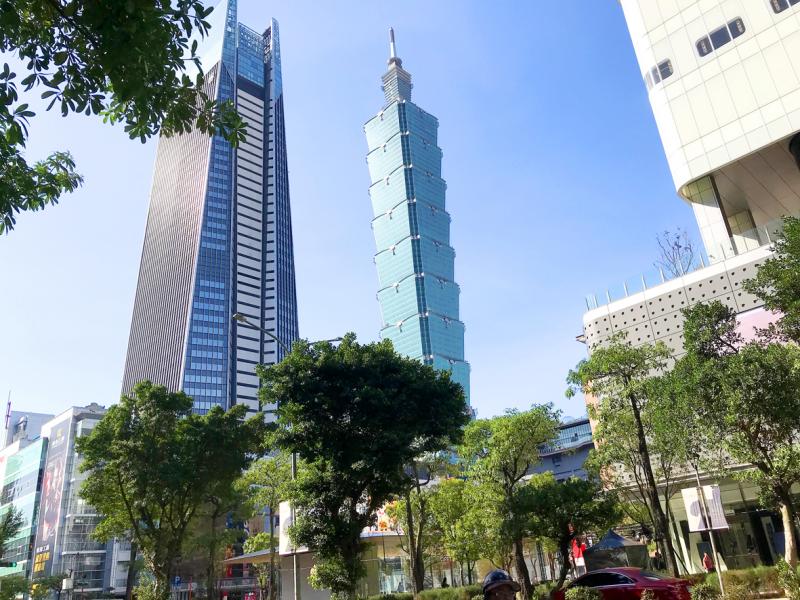
Photo: Hsu Yi-ping, Taipei Times
Wan Hai Lines Ltd (萬海航運) paid NT$2.12 billion for an office building from Chong Hong Construction Co (長虹建設), which is to be completed later this year, and spent another NT$540 million buying office space on Taipei’s Zhongxhiao E Road, Hsueh said.
Wan Hai plans to turn the Chong Hong building into its new headquarters and use the other office space to accommodate future expansions.
“The purchases make sense as demand for office space is gaining momentum, induced partly by global supply chain realignment amid the virus outbreak and US-China trade tensions,” Hsueh said.
The Cabinet yesterday announced its target to build Taiwan into the region’s technology hub, especially for high-end semiconductor firms that might generate NT$5 trillion in business by 2030. Taiwanese semiconductor firms command global leadership positions in making and designing top-grade chips.
General Interface Solution Ltd (英特盛) purchased a factory complex in Taichung for NT$1.77 billion and Getac Technology Corp (神基) bought another complex for NT$1.03 billion in Taoyuan, Hsueh said.
Cushman & Wakefield Taiwan general manager Billy Yen (顏炳立) said that more than 20 hotels would like to exit the market, but cannot secure buyers due to pricing differences, rather than a lack of interest.
“Potential buyers would place bids if sellers would lower prices by 30 percent from the current 10 percent,” Yen said, adding ample liquidity and ultra-low interest rates enable hotels to hold onto their property.
Land deals appeared unaffected by the virus downturn with transactions totaling NT$80.1 billion last quarter, Yen said.
Fubon Life Insurance Co (富邦人壽) secured a plot of land in Taipei’s Nangang District (南港) for NT$28.29 billion after losing a bid for a plot in Xinyi District (信義) to Nan Shan Life Insurance Co (南山人壽) by a mere NT$100 million.
Transglobe Life Insurance Co (全球人壽) contributed NT$9.78 billion to the second-quarter showing by acquiring a plot in Songshan District (松山) on which it plans to build its new headquarters.
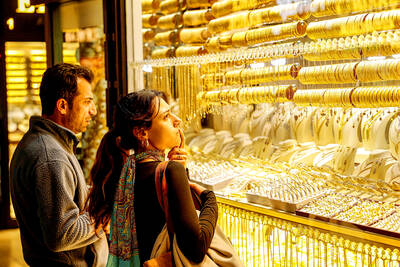
In Italy’s storied gold-making hubs, jewelers are reworking their designs to trim gold content as they race to blunt the effect of record prices and appeal to shoppers watching their budgets. Gold prices hit a record high on Thursday, surging near US$5,600 an ounce, more than double a year ago as geopolitical concerns and jitters over trade pushed investors toward the safe-haven asset. The rally is putting undue pressure on small artisans as they face mounting demands from customers, including international brands, to produce cheaper items, from signature pieces to wedding rings, according to interviews with four independent jewelers in Italy’s main

Japanese Prime Minister Sanae Takaichi has talked up the benefits of a weaker yen in a campaign speech, adopting a tone at odds with her finance ministry, which has refused to rule out any options to counter excessive foreign exchange volatility. Takaichi later softened her stance, saying she did not have a preference for the yen’s direction. “People say the weak yen is bad right now, but for export industries, it’s a major opportunity,” Takaichi said on Saturday at a rally for Liberal Democratic Party candidate Daishiro Yamagiwa in Kanagawa Prefecture ahead of a snap election on Sunday. “Whether it’s selling food or

CONCERNS: Tech companies investing in AI businesses that purchase their products have raised questions among investors that they are artificially propping up demand Nvidia Corp chief executive officer Jensen Huang (黃仁勳) on Saturday said that the company would be participating in OpenAI’s latest funding round, describing it as potentially “the largest investment we’ve ever made.” “We will invest a great deal of money,” Huang told reporters while visiting Taipei. “I believe in OpenAI. The work that they do is incredible. They’re one of the most consequential companies of our time.” Huang did not say exactly how much Nvidia might contribute, but described the investment as “huge.” “Let Sam announce how much he’s going to raise — it’s for him to decide,” Huang said, referring to OpenAI
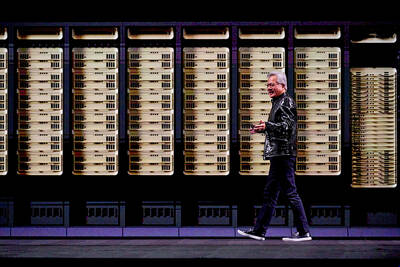
The global server market is expected to grow 12.8 percent annually this year, with artificial intelligence (AI) servers projected to account for 16.5 percent, driven by continued investment in AI infrastructure by major cloud service providers (CSPs), market researcher TrendForce Corp (集邦科技) said yesterday. Global AI server shipments this year are expected to increase 28 percent year-on-year to more than 2.7 million units, driven by sustained demand from CSPs and government sovereign cloud projects, TrendForce analyst Frank Kung (龔明德) told the Taipei Times. Demand for GPU-based AI servers, including Nvidia Corp’s GB and Vera Rubin rack systems, is expected to remain high,


 RSS
RSS