


With the restart of the Taichung Power Plant’s No. 2 coal-fired electrical generator continuing to cause controversy, Taiwan Power Co (Taipower, 台電) chairman Yang Wei-fuu (楊偉甫) yesterday called for a return to rule of law and professionalism, saying that he would take “personal responsibility” if the Taichung City Government insists on taking legal action against Taipower personnel.
The No. 2 generator is operating legally after the Environmental Protection Agency in February reversed sanctions imposed by the Taichung Environmental Protection Bureau, which in December last year revoked the operating licenses of the No. 2 and No. 3 generators at the Taichung Power Plant, Yang told a news conference yesterday in Taipei.
Taipower restarted the No. 2 generator on Wednesday night last week for testing. The Taichung City Government responded by issuing a fine of NT2 million (US$67,511) and demanded that the generator be shut down.
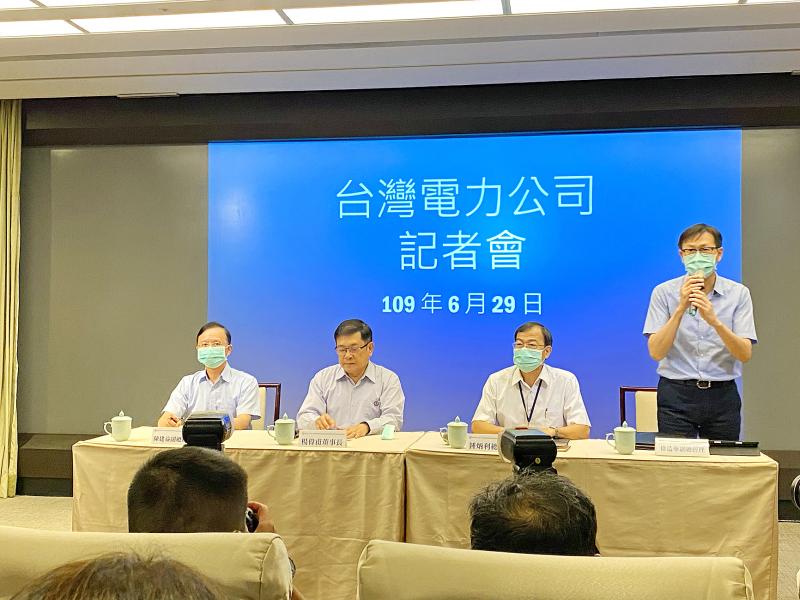
Photo: Huang Pei-chun, Taipei Times
The city government also said that it would fine the state-run utility NT$8 million to NT$20 million pending further investigation and file a lawsuit against key Taipower personnel if necessary.
In his 40 years as a bureaucrat, Yang said, he had never seen a local government invalidate a judgement made by the central government.
He said that he regretted the politicization of the power generator issue.
The city government’s possible legal action against Taipower personnel was unacceptable, Yang said, adding that he would cooperate with any investigation, as he considers protecting company staff part of his duty as chairman.
Taipower has followed the law to provide the electricity needed by Taiwanese, he said.
Providing a stable supply of electricity is no simple matter in the hot summer months, as demand can fluctuate wildly, Yang said, adding that Taipower must have a certain percentage of power generation capacity in reserve to guarantee an uninterrupted supply.
Citing the record-breaking consumption of 37.17 gigawatts on Wednesday last week, Yang said that it is necessary to bring the No. 2 and No. 3 generators back online to support peak usage next month and in August.
It is not the peak season for air pollution, so it is possible to bring coal-fired power plants back online while still ensuring good air quality, Yang added.

NEW IDENTITY: Known for its software, India has expanded into hardware, with its semiconductor industry growing from US$38bn in 2023 to US$45bn to US$50bn India on Saturday inaugurated its first semiconductor assembly and test facility, a milestone in the government’s push to reduce dependence on foreign chipmakers and stake a claim in a sector dominated by China. Indian Prime Minister Narendra Modi opened US firm Micron Technology Inc’s semiconductor assembly, test and packaging unit in his home state of Gujarat, hailing the “dawn of a new era” for India’s technology ambitions. “When young Indians look back in the future, they will see this decade as the turning point in our tech future,” Modi told the event, which was broadcast on his YouTube channel. The plant would convert

‘SEISMIC SHIFT’: The researcher forecast there would be about 1.1 billion mobile shipments this year, down from 1.26 billion the prior year and erasing years of gains The global smartphone market is expected to contract 12.9 percent this year due to the unprecedented memorychip shortage, marking “a crisis like no other,” researcher International Data Corp (IDC) said. The new forecast, a dramatic revision down from earlier estimates, gives the latest accounting of the ongoing memory crunch that is affecting every corner of the electronics industry. The demand for advanced memory to power artificial intelligence (AI) tasks has drained global supply until well into next year and jeopardizes the business model of many smartphone makers. IDC forecast about 1.1 billion mobile shipments this year, down from 1.26 billion the prior

People stand in a Pokemon store in Tokyo on Thursday. One of the world highest-grossing franchises is celebrated its 30th anniversary yesterday.

Zimbabwe’s ban on raw lithium exports is forcing Chinese miners to rethink their strategy, speeding up plans to process the metal locally instead of shipping it to China’s vast rechargeable battery industry. The country is Africa’s largest lithium producer and has one of the world’s largest reserves, according to the US Geological Survey (USGS). Zimbabwe already banned the export of lithium ore in 2022 and last year announced it would halt exports of lithium concentrates from January next year. However, on Wednesday it imposed the ban with immediate effect, leaving unclear what the lithium mining sector would do in the


 RSS
RSS