


Vaccine maker Adimmune Corp (國光生技) last week applied to the Food and Drug Administration (FDA) to run phase I human clinical trials of one of its COVID-19 vaccine candidates, the company said on Monday.
Last month, in the first stage of animal testing, one antigen prototype — four were designed to fight the virus based on the company’s recombinant protein technology — was found to inhibit growth of the novel coronavirus, the company said.
Although the candidate has yet to undergo full animal testing, Adimmune applied to use it in human trials under the FDA’s fast-track program for emergency use authorizations, which is intended to speed up the development of a treatment for COVID-19, it said.
The first stage of animal testing aimed to find out if mice injected with the antigen could generate antibodies strong enough to curb viral replication, while the second stage of testing aims to determine if the antigen would endanger the mice, Adimmune spokesman Pan Fei (潘飛) told the Taipei Times by telephone.
“The second stage will take six months and we just began the testing last month, so it would be too late if we waited for the outcome before moving on to human trials,” Pan added.
Adimmune hopes to start phase I human clinical trials by August, Pan said, adding that about 100 healthy volunteers are to be injected with the vaccine to see if the antigen is safe.
The protocol has not been finalized and must be approved by the FDA, he said.
The company had discussions with the regulator before submitting the application, but does not know how long the regulator’s review might take, Pan added.
If the phase I trials go smoothly, Adimmune plans to apply to run phase II human clinical trials by the end of this year, Pan said.
“We need to test the vaccine candidate’s effectiveness in double-blind phase II clinical trials. We would inject the antigen into volunteers and see if they can be infected in an environment exposed to the novel coronavirus,” he added.
However, as the outbreak is easing in Taiwan, phase II trials might need to be conducted in other countries, Pan said, adding that the firm would discuss the matter with foreign regulators.

In Italy’s storied gold-making hubs, jewelers are reworking their designs to trim gold content as they race to blunt the effect of record prices and appeal to shoppers watching their budgets. Gold prices hit a record high on Thursday, surging near US$5,600 an ounce, more than double a year ago as geopolitical concerns and jitters over trade pushed investors toward the safe-haven asset. The rally is putting undue pressure on small artisans as they face mounting demands from customers, including international brands, to produce cheaper items, from signature pieces to wedding rings, according to interviews with four independent jewelers in Italy’s main

Japanese Prime Minister Sanae Takaichi has talked up the benefits of a weaker yen in a campaign speech, adopting a tone at odds with her finance ministry, which has refused to rule out any options to counter excessive foreign exchange volatility. Takaichi later softened her stance, saying she did not have a preference for the yen’s direction. “People say the weak yen is bad right now, but for export industries, it’s a major opportunity,” Takaichi said on Saturday at a rally for Liberal Democratic Party candidate Daishiro Yamagiwa in Kanagawa Prefecture ahead of a snap election on Sunday. “Whether it’s selling food or

CONCERNS: Tech companies investing in AI businesses that purchase their products have raised questions among investors that they are artificially propping up demand Nvidia Corp chief executive officer Jensen Huang (黃仁勳) on Saturday said that the company would be participating in OpenAI’s latest funding round, describing it as potentially “the largest investment we’ve ever made.” “We will invest a great deal of money,” Huang told reporters while visiting Taipei. “I believe in OpenAI. The work that they do is incredible. They’re one of the most consequential companies of our time.” Huang did not say exactly how much Nvidia might contribute, but described the investment as “huge.” “Let Sam announce how much he’s going to raise — it’s for him to decide,” Huang said, referring to OpenAI
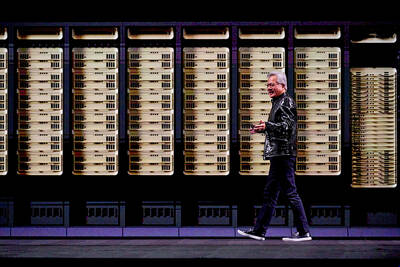
The global server market is expected to grow 12.8 percent annually this year, with artificial intelligence (AI) servers projected to account for 16.5 percent, driven by continued investment in AI infrastructure by major cloud service providers (CSPs), market researcher TrendForce Corp (集邦科技) said yesterday. Global AI server shipments this year are expected to increase 28 percent year-on-year to more than 2.7 million units, driven by sustained demand from CSPs and government sovereign cloud projects, TrendForce analyst Frank Kung (龔明德) told the Taipei Times. Demand for GPU-based AI servers, including Nvidia Corp’s GB and Vera Rubin rack systems, is expected to remain high,


 RSS
RSS