


In El-Arish, the provincial capital of Egypt’s North Sinai, a group of women sew colorful Bedouin designs on masks to protect against the COVID-19 pandemic, as an insurgency simmers in their restive region.
Egypt’s toll from the disease has reached more than 31,000 cases, including more than 1,100 deaths, while North Sinai itself remains the bloody scene of a long-running Islamist insurgency.
“I learned how to embroider when I was a young girl watching my mother,” homemaker Naglaa Mohammed, 36, said on a landline from El-Arish, as mobile phone links are often disrupted.
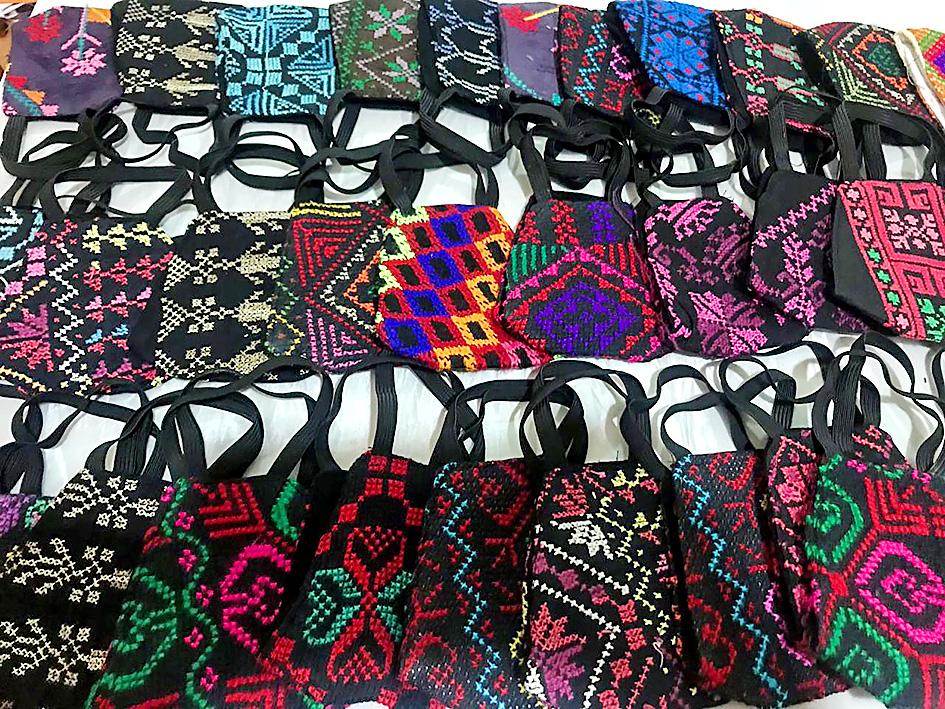
Photo: AFP / HO / AL-FAYROUZ ASSOCIATION
A versatile embroiderer, she also beads garments and crafts rings and bracelets. Now with the pandemic, she has been designing masks showcasing her Bedouin heritage.
Bedouins are nomadic tribes who traditionally inhabit desert areas throughout the Arab world, from North Africa to Iraq. Many have now integrated into a more urban lifestyle.
Egypt’s Bedouin textile tradition of tatriz — weaving and beading rich geometric and abstract designs on garments, cushions and purses — has been passed down from generation to generation for centuries.
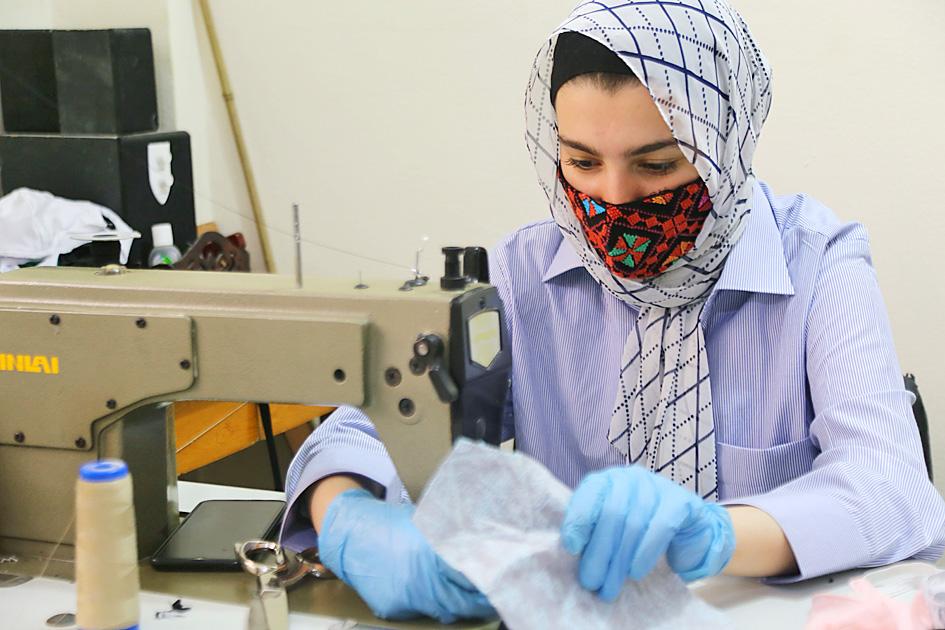
Photo: AFP
It has survived in the Sinai Peninsula, whose north has been plagued by years of militant activity and terror attacks spearheaded by a local affiliate of the Islamic State group.
Security forces have been locked in a battle to quell an insurgency in Sinai that intensified after the military’s 2013 ouster of Egyptian president Mohamed Morsi.
In February 2018, authorities launched a nationwide operation against militants, focusing on North Sinai.
About 970 suspected militants have since been killed in the region along with dozens of security personnel, official figures showed.
Local and international media are banned from entering heavily militarized North Sinai.
Yet for Amany Gharib, who founded the El Fayrouz For Environmental and Social and Economic Services Association in El-Arish in 2010, the violence has not dissuaded her from keeping Bedouin heritage alive while at the same time empowering local women.
She now employs about 550 women such as Mohammed — many of them casually or part-time — as part of a textiles workshop.
“The masks are composed of two layers — one inner layer directly on the face which is disinfected, and the colorful, beaded one outside,” Gharib said.
All the women take the necessary precautions while working, including wearing gloves and masks while using sewing machines.
The finished products are washed, packed and shipped off to distribution centers in Cairo, where they are sold online in partnership with Jumia — Africa’s e-commerce giant — for about US$2.50 each.
The beading process takes about two days for each mask, Gharib said.
Amid the volatile security situation, Mohammed has been able to eke out a meager living with her embroidery skills.
“We work and are given our dues depending on the orders we get ... with the masks it has been a new challenge we’ve tackled,” she said.
Dire economic conditions in Egypt have been even tougher for women of the Sinai since the pandemic began.
“Times are really tough for the women, but we have adjusted,” Gharib said.
While militant attacks on security checkpoints have continued, Gharib expressed confidence in the army.
“We feel a sense of security and stability with the military presence. We trust them,” she said.
The region witnessed the deadliest terror attack in Egypt’s modern history when militants killed more than 300 worshipers in a mosque in November 2017.
Gharib said that in North Sinai’s tight-knit community, each family knew someone who had been killed in an attack.
“Anyone of us who is killed, we consider them a martyr,” she said. “We are in a war with terror ... but the people have learned to live with it.”

Taiwanese firms have increased investment in the Philippines in recent years as Manila’s ties with Washington deepen and global supply chains continue to shift away from China, an expert at the Chung-Hua Institution for Economic Research (CIER, 中華經濟研究院) said yesterday. The Philippines had not been among Taiwanese investors’ top choices in Southeast Asia, CIER Taiwan ASEAN Studies Center director Kristy Hsu (徐遵慈) said at a seminar in Taipei. However, Taiwan’s investment in the country has grown significantly since the COVID-19 pandemic, reaching US $257 million last year, a high in recent years, she said. Although Taiwan’s total investment in the Philippines still lags

Intel Corp regards Taiwan Semiconductor Manufacturing Co (TSMC, 台積電) as a longstanding partner, as the US chipmaker would continue outsourcing production of advanced chips to TSMC, Intel chief executive officer Lip-Bu Tan (陳立武) said yesterday. “I don’t look at people as competitors. I look at the collaboration... Nvidia is also, you know, a good friend,” Tan told a news conference following his keynote speech at the Computex trade show in Taipei. “It’s a very trusted partnership for us... We are a big, top customer for them, and we’re going to continue doing that,” he said, referring to TSMC, the world’s largest foundry

Artificial intelligence (AI) agents would supplant smartphones as the center of people’s digital lives, fundamentally reshaping personal devices and driving a major computing upgrade cycle, Qualcomm Inc CEO Cristiano Amon said yesterday. In his keynote speech for this year’s Computex trade show in Taipei, Amon said that the rise of "agentic AI" — AI systems capable of reasoning, planning and carrying out tasks autonomously — would transform how people interact with technology across phones, PCs, vehicles and wearable devices. Describing the technology as the next major evolution in computing, Amon said that "2026 is the year of agents.” For decades, smartphones have sat

Hon Hai Precision Industry Co (鴻海精密) yesterday said it would work with US chipmaker Intel Corp to jointly develop and deploy next-generation artificial intelligence (AI) infrastructure and intelligent computing platforms in a move to capture booming demand for AI computing systems. Hon Hai, also known as Foxconn Technology Group (富士康), said in a statement that the partnership would combine its global manufacturing scale, system integration expertise and AI data center deployment capabilities with Intel’s strengths in processor architecture, silicon technologies and software ecosystem. The companies said they plan to work on equipment used in AI data centers, including server racks powered by


 RSS
RSS