


Macau gambling king Stanley Ho (何鴻燊), who built a business empire from scratch in the former Portuguese colony and became one of Asia’s richest men, died yesterday at the age of 98.
The flamboyant tycoon, who loved to dance, and advised his nearest and dearest to shun gambling, headed one of the world’s most lucrative gaming businesses through his flagship firm, SJM Holdings Ltd (澳門博彩控), valued at about US$6 billion.
Shielded from challengers by a four-decade monopoly on gambling, Ho helped transform Macau from a sleepy peninsula dotted with seedy, windowless gambling dens into the world’s biggest casino center.
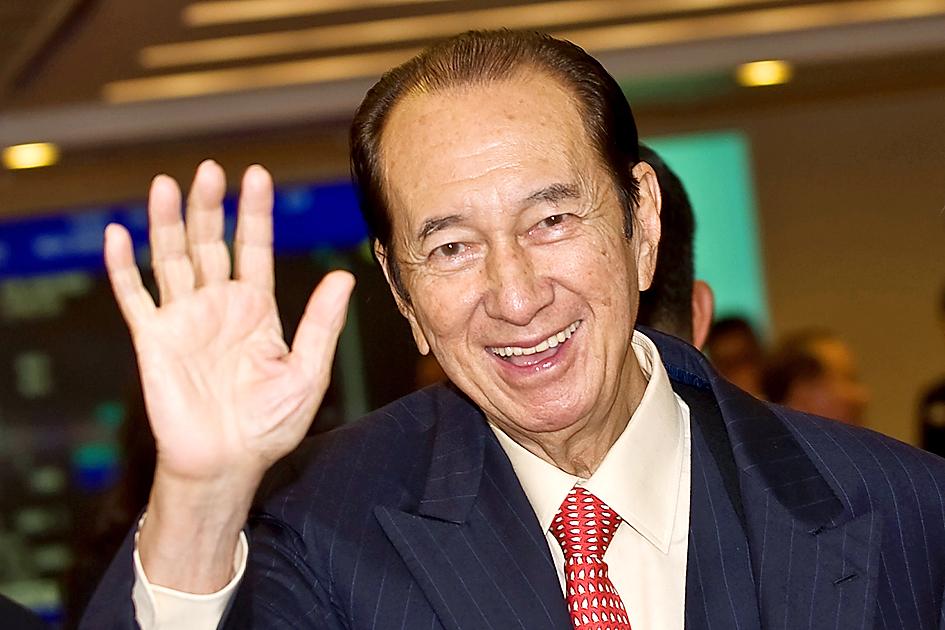
Photo: AFP
However, Ho’s interests in Macau, on the coast of southeast China across the mouth of the Pearl River opposite Hong Kong, were not limited to the roulette wheels and baccarat tables.
His privately held company, Sociedade de Turismo e Diversoes de Macau, or STDM, has stakes in everything from luxury hotels to helicopters and horse racing.
Ho lost his gambling monopoly in 2002 when Macau was opened up to competition, three years after the enclave returned to Chinese rule. STDM’s main asset, SJM, is facing increasing competition from the other five licensed operators in Macau including US billionaire Sheldon Adelson’s Sands China Ltd (金沙中國).
US regulators said Ho was linked to triads, or criminal gangs, which he denied.
However, Ho earned the adoration of many Hong Kong and Macau residents for his swashbuckling business style and his philanthropic work.
He spearheaded what is known in Macau as the junket VIP system, whereby intermediaries act on behalf of casinos by extending credit to gamblers and taking responsibility for collecting debts.
He had four wives and 17 known children, and was forced to restructure his business after a legal battle erupted within the family in 2012 over his fortune.
Born in Hong Kong in 1921 and related to the wealthy Ho Tung (何東) family of Chinese and European descent, Ho’s privileged upbringing was short-lived. At 13, his father lost everything in the stock market and fled to Vietnam, abandoning his wife and children.
Ho was determined to succeed and earned a place at the University of Hong Kong.
Although World War II intervened, his luck held. He left school and worked for seven days for the Air Raid Service Department before the Japanese captured Hong Kong.
“I earned HK$10 out of the seven days ... then I went to Macau,” he once told Reuters in an interview.
“I was a very poor man,” he said. “I started with only HK$10. That was my capital.”
He got a job with the Macau government, bartering goods with the Japanese. The experience led to his own trading company and he became a millionaire.
In the early 1960s, he bid for the Macau gaming monopoly being offered by the Portuguese in its largely forgotten Asian outpost.
Ho won the concession, built a harbor, added high-speed boats to lure Hong Kong’s avid gamblers and created the cash cow that made his empire possible.
As a result of the company restructuring that followed the family legal battle, Ho dropped off the ranks of Hong Kong’s richest people for the first time in many years.
Angela Leong (梁安琪), his fourth wife and a co-chairperson at SJM, has seen her net worth jump to US$4.1 billion, according to Forbes.
Some of Ho’s children have become successful gaming operators in their own right. Daughter Pansy (何超瓊) is the co-chairperson of MGM Resorts International’s Macau unit, while son Lawrence (何猷龍) runs Melco Resorts & Entertainment Ltd (新濠博亞娛樂).
Among his other children, Josie (何超儀), born to Ho’s second wife, has forged a career as a movie star, appearing in the 2011 thriller Contagion.
SJM’s most lavish casino, the 12-year-old Grand Lisboa, a 48-story building shaped like a lotus flower, remains one of Macau’s most prominent destinations.
However, ironically, the casino king did not gamble.
“I have always told my children and my good friends: ‘For God’s sake, never gamble heavily and if you can avoid it, don’t ever gamble,’” he told the Far Eastern Economic Review in 1999.


Taiwanese firms have increased investment in the Philippines in recent years as Manila’s ties with Washington deepen and global supply chains continue to shift away from China, an expert at the Chung-Hua Institution for Economic Research (CIER, 中華經濟研究院) said yesterday. The Philippines had not been among Taiwanese investors’ top choices in Southeast Asia, CIER Taiwan ASEAN Studies Center director Kristy Hsu (徐遵慈) said at a seminar in Taipei. However, Taiwan’s investment in the country has grown significantly since the COVID-19 pandemic, reaching US $257 million last year, a high in recent years, she said. Although Taiwan’s total investment in the Philippines still lags

Intel Corp regards Taiwan Semiconductor Manufacturing Co (TSMC, 台積電) as a longstanding partner, as the US chipmaker would continue outsourcing production of advanced chips to TSMC, Intel chief executive officer Lip-Bu Tan (陳立武) said yesterday. “I don’t look at people as competitors. I look at the collaboration... Nvidia is also, you know, a good friend,” Tan told a news conference following his keynote speech at the Computex trade show in Taipei. “It’s a very trusted partnership for us... We are a big, top customer for them, and we’re going to continue doing that,” he said, referring to TSMC, the world’s largest foundry
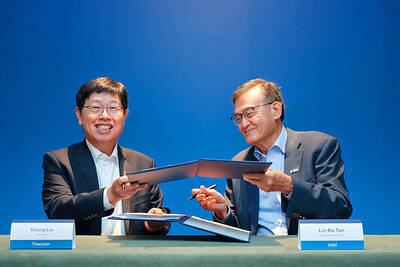
Hon Hai Precision Industry Co (鴻海精密) yesterday said it would work with US chipmaker Intel Corp to jointly develop and deploy next-generation artificial intelligence (AI) infrastructure and intelligent computing platforms in a move to capture booming demand for AI computing systems. Hon Hai, also known as Foxconn Technology Group (富士康), said in a statement that the partnership would combine its global manufacturing scale, system integration expertise and AI data center deployment capabilities with Intel’s strengths in processor architecture, silicon technologies and software ecosystem. The companies said they plan to work on equipment used in AI data centers, including server racks powered by
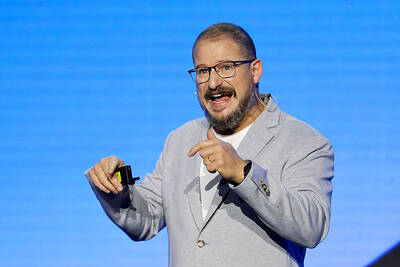
Artificial intelligence (AI) agents would supplant smartphones as the center of people’s digital lives, fundamentally reshaping personal devices and driving a major computing upgrade cycle, Qualcomm Inc CEO Cristiano Amon said yesterday. In his keynote speech for this year’s Computex trade show in Taipei, Amon said that the rise of "agentic AI" — AI systems capable of reasoning, planning and carrying out tasks autonomously — would transform how people interact with technology across phones, PCs, vehicles and wearable devices. Describing the technology as the next major evolution in computing, Amon said that "2026 is the year of agents.” For decades, smartphones have sat


 RSS
RSS