


Worldwide, the COVID-19 pandemic has left people scrambling for protective face coverings. However, in Mexico, where the masked stars of lucha libre are already cultural icons, people are using their colorful masks to ward off the novel coronavirus in style.
The wrestling masks, fitted out with an added chin strap, are highly sought after as they cover the nose and the mouth of the wearer, and hundreds have been sold since the outbreak began.
The handmade masks use the same colors and designs worn by the most famous wrestling stars and are produced by a 53-year-old former wrestler, Jose Isaias Huerta, known in his days in the ring as “The Grey Cat.”
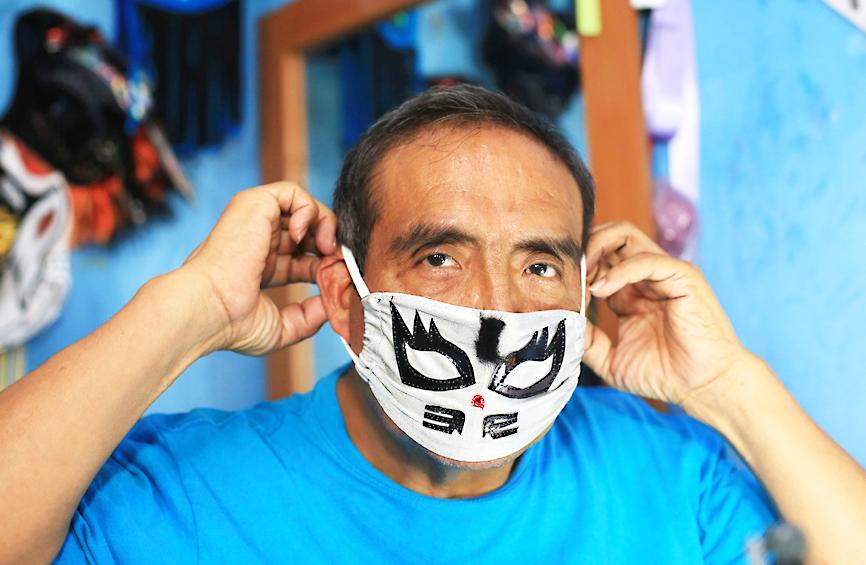
Photo: AFP
In less than a month, Huerta has sold 600 masks, churning out 30 per day — and he has a backlog of orders that would take more than a month to fulfill.
“Mexicans have lucha libre in their blood — the wrestler is a living hero for the fans,” Huerta told reporters.
“I see that with this,” he added, pointing at his masks.
The emblematic masks of stars such as “El Santo,” “Blue Demon” or “Parka” have been recreated using regular fabrics, and the maker does not claim that they have the protective quality of surgical masks.
Huerta sells them for 50 pesos (US$2) apiece — almost 10 times the price of a conventional mask sold in packets of 10 in pharmacies, which are not as thick as his.
Huerta made his amateur debut in the wrestling ring at age 11 and had his first professional bout when he was 14. Since then, he has never strayed far from the canvas.
After retiring, he got his hands on a couple of old sewing machines and started turning out — together with his sister — masks for professional wrestlers and their fans. They sold well at the gates to the lucha libre arenas, given the widespread homegrown fan base and the curiosity of tourists looking for souvenirs.
However, several weeks ago, all wrestling matches were suspended as part of the effort to curb the spread of the coronavirus, which left vendors and producers facing bankruptcy.
However, Huerta then stumbled on the idea of selling the masks as protective face gear. The inspiration came by chance, when he gave a mask to his eight-year-old grandson — also a big fan of the sport.
That was when his son-in-law noticed how useful and attractive the mask could be for Mexicans facing the disease.
Cristobal Lobato, a fan of the “tough guys” strain of lucha libre wrestling, whose adherents flout the rules and are craftier in the ring, was one of the first to buy in.
“I saw them on the Internet and hunted until I found out where to buy them,” said the digital strategist, who bought 10 masks to give to family members, especially children.
“They don’t really understand what is going on and putting on the mask of a luchador makes them feel like superheroes, while it also protects them,” he said.
The walls of Huerta’s poorly lit workshop, where he works furiously to meet his orders, are covered with old newspaper cuttings and photographs of him in his glory days as The Grey Cat.
His newfound success came suddenly, when a local radio station in Puebla — 120km to the south of Mexico City — mentioned his masks and triggered a surge of interest.
Huerta has quickly cobbled together a crew of six friends and family members to churn out masks for as long as demand lasts. Every day, they have to figure out how to send packages to far-flung parts of the country, like prosperous Monterrey in the north.
Having no experience servicing nationwide demand, they have even had to ask their new clients if they know how much it costs to send packages across the country.
“We’re up front with them — we don’t want to make a bad impression. We sell in small batches — five, 10, no more,” Huerta said.
The first masks were made with leftover fabric, and acquiring new material has been difficult because of a national lockdown and the closure of stores.
Huerta’s passion for the wrestling craft has been key to the success of his business.
“We know they’re made-up — Santo, Blue Demon — but we carry on watching them and say: ‘These are our idols,’ and they are the ones that sell the most,” he said.
As of Friday, Mexico had reported 11,633 COVID-19 cases and 1,069 deaths.
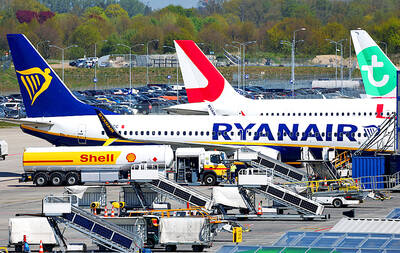
Ryanair, Transavia, Volotea and other low-cost airlines are feeling the financial pain from high jet fuel prices as a result of the Middle East war and are cutting flights. The closure of the Strait of Hormuz has taken a huge chunk of oil supplies off the market, sending the price of jet fuel soaring and triggering fears of shortages that could force airlines to cancel flights. Airlines are not waiting for a lack of supplies to react. “Travel alert: Airlines are cutting thousands of flights right now,” Travel Therapy host Karen Schaler said in an Instagram reel this past weekend.

MANAGING RISKS: Taiwan has secured LNG sufficient to cover 95 percent of electricity demand for next month, UBS said, describing the government’s approach as proactive UBS Group AG has raised its forecast for Taiwan’s economic growth this year to 8 percent, up from 6.9 percent previously, and said expansion could reach as high as 8.6 percent if external energy shocks are avoided. The upgrade reflects a stronger-than-expected first-quarter performance and sustained momentum in artificial intelligence (AI)-driven exports, which UBS said are providing a firm foundation for growth despite geopolitical and energy risks. Taiwan’s GDP expanded 13.69 percent year-on-year in the first quarter, the fastest growth since the second quarter of 1987, the Directorate-General of Budget, Accounting and Statistics (DGBAS) reported on Thursday. On a seasonally
The Fair Trade Commission’s (FTC) ongoing review of Grab Holdings Ltd’s US$600 million acquisition of Foodpanda Taiwan’s operations, announced on March 23, has taken on fresh urgency as industry experts warn that the transaction could embed significant Chinese cybersecurity vulnerabilities into Taiwan’s digital infrastructure through Grab’s deep ties to autonomous-driving firm WeRide (文遠知行). Less than 16 months after the FTC blocked Uber Eats’ direct attempt to acquire Foodpanda Taiwan — citing potential combined market shares of 80 to 90 percent — the emergence of Grab as the buyer has prompted questions about whether the same competitive harm is simply being rerouted

The list of Asian stocks that benefit from business partnership with Nvidia Corp is getting longer, as the region further integrates into the artificial intelligence (AI) chip giant’s business ecosystem. Just in the past week, South Korea’s LG Electronics Inc, Taiwan’s Nanya Technology Corp (南亞科技), as well as China’s Huizhou Desay SV Automotive Co (德賽西威) and Pateo Connect Technology Shanghai Corp (博泰車聯) have become the latest to rally on news of tie-ups, supply-chain participation or product collaboration with the US chip designer. Asian suppliers account for about 90 percent of Nvidia’s production costs, up from about 65 percent last year, data compiled


 RSS
RSS