


Housing transactions in the six special municipalities totaled 19,824 units last month, up 7.8 percent from a year earlier, brokers said, citing government data.
Last month’s data mainly reflected deals made in February, when the pinch of the COVID-19 pandemic was not yet evident, they said.
Taoyuan posted the largest improvement, with housing transactions soaring 36.6 percent year-on-year to 3,676 units, local government data showed.
Taiwan Realty Co (台灣房屋) attributed the pickup to the completion of two presale residential projects in the municipality.
Houses in Taoyuan have increasingly gained in popularity in the past few year years due to relatively affordable home prices and improving infrastructures, such as the Asian Silicon Valley project, the Taoyuan Aerotropolis (桃園航空城) and the Taiwan Taoyuan International Airport Access MRT, Taiwan Realty research manager Chen Ping-chen (陳炳辰) said.
That helped boost Taoyuan’s population by 200,000 in the past five years to 2.25 million, the broker said, adding that the trend fueled real demand and asset allocation needs.
Taipei reported a 20.8 percent increase in housing deals from a year earlier to 2,483, also aided by transfers of newly completed projects in Nangang District (南港), Chen said.
Zhongshan District (中山) was another hot spot, he said.
Transactions in New Taipei City rose 5.1 percent to 4,849 and surged 18.7 percent to 3,826 in Taichung, data from the local governments showed.
However, southern Taiwan put up a weak showing, with transactions dropping 4.9 percent in Tainan and plunging 18.9 percent to 3,088 in Kaohsiung, official tallies showed.
Evertrust Rehouse Co (永慶房屋) spokesman Jay Hsieh (謝志傑) attributed the fall in Kaohsiung to a higher base last year, when a new residential complex was completed.
The spread of COVID-19 in February was relatively mild in Taiwan and abroad, except for China and South Korea, but its impact might start to emerge going forward, analysts said.
The virus has since rapidly swept across Europe and the US, with no sign of easing, dashing hopes of a return to normalcy soon, Hsieh said.
Businesses in Taiwan cannot stay above a looming global recession induced partly by draconian isolation measures worldwide to contain the pandemic, Hsieh said.
There is no room for optimism as figures of business closures and people on unpaid leave escalate, Hsieh said.
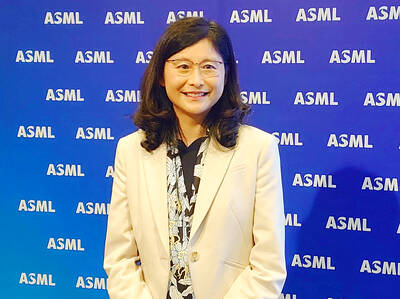
Netherlands-based semiconductor equipment supplier ASML Holding NV yesterday said that it is planning to hire an additional 1,000 people in Taiwan this year in response to growing demand from clients. ASML had previously planned to recruit 600 people this year, but that the plan has been adjusted upward, ASML vice president and ASML Taiwan general manager Grace Wang (汪佳慧) told reporters. ASML has a workforce of more than 4,500 in Taiwan, accounting for about 10 percent of its global total, Wang said. This year’s recruitment campaign would focus on adding people in the customer support, manufacturing and supply chain domains to assist ASML
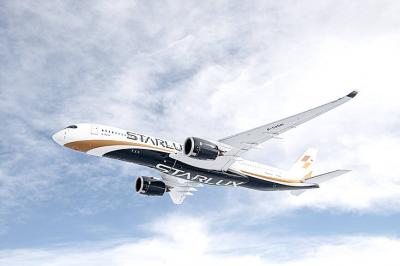
Starlux Airlines Co (星宇航空) today unveiled a long-haul network expansion plan at a shareholders’ meeting in Taipei, including direct flights to Barcelona, Spain, and Zurich, Switzerland, as well as a service connecting Taipei, Sydney and New Zealand. Starlux is to become the first Taiwanese carrier to offer non-stop services to the two European cities, while the inaugural oceanic route is expected to expand transit opportunities within the Australia-New Zealand market, Starlux said. Flight services to Chicago, Dallas, Washington and New York are under evaluation, the airline added. Prior to the shareholders’ meeting, the airline earlier this year announced that it would be

UNDER MICROSCOPE: Taiwan detained three people who allegedly conspired to buy servers in Taiwan and export them using fraudulent documentation, prosecutors said Nvidia Corp chief executive officer Jensen Huang (黃仁勳) on Saturday urged Super Micro Computer Inc to tighten up on compliance after Taiwan detained three people this week for allegedly making fraudulent declarations about artificial intelligence (AI) servers made by its US partner. The development marked the nation’s first crackdown on semiconductor smuggling, which grew after the US slapped restrictions on exports of high-end chips such as Nvidia AI accelerators to China. Nvidia is “rigorous” in explaining regulations to all of its partners, Huang told reporters after arriving in Taipei. “Ultimately Super Micro has to run their own company,” he said in response to
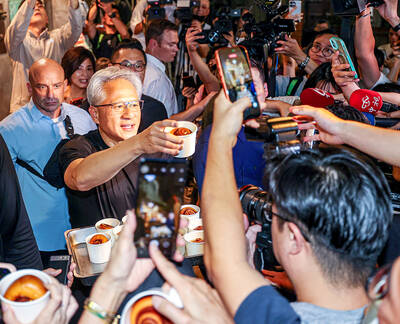
Nvidia Corp yesterday announced that CEO Jensen Huang (黃仁勳) would attend an employee meeting in Taipei tomorrow to celebrate the launch of the company’s Taiwan headquarters project. Huang would attend a gathering at the site of Nvidia’s planned headquarters in Beitou Shilin Technology Park (北投士林科技園區), the company said in a statement. After arriving in Taiwan on Saturday last week, Huang told reporters that he plans to meet with Quanta Computer Inc (廣達) chairman Barry Lam (林百里) and Taiwan Semiconductor Manufacturing Co (TSMC, 台積電) chairman C.C. Wei (魏哲家), and would attend the groundbreaking ceremony for Nvidia’s Taiwan headquarters tomorrow. Nvidia has not yet applied


 RSS
RSS