


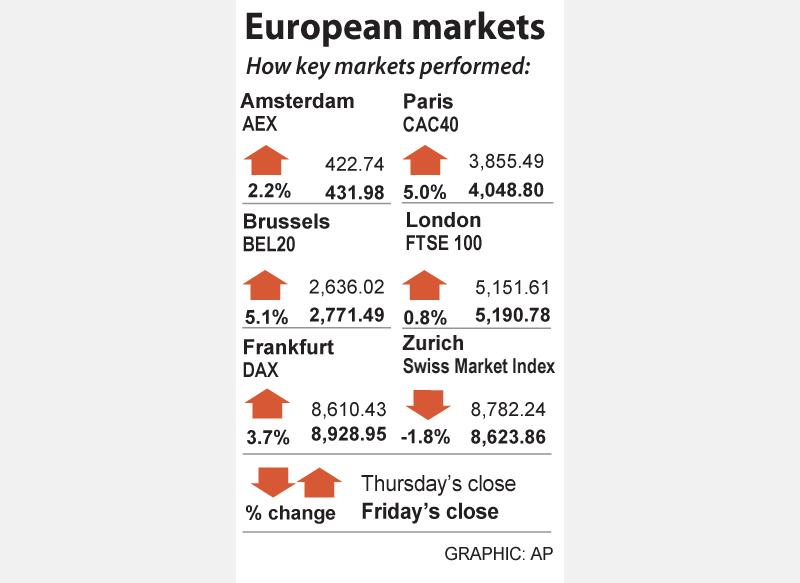
European shares jumped for a second straight session on Friday, as a wave of fiscal and monetary stimulus tempted investors back into equity markets after days of selling on signs the world was headed into a deep, coronavirus-driven recession.
The European Commission said that it was looking at loosening debt rules for member states and issuing common eurozone bonds in an attempt to shore up businesses and households crushed by the meltdown in economic activity.
The pan-European STOXX 600 rose 1.8 percent on Friday, but was down 2 percent for the week and still looking at its worst month in three decades as the deepening spread of COVID-19 in Europe forces countries to shut down.
Financials on Friday rose 3.9 percent from a near 30-year low, with Allianz SE, Prudential PLC, ING Groep and Zurich Insurance Group surging 8.5 percent to 12 percent.
Even travel and leisure stocks attempted a rebound in what has been their worst month so far since October 1987, as the promise of more stimulus raised hopes of a smoother recovery from the health crisis.
The optimism was reflected across global equity markets, as the US Senate debated a US$1 trillion-plus package that would include direct financial help for Americans.
Meanwhile, sources told reporters that China was set to unleash trillions of yuan of fiscal stimulus.
“It’s seemingly having a positive effect given the market needed a trillion-dollar worth of help this week to just make it to the weekend,” AxiCorp Financial Services Pty Ltd markets strategist Stephen Innes said.
“[But it is] the calm before the storm, I’m afraid, as the nasty impact on corporate solvency will become more evident in the weeks ahead, when the demand shock filters through to the real economy,” Innes said.
Several blue-chip European firms have flagged a severe hit to business as the pandemic empties hotels and crushes consumer spending, with the airline industry facing a complete collapse in the face of halt in global travel.
British retailer Marks & Spencer Group PLC was the latest to warn about an impact in its clothing, homewares and international businesses, sending its shares down 5.2 percent.
Holiday Inn owner InterContinental Hotels Group PLC said demand for hotels was at the lowest levels it had ever seen and announced a series of measures to cut costs.

Among the rows of vibrators, rubber torsos and leather harnesses at a Chinese sex toys exhibition in Shanghai this weekend, the beginnings of an artificial intelligence (AI)-driven shift in the industry quietly pulsed. China manufactures about 70 percent of the world’s sex toys, most of it the “hardware” on display at the fair — whether that be technicolor tentacled dildos or hyper-realistic personalized silicone dolls. Yet smart toys have been rising in popularity for some time. Many major European and US brands already offer tech-enhanced products that can enable long-distance love, monitor well-being and even bring people one step closer to

TRANSFORMATION: Taiwan is now home to the largest Google hardware research and development center outside of the US, thanks to the nation’s economic policies President Tsai Ing-wen (蔡英文) yesterday attended an event marking the opening of Google’s second hardware research and development (R&D) office in Taiwan, which was held at New Taipei City’s Banciao District (板橋). This signals Taiwan’s transformation into the world’s largest Google hardware research and development center outside of the US, validating the nation’s economic policy in the past eight years, she said. The “five plus two” innovative industries policy, “six core strategic industries” initiative and infrastructure projects have grown the national industry and established resilient supply chains that withstood the COVID-19 pandemic, Tsai said. Taiwan has improved investment conditions of the domestic economy

Malaysia’s leader yesterday announced plans to build a massive semiconductor design park, aiming to boost the Southeast Asian nation’s role in the global chip industry. A prominent player in the semiconductor industry for decades, Malaysia accounts for an estimated 13 percent of global back-end manufacturing, according to German tech giant Bosch. Now it wants to go beyond production and emerge as a chip design powerhouse too, Malaysian Prime Minister Anwar Ibrahim said. “I am pleased to announce the largest IC (integrated circuit) Design Park in Southeast Asia, that will house world-class anchor tenants and collaborate with global companies such as Arm [Holdings PLC],”

MAJOR BENEFICIARY: The company benefits from TSMC’s advanced packaging scarcity, given robust demand for Nvidia AI chips, analysts said ASE Technology Holding Co (ASE, 日月光投控), the world’s biggest chip packaging and testing service provider, yesterday said it is raising its equipment capital expenditure budget by 10 percent this year to expand leading-edge and advanced packing and testing capacity amid strong artificial intelligence (AI) and high-performance computing chip demand. This is on top of the 40 to 50 percent annual increase in its capital spending budget to more than the US$1.7 billion to announced in February. About half of the equipment capital expenditure would be spent on leading-edge and advanced packaging and testing technology, the company said. ASE is considered by analysts


 RSS
RSS