


Taiwanese companies returning to the nation have pledged up to NT$703.4 billion (US$23.06 billion) in investments, the Ministry of Economic Affairs said yesterday, as it approved another two firms’ applications to take part in a government incentive program.
New Taipei City-based lastic flooring supplier M.J. International Co Ltd (美喆) has decided to invest about NT$2.6 billion to set up a stone plastic composite floorings plant in the Tainan Technology Industrial Park (台南科技工業區), the ministry said.
The new plant would implement environmentally friendly manufacturing and smart production processes, and would create 245 job opportunities, it said.
An unspecified test fixture firm — which serves companies such as Advanced Micro Devices Inc, Siliconware Precision Industries Co (矽品精密), ASE Technology Holding Co (日月光投資控股) and King Yuan Electronics Co (京元電子) — plans to invest more than NT$3 billion to set up a smart production plant in Kaohsiung’s Nantze Export Processing Zone (楠梓加工出口區), the ministry said.
The company’s customers had requested the investment, which comes amid rising demand from semiconductor firms, the ministry said, adding that it would create 145 jobs.
SECOND PROGRAM
In related news, the ministry has also approved applications by Hsiner Co Ltd (新廣業), Intai Technology Corp (鐿鈦科技) and Tong Hsing Electronic Industries Ltd (同欣電子) to join in a separate government program that is also aimed at boosting investment and generating jobs in Taiwan.
Taichung-based Hsiner, a liquid silicone products manufacturer, is to invest NT$750 million to establish a new plant in the Central Taiwan Science Park (中部科學園區) and add a smart production line for oxygen therapy humidifiers, the ministry said.
The plant would create 100 job opportunities, it said.
Intai, a Taichung-based precision hardware manufacturer, is also to invest NT$1.5 billion in the science park to introduce automated production lines at its existing plant, the ministry said.
New Taipei City-based Tong Hsing, which provides micro module assembly and thick-film/thin-film substrate foundry services, is to invest more than NT$9.7 billion to expand its plant in Taoyuan’s Bade District (八德) and add new production lines at its plant in Longtan District (龍潭), the ministry added.
The company would offer up to 588 job opportunities, it said.
Companies participating in this program have pledged NT$66.1 billion in investments, which would create up to 4,630 job opportunities, the ministry said.

Cairo’s new monorail slices across the city skyline, running above the familiar chaos of blaring horns and aging buses’ exhaust fumes that mark rush hour below. The US$4.5 billion monorail, opened this month, is among Egypt’s most prominent new transport projects, part of a debt-funded infrastructure drive criticized for sapping state finances while bringing limited benefits to most of the country’s 109 million people. “It feels like you’re in a different country,” said Ramy Sayed, a restaurant manager, aboard a driverless Innovia 300 train. “No noise, no traffic, we’re not used to this.” The eastern line runs 56km from the bustling middle-class
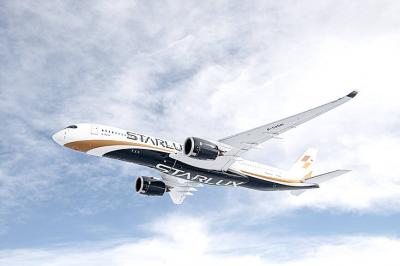
Starlux Airlines Co (星宇航空) today unveiled a long-haul network expansion plan at a shareholders’ meeting in Taipei, including direct flights to Barcelona, Spain, and Zurich, Switzerland, as well as a service connecting Taipei, Sydney and New Zealand. Starlux is to become the first Taiwanese carrier to offer non-stop services to the two European cities, while the inaugural oceanic route is expected to expand transit opportunities within the Australia-New Zealand market, Starlux said. Flight services to Chicago, Dallas, Washington and New York are under evaluation, the airline added. Prior to the shareholders’ meeting, the airline earlier this year announced that it would be
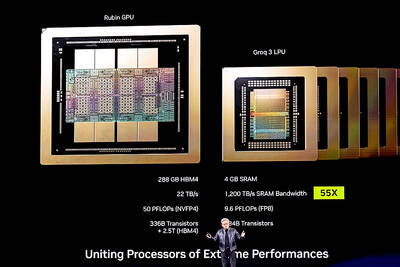
Taiwanese prosecutors suspect that three people successfully smuggled at least one shipment of Nvidia Corp artificial intelligence (AI) chips to China after first exporting them to Japan, people familiar with the matter said. The trio was detained last week by the Keelung District Prosecutors’ Office for allegedly falsifying documents related to exports of Super Micro Computer Inc servers containing advanced Nvidia chips, which the US has barred from sale to China without a license from Washington. The move marked Taiwan’s first public crackdown on AI chip diversion after years of pressure from the US to take a more active role in curtailing
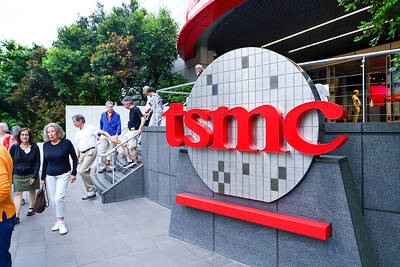
Taiwan Semiconductor Manufacturing Co (TSMC, 台積電) employee bonuses are likely to grow more than 30 percent this year, in line with the past few years as the company’s profits continue to set new records, an anonymous source cited TSMC chairman C.C. Wei (魏哲家) as saying yesterday. TSMC, the world’s largest contract chipmaker, is committed to taking care of its workers, the source said, citing Wei’s meeting with employees yesterday morning. Wei also expressed gratitude to employees for their contribution to the company’s improving bottom line, the source added. Since 2023, TSMC’s employee bonuses have grown at an annual rate of


 RSS
RSS