


World Bank president David Malpass yesterday urged China to further open up its economy and reduce state subsidies, echoing key demands made by the US in protracted trade negotiations.
Malpass made the remarks after a roundtable meeting with Chinese Premier Li Keqiang (李克強) and the heads of other global institutions, including the IMF and the WTO.
“I encouraged new reforms and liberalization,” he said.
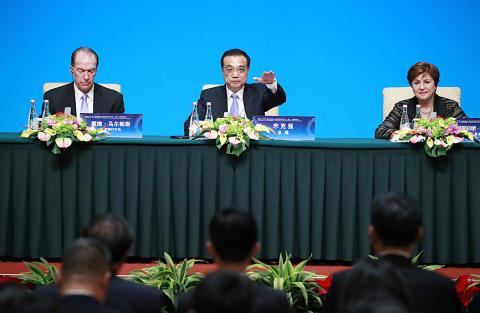
Photo: EPA-EFE
Beijing is struggling to kickstart the economy, which expanded at its slowest pace for nearly three decades in the third quarter amid cooling global demand for its exports and a looming debt crisis at home.
Malpass said Beijing must resolve bilateral trade disputes and improve transparency in lending to avoid a sharp downturn on growth over the coming decades.
“China could improve the rule of law, allow the market to play a more decisive role in allocating resources, including debt and investment, reduce subsidies for state-owned enterprises ... and remove barriers to competition,” he said.
“It is hard to achieve, but it is vital for reducing any inequality and building [a] higher living standard,” Malpass said.
China’s National People’s Congress in March passed a foreign investment law that promises to address these issues, but local governments are still working on detailed rules needed to implement it.
Beijing has also announced a timetable to open up its financial sector to foreign investors next year, as it attempts to woo outside capital to shore up an economy battered by the trade conflict with the US.
The two nations have slapped tariffs on more than US$360 billion of goods in two-way trade.
Negotiators from both sides have been working toward a partial deal, but US President Donald Trump on Wednesday said Beijing has not made sufficient concessions, making him reluctant to conclude a bargain.
Completion of a “phase one” US-China trade deal could slide into next year, trade experts and people close to the White House said, as Beijing presses for more extensive tariff rollbacks and the Trump administration counters with heightened demands of its own.
An initial trade deal could take as long as five weeks to sign, Trump and US Secretary of Treasury Steven Mnuchin said last month.
Just over five weeks later, a deal is still elusive, and negotiations might be getting more complicated, trade experts and people briefed on the talks said this week.
Asked on Wednesday about the status of the China deal, Trump told reporters in Texas: “I don’t think they’re stepping up to the level that I want.”
Trump and US Trade Representative Robert Lighthizer recognize that rolling back tariffs for a deal that fails to address core intellectual property and technology transfer issues will not be seen as a good deal for the US, a person briefed on the matter said.
“Negotiations are continuing and progress is being made on the text of the phase one agreement,” White House spokesman Judd Deere said in an e-mail on Wednesday afternoon.
In a dinner speech in Beijing on Wednesday, Vice Premier Liu He (劉鶴) said he was “cautiously optimistic” on a phase one deal, Bloomberg News said, citing people who attended the event ahead of a forum organized by Bloomberg LP.
Liu, China’s chief negotiator at the Sino-US trade talks, separately told one of the attendees that he was “confused” about the US demands, but was confident the first phase of a deal could be completed nevertheless, Bloomberg added.
Liu’s comments came before the US House of Representatives voted 417-1 for legislation supporting Hong Kong protesters that has already been unanimously approved by the Senate.
It could go to Trump as soon as yesterday and he plans to sign the bill, a person familiar with the matter said.
The crackdown on protests in Hong Kong might complicate the deal’s completion, experts said.
The Hong Kong issue is definitely a negative factor in the trade talks, Zhang Yansheng (張燕生), principal researcher at the state-affiliated think-tank China Center for International Economic Exchanges, said at a Bloomberg forum yesterday.
A phase one deal is likely this year if there was “no disturbance,” Zhang said, without elaborating.
China will strive to reach a “phase one” trade deal with the United States as both sides keep communication channels open, the spokesman at the Chinese Ministry of Commerce told reporters.

Taiwanese firms have increased investment in the Philippines in recent years as Manila’s ties with Washington deepen and global supply chains continue to shift away from China, an expert at the Chung-Hua Institution for Economic Research (CIER, 中華經濟研究院) said yesterday. The Philippines had not been among Taiwanese investors’ top choices in Southeast Asia, CIER Taiwan ASEAN Studies Center director Kristy Hsu (徐遵慈) said at a seminar in Taipei. However, Taiwan’s investment in the country has grown significantly since the COVID-19 pandemic, reaching US $257 million last year, a high in recent years, she said. Although Taiwan’s total investment in the Philippines still lags
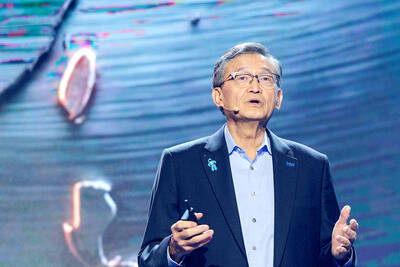
Intel Corp regards Taiwan Semiconductor Manufacturing Co (TSMC, 台積電) as a longstanding partner, as the US chipmaker would continue outsourcing production of advanced chips to TSMC, Intel chief executive officer Lip-Bu Tan (陳立武) said yesterday. “I don’t look at people as competitors. I look at the collaboration... Nvidia is also, you know, a good friend,” Tan told a news conference following his keynote speech at the Computex trade show in Taipei. “It’s a very trusted partnership for us... We are a big, top customer for them, and we’re going to continue doing that,” he said, referring to TSMC, the world’s largest foundry

Artificial intelligence (AI) agents would supplant smartphones as the center of people’s digital lives, fundamentally reshaping personal devices and driving a major computing upgrade cycle, Qualcomm Inc CEO Cristiano Amon said yesterday. In his keynote speech for this year’s Computex trade show in Taipei, Amon said that the rise of "agentic AI" — AI systems capable of reasoning, planning and carrying out tasks autonomously — would transform how people interact with technology across phones, PCs, vehicles and wearable devices. Describing the technology as the next major evolution in computing, Amon said that "2026 is the year of agents.” For decades, smartphones have sat

Hon Hai Precision Industry Co (鴻海精密) yesterday said it would work with US chipmaker Intel Corp to jointly develop and deploy next-generation artificial intelligence (AI) infrastructure and intelligent computing platforms in a move to capture booming demand for AI computing systems. Hon Hai, also known as Foxconn Technology Group (富士康), said in a statement that the partnership would combine its global manufacturing scale, system integration expertise and AI data center deployment capabilities with Intel’s strengths in processor architecture, silicon technologies and software ecosystem. The companies said they plan to work on equipment used in AI data centers, including server racks powered by


 RSS
RSS