

The sky turned from indigo to ebony as the tropical night fell, and the train patiently thrust through the jungle toward its destination, still hundreds of kilometers away.
The trek has the hallmarks of one of the world’s great forgotten train journeys — a voyage through 648km of lush equatorial forest.
The Trans-Gabon Railway is the brainchild of former Gabonese president Omar Bongo, who ruled for 42 years until his death in 2009.

Photo: AFP
In the 1970s, he dreamed of linking the central African state’s resource-rich interior with the Atlantic coast — and he saw it through, despite being rebuffed by the World Bank, which refused to fund it on the grounds that it was not economically viable.
Today, the “Bongo Train,” as it is affectionately known, remains the country’s sole railway line, linking 23 stations from the coastal capital, Libreville, to distant Franceville, the country’s third-most populous city.
“The Transgabonais binds Gabonese society,” said Christian Antchouet Roux, the stationmaster at Franceville.
About 320,000 people take the train every year, a sign of its affordability for the average Gabonese. Ticket prices depend on the time of year and class — the train has a VIP carriage, as well as first and second classes.
Passengers travel only at nighttime, but in air-conditioned comfort — a rarity in the world’s poorest continent — and the blue and yellow compartments are modern.
One such traveler is Miyha Koumba, a young student in Libreville who uses it to visit her family at the other end of the line.
“I take the train at least four times a year. I can visit my parents regularly,” she said, arriving in Libreville at 7am bleary-eyed, having departed Franceville at 5:30pm the day before.
During the day, the train hauls manganese — a key export after oil — from the interior to the oceanside capital.
Touting the train as a symbol of national unity and modernization, Bongo doggedly pressed on with the plan, saying: “If we need to have a pact with the devil, we’ll do that.”
Fortune smiled on Gabon’s leader in 1973, when the OPEC cartel of oil producing nations raised prices dramatically, filling the country’s coffers and enabling him to start construction with the additional help of Western aid, notably from former colonial ruler France.
Bongo flagged off the project — the largest in Africa at the time — on Dec. 30, 1973. It cost US$1.65 billion and millions of trees were felled to cut the swathe through the jungle for the track, which is unelectrified.
In 1986, the last stretch was inaugurated in the presence of then-French prime minister Jacques Chirac.
Critics of the project have long pointed to its cost, to its use as a political tool for Bongo, whose partisan stronghold was centered in the region where Franceville is located, and to French involvement.
“Since its creation, the Transgabonais has been closely linked to France and its interests,” said US-based law professor Douglas Yates, author of The Rentier State in Africa: Oil Rent Dependency & Neocolonialism in the Republic of Gabon.
Its champions view it as a critical piece of infrastructure for Gabon’s development.
There is a road running parallel to the tracks, but it is riddled with potholes, making the journey much longer and far less comfortable, as well as dangerous.
In a country that has been grappling with the effects of falling oil prices since 2014, the importance of manganese for the economy has ballooned.
“Without manganese, this train could not exist,” Gabonese economist Mays Mouissi said.
According to an economic report by the Gabonese government, the ore accounts for one-fourth of non-oil exports.
Although still volatile, a surge in manganese prices over the past couple of years has boosted the country’s oil-dependent economy.
French mining group Eramet SA, which extracts 80 percent of Gabon’s manganese, has said that it wants to boost production by 60 percent by 2023.
However, more than 33 years after the first train started rolling, the line is facing problems.
There have been many derailments on a stretch built on unstable terrain and maintenance has been poor.
Train services have been further compromised by technical problems, while elephants wandering over the tracks have caused delays.
To keep the line going, a massive eight-year revamp was launched in 2015, costing an estimated 330 million euros (US$363.5 million). More than half of the total is to be financed by France, together with, ironically, the World Bank.
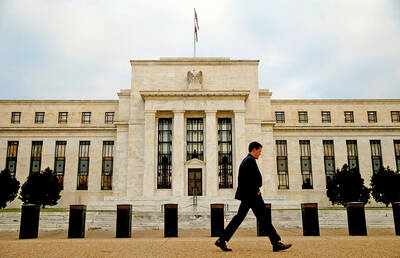
Federal Reserve Bank of Philadelphia President Anna Paulson on Thursday joined the chorus of policymakers saying additional interest-rate increases may be needed to ensure inflation returns to the central bank’s 2 percent goal. “Looking ahead, if conditions evolve as I expect, some modest further tightening may be warranted,” Paulson said on Thursday at an event in Philadelphia. Earlier on Thursday, New York Fed President John Williams said he and his colleagues “still have a lot of work to do” in dealing with lingering inflation risks. Several other officials have aired similar comments, in line with the signal given last week when policymakers voted
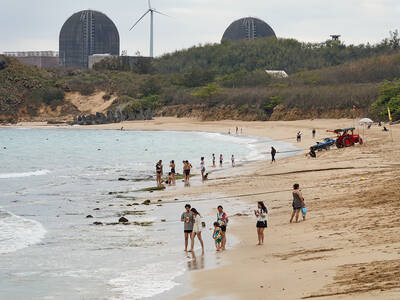
COURSE CHANGE: The shift comes amid pressure from chipmakers for stable, low-carbon electricity. Officials said Ma-anshan could be restarted as early as 2028 Taiwan has approved a preliminary plan to restart an idled atomic power plant, marking a reversal of the ruling party’s anti-nuclear stance as the nation pursues greater energy security. The Nuclear Safety Commission has cleared its review of an initial proposal to restart the Ma-anshan Nuclear Power Plant, it said in a statement on Thursday. Taiwan Power Co (台電) will still need to carry out follow-up work including safety inspections, before submitting another report on implementation for review, the commission said. The earliest the plant could resume operations is 2028, according to previous reports in local media, citing Minister of Economic Affairs

GlobalFoundries Inc yesterday said it plans to accelerate global capacity optimization and expansion to accommodate exponential growth in radio frequency (RF) and other chips driven by the artificial intelligence (AI) boom. Singapore will pay a vital role in the company’s capacity expansion, alongside production line optimizations across its manufacturing sites, GlobalFoundries Asia Pacific head Vincent Feng (范曾文) told a news conference in Hsinchu City. “Many might be surprised to hear that the RF market is thriving now. We are gearing up for a massive capacity expansion, and it is all being driven by AI,” Feng said. He declined to disclose details of the
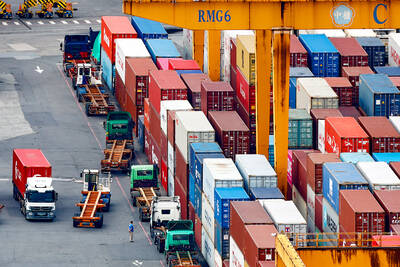
LOPSIDED DEVELOPMENT: While AI firms are riding the wave as far it can take them, traditional industries and their workers are not floated by the same flood While Taiwan is benefiting from a global artificial intelligence (AI) boom, many traditional industries have seen little of the benefit, widening the country’s “K-shaped” economic divide, an economist said. A “K-shaped” economy is one in which some sectors expand rapidly while others struggle, head of the commerce development and strategy research division at the Commerce Development Research Institute Ju Haw (朱浩) said in an interview. In Taiwan’s case, high-tech and AI-related industries have continued to grow while traditional industries have come under increasing pressure, he said. AI development has created crowding-out effects, as large high-tech firms generating strong profits are better able


 RSS
RSS