


One evening last year, David Burek noticed charred wood and a burning smell in his attic, near his young sons’ bedroom. He climbed a ladder and saw a melted connector wire from the solar panels installed on the roof of his North Dartmouth, Massachusetts, home.
Firefighters rushed over and discovered that flames had burned through the shingles, the roof and a support beam. Luckily, a recent rain had doused it.
A month later, a fire broke out on the roof of Ken Tomasello’s home in Waldorf, Maryland, sending a section of the ceiling crashing onto a bed. It ultimately caused so much fire, smoke and water damage that Tomasello and his wife had to live in a hotel for more than a year.
The two homes had something in common: SolarCity, now a unit of Elon Musk’s Tesla Inc, had installed their rooftop panels. While these are just a pair of relatively small incidents at a company with about 400,000 solar customers — one of the biggest such portfolios in the US — they add to the growing concern about the safety of Tesla’s solar systems.
In the past couple weeks, Walmart Inc and Amazon.com Inc have said that Tesla systems caused roof fires at their stores or warehouses.
Those were commercial installations. The Burek and Tomasello episodes show there are potentially also problems with residential systems, a much bigger part of the company’s sputtering business.
Further underscoring those worries, Tesla has reached out to homeowners across the US to tell them they need preventive maintenance.
The company says the remediation effort is designed to ensure that systems last 10 to 20 years.
In an interview, Burek said he heard from Tesla in October last year — about five months after his panels had been removed.
“When I called Tesla back, they said our system had been flagged for bad connectors,” Burek said. “I told them there was no system to maintain because they’d already caused a fire on my roof.”
Although not tracked nationally, rooftop solar fires are rare.
Tesla said its customers’ risk of fire is seven times lower than they face from home wiring and lighting.
“While we strive for zero risks across all of our products, this rate of risk presents less of a household danger than a home washer or dryer,” the company said in a statement.
News about fires threatens to worsen the woes at Tesla’s solar unit, which in turn would only add to the recent struggles for the automaker.
Tesla’s main electric car business faces a host of challenges: Musk’s tweeting has drawn scrutiny from federal securities regulators, the company has yet to report an annual profit and Tesla’s stock is down about 33 percent this year.
Tesla bought SolarCity in 2016. It is losing market share, reporting only 29 megawatts (MW) worth of installations in the second quarter, down from a high of more than 200MW in 2016.
Much of the reason: strategic shifts, including an end of door-to-door sales and marketing through Home Depot Inc.
Its shortcomings are all the more evident as solar is taking off in the US and around the world.
Sarah Wilder, director of curriculum development and instruction at Solar Energy International, a nonprofit focusing on technical training, said that a shortage of qualified workers can lead to a decline in system quality.
Faulty components, shoddy workmanship or wiring, or a combination, can cause fires, Wilder said.
So can poor maintenance.
“There’s a lot of emphasis by solar companies on getting that installation, but insufficient emphasis on making sure that the system is rigorously operated and maintained,” said Joe Osha, an equity analyst at JMP Securities LLC, a San Francisco investment-banking firm, who was not speaking specifically about Tesla. “These are not install-and-forget assets.”
Now, the fires are sparking finger-pointing and lawsuits.
Last week, Amazon said that a blaze on the roof of one of its warehouses in Southern California in June last year also involved a Tesla system.
Tesla called it “an isolated incident” that it addressed and that all 11 of its Amazon solar sites are generating energy.
Earlier this month, Walmart sued Tesla, claiming that the company failed to meet industry standards in the installation of solar systems atop hundreds of its stores and caused fires in at least seven of them, including two in May last year.
The companies have issued a statement saying they “look forward to addressing all issues” and “re-energizing Tesla solar installations at Walmart stores.”
After the Massachusetts and Maryland fires, two homeowners insurers, Citation Insurance Co and Allstate Corp, accused Tesla of negligence and breach of contract over the fires.
They each sued Tesla and Wallingford, Connecticut-based Amphenol Corp, which makes electrical connectors, including those used in Tesla installations.
“We believe these lawsuits are without merit and will vigorously defend ourselves against them,” Amphenol said.
While Tesla declined to comment on the complaints, it denied the allegations in a court filing in the Citation case.
Tesla has raised concerns about Amphenol’s connectors, which it said are more prone to failure.
In an e-mail, it said that even solar panels using those connectors have a low rate of catching fire.
“In the past year, less than 1 percent of 1 percent” of those sites have experienced “any type of thermal event necessitating any form of emergency response, and there have been no injuries,” the company said.
In its January suit in the Circuit Court for Charles County, Maryland, Tomasello’s insurer, Allstate, said that it was seeking to recover at least US$300,000 it paid to make up for his fire-related losses.
“When I heard about the Walmart fires, I wasn’t surprised at all,” Tomasello said in an interview. “I’m sure there are other homes that have had experiences similar to ours.”
In its April lawsuit in New Bedford District Court in Massachusetts, David and Stephanie Burek’s insurer, Citation, said that it was suing to recover about US$12,000 it paid to the couple because of losses in the fire.
A year after the fire, Burek posted photographs of the damage on Facebook, along with a long note of warning to friends and family: “I caution you on using Tesla or any solar company for that matter as while it can certainly save you money it may potentially cost you much, much more. To us our family is way more valuable than any amount of money we would ever save.”
SEEKING CLARITY: Washington should not adopt measures that create uncertainties for ‘existing semiconductor investments,’ TSMC said referring to its US$165 billion in the US Taiwan Semiconductor Manufacturing Co (TSMC, 台積電) told the US that any future tariffs on Taiwanese semiconductors could reduce demand for chips and derail its pledge to increase its investment in Arizona. “New import restrictions could jeopardize current US leadership in the competitive technology industry and create uncertainties for many committed semiconductor capital projects in the US, including TSMC Arizona’s significant investment plan in Phoenix,” the chipmaker wrote in a letter to the US Department of Commerce. TSMC issued the warning in response to a solicitation for comments by the department on a possible tariff on semiconductor imports by US President Donald Trump’s
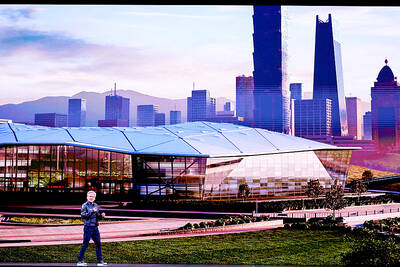
The government has launched a three-pronged strategy to attract local and international talent, aiming to position Taiwan as a new global hub following Nvidia Corp’s announcement that it has chosen Taipei as the site of its Taiwan headquarters. Nvidia cofounder and CEO Jensen Huang (黃仁勳) on Monday last week announced during his keynote speech at the Computex trade show in Taipei that the Nvidia Constellation, the company’s planned Taiwan headquarters, would be located in the Beitou-Shilin Technology Park (北投士林科技園區) in Taipei. Huang’s decision to establish a base in Taiwan is “primarily due to Taiwan’s talent pool and its strength in the semiconductor
An earnings report from semiconductor giant and artificial intelligence (AI) bellwether Nvidia Corp takes center stage for Wall Street this week, as stocks hit a speed bump of worries over US federal deficits driving up Treasury yields. US equities pulled back last week after a torrid rally, as investors turned their attention to tax and spending legislation poised to swell the US government’s US$36 trillion in debt. Long-dated US Treasury yields rose amid the fiscal worries, with the 30-year yield topping 5 percent and hitting its highest level since late 2023. Stocks were dealt another blow on Friday when US President Donald

UNCERTAINTY: Investors remain worried that trade negotiations with Washington could go poorly, given Trump’s inconsistency on tariffs in his second term, experts said The consumer confidence index this month fell for a ninth consecutive month to its lowest level in 13 months, as global trade uncertainties and tariff risks cloud Taiwan’s economic outlook, a survey released yesterday by National Central University found. The biggest decline came from the timing for stock investments, which plunged 11.82 points to 26.82, underscoring bleak investor confidence, it said. “Although the TAIEX reclaimed the 21,000-point mark after the US and China agreed to bury the hatchet for 90 days, investors remain worried that the situation would turn sour later,” said Dachrahn Wu (吳大任), director of the university’s Research Center for


 RSS
RSS