


The Ministry of Economic Affairs yesterday approved five more applications by firms to participate in a government program to boost investment in Taiwan.
With the five companies’ NT$9.5 billion (US$306.2 million) in combined investments, 89 applications have been approved since the beginning of the year, bringing total investment to more than NT$444.1 billion and creating more than 40,000 job opportunities, the ministry said.
Wiwynn Corp (緯穎科技), which specializes in cloud-based computing technology, plans to invest more than NT$1.5 billion by building a research and development center that would also provide after-sales services at the Southern Taiwan Science Park (南部科學園區), the ministry said.
The company plans to recruit up to 410 local professionals, the ministry said.
YFC-Boneagle Electric Co Ltd (岳豐科技), a manufacturer of power extension cords and networking cables, plans to move part of its Chinese production to Taiwan to avoid US tariffs, the ministry said.
The company would also relocate its headquarters in Taoyuan and build a new manufacturing plant, the ministry said, adding that YFC’s NT$900 million investment is expected to provide 34 jobs, it said.
Automotive parts maker China Fineblanking Technology Co Ltd (和勤精機), a supplier of Volkswagen AG, Magna PT, Danfoss A/S and Tesla Inc, plans to invest more than NT$1.5 billion by relocating part of its production line to its plant at the Central Taiwan Science Park (中部科學園區) and is expected to offer 188 jobs, the ministry said.
Eclat Textile Co (儒鴻企業) plans to invest NT$1.02 billion to establish a new digital printing plant in Miaoli County and recruit an estimated 60 tech professionals to produce high-value-added printed fabric, it said.
A listed company — which the ministry did not name — that supplies core materials to flat-panel makers, plans to invest several billion New Taiwan dollars by setting up a new production site, adding battery material production lines and expanding its plant in Taiwan, it said.
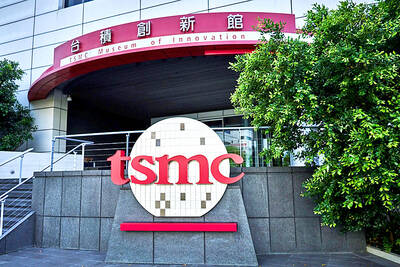
SEEKING CLARITY: Washington should not adopt measures that create uncertainties for ‘existing semiconductor investments,’ TSMC said referring to its US$165 billion in the US Taiwan Semiconductor Manufacturing Co (TSMC, 台積電) told the US that any future tariffs on Taiwanese semiconductors could reduce demand for chips and derail its pledge to increase its investment in Arizona. “New import restrictions could jeopardize current US leadership in the competitive technology industry and create uncertainties for many committed semiconductor capital projects in the US, including TSMC Arizona’s significant investment plan in Phoenix,” the chipmaker wrote in a letter to the US Department of Commerce. TSMC issued the warning in response to a solicitation for comments by the department on a possible tariff on semiconductor imports by US President Donald Trump’s
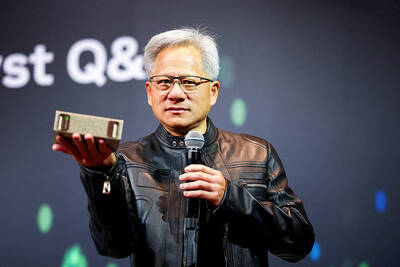
‘FAILED EXPORT CONTROLS’: Jensen Huang said that Washington should maximize the speed of AI diffusion, because not doing so would give competitors an advantage Nvidia Corp cofounder and chief executive officer Jensen Huang (黃仁勳) yesterday criticized the US government’s restrictions on exports of artificial intelligence (AI) chips to China, saying that the policy was a failure and would only spur China to accelerate AI development. The export controls gave China the spirit, motivation and government support to accelerate AI development, Huang told reporters at the Computex trade show in Taipei. The competition in China is already intense, given its strong software capabilities, extensive technology ecosystems and work efficiency, he said. “All in all, the export controls were a failure. The facts would suggest it,” he said. “The US

The government has launched a three-pronged strategy to attract local and international talent, aiming to position Taiwan as a new global hub following Nvidia Corp’s announcement that it has chosen Taipei as the site of its Taiwan headquarters. Nvidia cofounder and CEO Jensen Huang (黃仁勳) on Monday last week announced during his keynote speech at the Computex trade show in Taipei that the Nvidia Constellation, the company’s planned Taiwan headquarters, would be located in the Beitou-Shilin Technology Park (北投士林科技園區) in Taipei. Huang’s decision to establish a base in Taiwan is “primarily due to Taiwan’s talent pool and its strength in the semiconductor
French President Emmanuel Macron has expressed gratitude to Hon Hai Precision Industry Co (鴻海精密) for its plan to invest approximately 250 million euros (US$278 million) in a joint venture in France focused on the semiconductor and space industries. On his official X account on Tuesday, Macron thanked Hon Hai, also known globally as Foxconn Technology Group (富士康科技集團), for its investment projects announced at Choose France, a flagship economic summit held on Monday to attract foreign investment. In the post, Macron included a GIF displaying the national flag of the Republic of China (Taiwan), as he did for other foreign investors, including China-based


 RSS
RSS