


There has been much discussion in recent years about slowing growth of cosmetics retail chains amid a moderate increase in domestic consumption, while retailers manage to upgrade their services as they seek to increase customer traffic and single-store sales, but Poya International Co Ltd (寶雅國際) said it would seek sustained growth via new store openings and tapping the hardware merchandise business.
Poya, which operates 208 outlets selling cosmetics, lingerie and stationery, plans to open 20 to 30 new stores each year and increase its number of stores to 302 by 2022 and 400 by 2026. The company aims to maintain steady single-store sales growth through store improvements and a better product mix, according to a presentation document on the company’s Web site following an investors’ conference on June 26 in Taipei.
The company is ready to launch its first hardware store, Poya Home (寶家), in the third quarter and establish three such outlets nationwide by the end of this year. At the conference, Poya said it plans to add 10 Poya Home outlets next year and up to 30 stores in 2021 to increase the economy of scale.
“Although Poya Home will target a different clientele compared with Poya’s cosmetics stores, management is confident that it can leverage its brand equity and experience running a large store network to build a network of profitable Poya Home stores. We estimate the new business will contribute sales of NT$20 million to NT$30 million [US$642,900 to NT$964,400] in 2019, and NT$400 million in 2020 in tandem with store additions,” SinoPac Securities Investment Service Corp (永豐投顧) analyst Fion Chen (陳奕均) said in a research note on Tuesday last week.
Chen said the nation’s hardware merchandise business generates sales of NT$60 billion a year, but the market is highly fragmented, as independent stores comprise more than 80 percent of total stores.
“Poya has ample resources and economies of scale to snatch a share of the market,” Chen said.
In Taiwan, retail sales of general merchandise — including at department stores, supermarkets, hypermarkets, convenience stores and cosmetics stores — are a closely watched gauge of household consumer confidence and the Ministry of Economic Affairs’ tallies released last month showed that sales increased 3.6 percent to NT$514.3 billion in the first five months, which remain resilient despite slowing economic growth.
SinoPac said it is positive about Poya’s new hardware merchandise business and believes there is ample room for the company’s further store expansion given an estimated domestic market size of 400 cosmetics stores in Taiwan.
“We project more than 10 percent year-on-year sales growth for Poya in 2019 and 2020,” Chen said.
Poya reported consolidated sales grew 10.31 percent annually to NT$6.29 billion in the first five months of the year. In the first quarter, the company’s net profit grew 2.5 percent year-on-year to NT$454.3 million, with earnings per share of NT$4.65.
Poya shares were up 2.38 percent last week and closed at NT$430 on Friday. SinoPac has a 12-month target price of NT$490 on Poya, valuing the stock at 22 times its estimated earnings per share of NT$22.27 next year.

Apple Inc increased iPhone production in India by about 53 percent last year and now makes a quarter of its marquee devices there, reflecting the US company’s efforts to avoid tariffs on China. The company assembled about 55 million iPhones in India last year, up from 36 million a year earlier, people familiar with the matter said, asking not to be named because the numbers aren’t public. Apple makes about 220 million to 230 million iPhones a year globally, with India’s share of the total increasing rapidly. Apple has accelerated its expansion in the world’s most populous country in recent years, bolstered

DAMAGE REPORT: Global central banks are assessing war-driven inflation risks as the law of unintended consequences careens around the world, spiking oil prices Central banks from Washington to London and from Jakarta to Taipei are about to make their first assessments of economic damage after more than two weeks of conflict between the US and Iran. Decisions this week encompassing every member of the G7 and eight of the world’s 10 most-traded currency jurisdictions are likely to confirm to investors that the specter of a new inflation shock is already worrying enough to prompt heightened caution. The US Federal Reserve is widely expected to do exactly what everyone anticipated weeks ahead of its March 17-18 policy gathering: hold rates steady. The narrative surrounding that
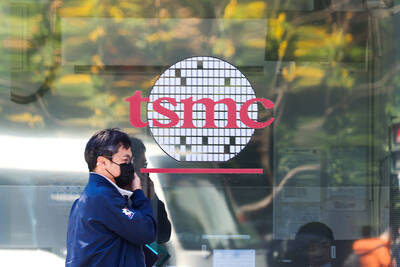
Taiwan Semiconductor Manufacturing Co’s (TSMC, 台積電) share of the global foundry market rose to almost 70 percent last year amid booming demand for artificial intelligence (AI), market information advisory firm TrendForce Corp (集邦科技) said on Thursday. The contract chipmaker posted US$122.54 billion in revenue, up 36.1 percent from a year earlier, accounting for 69.9 percent of the global market, TrendForce said. Its share was up from 64.4 percent in 2024, it said. TSMC’s closest rival, Samsung Electronics, was a distant second, posting US$12.63 billion in sales, down 3.9 percent from a year earlier, for a 7.2 percent share of the global market. In the

HEADWINDS: The company said it expects its computer business, as well as consumer electronics and communications segments to see revenue declines due to seasonality Pegatron Corp (和碩) yesterday said it aims to grow its artificial intelligence (AI) server revenue more than 10-fold this year from last year, driven by orders from neocloud solutions clients and large cloud service providers. The electronics manufacturing service provider said AI server revenue growth would be driven primarily by the Nvidia Corp GB300 server platform. Server shipments are expected to increase each quarter this year, with the second half likely to outperform the first half, it said. The AI server market is expected to broaden this year as more inference applications emerge, which would drive demand for system-on-chip, application-specific integrated circuits


 RSS
RSS