


When inflation began eating into her state-paid salary, Libyan architect and assistant professor Seham Saleh started selling drawings over the Internet to help pay the bills.
She joins a growing number of Libyan women launching start-ups in the conservative Arab country, where many still think a woman’s place is in the home, but where the strains on personal and family income following years’ of political chaos have forced women to look for more work.
Libya has only a tiny private sector, which means there is a market for locally produced goods. The economy is dominated by the state, which employs most adults under a structure set up by late Libyan leader Muammar Qaddafi, who was toppled in 2011.
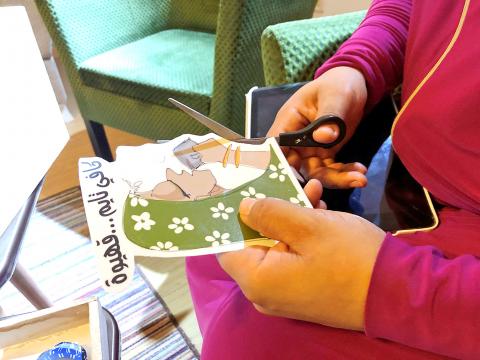
Photo: Reuters
Men are the traditional breadwinners, although about 30 percent of women were in the labor force as of 2015, a UN report said.
“I cannot live on my assistant professor salary of 1,000 dinars [US$719] even if it is paid out,” Saleh said.
She has been selling drawings of people in Libyan dress or bookmarks she created on a computer.
“Thank God ... people wanted to buy the products,” she said.
She also does freelance work as an architect.
Once one of the richest countries in the region, the chaos and civil war that ensued after the fall of Qaddafi has seen Libya’s living standards erode. Little is now produced in Libya other than oil — even milk is imported from Europe.
Cumulative inflation over the past four years has seen real incomes lose more than half of their purchasing power, and the government effectively devalued the dinar in September last year.
A cash crisis means public servants often do not have their salaries paid out in full. Lenders have no cash deposits, as the rich prefer to hold their cash themselves, rather than deposit it in a bank.
Women rarely had jobs outside of sectors such as teaching, although the need for more family income has changed the situation, said Jasmin Khoja, head of the Jusoor Center for Studies and Development, a women’s business support venture.
Her organization has trained about 33 would-be female entrepreneurs, and offers legal advice and office space, as women often cannot afford their own.
While Seham’s “Naksha” art business is in its early stages, others such as Najwa Shoukri’s start-up are growing fast. She started designing clothes from home in 2016, and selling them online.
Now, together with five other women, she has a workshop selling 50 pieces a month and plans to open a shop next year on Jaraba Street, the main fashion shopping avenue in Tripoli.
To make the shop a success, her output would have to rise to 150 pieces a month.
Her brother and family have contributed to investments worth 10,000 dinars.
The biggest challenges for start-ups are legal hurdles and the lack of electronic payment systems.
Some Libyan commercial laws go back to the 1960s and are aimed at big corporations such as oil firms, not start-ups. Under these regulations firms need to deposit thousands of dinars.
“Banks do not give loans, which stops projects and makes them unable to grow or employ other women and young people,” Khoja said.
Undeterred, Mayaz Elahshmi started a business last week training women to fix computers and smartphones.
“There is big demand as many women are reluctant to go to a phone shop where men work, as they have personal files on their phones,” she said.
Six people came to her first training session, each paying 30 dinars.
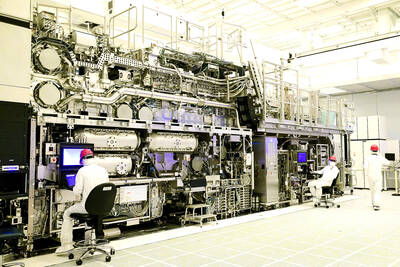
ASML Holding NV’s new advanced chip machines have a daunting price tag, said Taiwan Semiconductor Manufacturing Co (TSMC, 台積電), one of the Dutch company’s biggest clients. “The cost is very high,” TSMC senior vice president Kevin Zhang (張曉強) said at a technology symposium in Amsterdam on Tuesday, referring to ASML’s latest system known as high-NA extreme ultraviolet (EUV). “I like the high-NA EUV’s capability, but I don’t like the sticker price,” Zhang said. ASML’s new chip machine can imprint semiconductors with lines that are just 8 nanometers thick — 1.7 times smaller than the previous generation. The machines cost 350 million euros (US$378 million)

EXPLOSION: A driver who was transporting waste material from the site was hit by a blunt object after an uncontrolled pressure release and thrown 6m from the truck Taiwan Semiconductor Manufacturing Co (TSMC, 台積電) said yesterday there was no damage to its facilities after an incident at its Arizona factory construction site where a waste disposal truck driver was transported to hospital. Firefighters responded to an explosion on Wednesday afternoon at the TSMC plant in Phoenix, the Arizona Republic reported, citing the local fire department. Cesar Anguiano-Guitron, 41, was transporting waste material from the project site and stopped to inspect the tank when he was made aware of a potential problem, a police report seen by Bloomberg News showed. Following an “uncontrolled pressure release,” he was hit by a blunt

Quanta Computer Inc (廣達), which makes servers and laptop computers on a contract basis, yesterday said it expects artificial intelligence (AI) devices to bring explosive growth to Taiwan’s electronics industry, as AI applications are starting to run on edge devices such as AI PCs. Taiwanese electronics manufacturers such as chipmakers, component suppliers and hardware assemblers are likely to benefit from a rapid uptake of AI applications, Mike Yang (楊麒令), president of Quanta Cloud Technology Inc (雲達科技), a server manufacturing arm of Quanta, told reporters on the sidelines of a technology forum in Taipei yesterday. “I believe the growth potential is promising once

‘WORST OVER’: A large portion of Hon Hai’s non-operating loss came from Sharp’s large flat-screen business, but Young Liu said the situation is expected to improve Hon Hai Precision Industry Co (鴻海精密), a major iPhone assembler, yesterday reported annual growth of 72 percent in net profit last quarter, due to a dramatic decrease in losses from Sharp Corp’s display business. Net profit surged to NT$22 billion (US$678.7 million) last quarter, from NT$12.83 billion a year earlier, as Hon Hai booked a non-operating loss of NT$4.24 billion, an improvement from NT$20.12 billion in the first quarter of last year. A major portion of its non-operating loss came from Sharp’s large flat-screen business Sakai Display Products Corp. On a quarterly basis, Hon Hai’s net profit sank 59 percent from NT$53.15


 RSS
RSS