


Where can consumers find quality bed or kitchenware? Does Taiwan produce non-toxic wooden furniture? What kind of new products are featured in intelligent buildings?
The four-day Taiwan International Architechture, Design and Building Material Expo in Taipei, which ended on Monday last week, not only answered all of those questions, but also shed light on how local manufacturers can survive in a market that is vulnerable to global trade policies and production costs.
The portable pneumatic vacuum elevator, NuVa, was introduced by Howtobe Technology Co Ltd (好厝邊), a subsidiary of elevator supplier GFC Ltd (崇友實業) at the expo at Taipei World Trade Center Exhibition Hall 1.
The company said that its elevator does not require a shaft or machine room.
“When an earthquake strikes and the power goes off, the NuVa will return to the ground floor and open automatically,” a Howtobe employee told the Taipei Times.
At another booth, Kitchenware manufacturer Helion International Co Ltd (赫里翁) introduced the company’s intelligent kitchen system, which is able to detect leaking gas and control the gas switch remotely.
“There are a lot of inquiries from customers, as they want to know how our products function while they are at work,” Helion general manager Yu Chiu-nan (游秋男) said.
In the Taiwanese furniture sector, manufacturers are keen to maintain a competitive edge, as consumers are placing more emphasis on convenience and security, as well as intelligent and environmentally friendly designs.
Others are collaborating to provide high-end services and fend off intensifying competition from foreign firms.
“Do you see the booth next to us that sells kitchen cupboards?” asked Liu Ming-fu (劉明富), chairman of Taipei-based hardware importer Liu San Hardware (劉三五金).
“They need our hinges to increase their products’ value. It is a win-win situation for us, because we import quality products from abroad to add value to the local industry,” Liu said.
The Taiwanese furniture market boomed in the 1960s, with sales peaking between the late 1970s and late 1980s.
However, many manufacturers relocated to China or other emerging markets to cope with rising production costs at home.
More recently, the industry has faced other problems, such as a lack of new talent in the carpentry field, increased competition from Chinese manufacturers in the low-end market and formidable German firms in the high-end segment, a 2014 Taiwan Institute of Economic Research report said.
Taiwan’s furniture exports totaled NT$46.92 billion (US$1.52 billion at the current exchange rate) in 2017, an annual Taiwan Furniture Manufacturers’ Association report said.
The US was the sector’s largest export market at 43.4 percent, followed by Japan at 14.35 percent and China at 5.71 percent, it said.
In the same year, furniture imports totaled NT$18.85 billion, with 51.82 percent coming from China, followed by Italy at 8.03 percent, Indonesia at 6.48 percent and Vietnam at 5.32 percent, the association’s data showed.
The US-China trade dispute has prompted some Taiwanese firms operating in China to relocate part of their production bases to avoid tariffs, while benefiting those who have factories outside China.
“We have seen increased sales of server rail kits in the US market,” said Ling Lin (林靈), an international sales specialist with King Slide Works Co Ltd (川湖科技).
While Lin said that it is too early to say how the firm’s revenue would benefit, as the trade dispute is not over, the company has continued to invest in new products, new technologies and in customer services to ensure that it is always ahead of its Chinese rivals.
King Slide is not the only Taiwanese company trying to innovate and gain customers.
MORiii (森手木工) founder Peter Lai (賴伯燁) said that despite fierce competition from China, the Taichung-based firm has tried to stand out by using wood from the US and ensure that its products are free of formaldehyde.
The company also produces customized wooden furniture for household and office use.
“Taiwan has many experienced carpenters and we are just doing what we’re good at,” Lai said.
For some Taiwanese firms, certification is a way to gain publicity.
“Our locally made chairs have a lower price tag than some European brands, but we have acquired international certification that ensures the quality of our products,” said Lin Cheng-hung (林政宏), owner of Chaiyi-based Mesh 3 Chair (崴美). “When customers find that their low-priced products wear out quickly, they will come to us.”
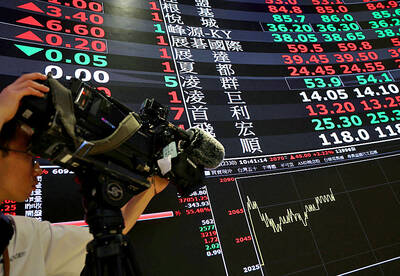
After several years flying high as Asia’s best Nvidia Corp proxy, Taiwan Semiconductor Manufacturing Co (TSMC, 台積電) is increasingly vying with other artificial intelligence (AI) stocks for investor attention. Stock traders are chasing a wider array of beneficiaries as mainstream usage of AI creates demand for hardware beyond the most-advanced chips TSMC makes for Nvidia. Subthemes from the deepening memory crunch to advances in robotics are also luring bids. At the same time, investment caps on single stocks are pushing funds to diversify, while retail investors long familiar with TSMC through its US depositary receipts are being offered a broader set of

Netherlands-based semiconductor equipment supplier ASML Holding NV yesterday said that it is planning to hire an additional 1,000 people in Taiwan this year in response to growing demand from clients. ASML had previously planned to recruit 600 people this year, but that the plan has been adjusted upward, ASML vice president and ASML Taiwan general manager Grace Wang (汪佳慧) told reporters. ASML has a workforce of more than 4,500 in Taiwan, accounting for about 10 percent of its global total, Wang said. This year’s recruitment campaign would focus on adding people in the customer support, manufacturing and supply chain domains to assist ASML

UNDER MICROSCOPE: Taiwan detained three people who allegedly conspired to buy servers in Taiwan and export them using fraudulent documentation, prosecutors said Nvidia Corp chief executive officer Jensen Huang (黃仁勳) on Saturday urged Super Micro Computer Inc to tighten up on compliance after Taiwan detained three people this week for allegedly making fraudulent declarations about artificial intelligence (AI) servers made by its US partner. The development marked the nation’s first crackdown on semiconductor smuggling, which grew after the US slapped restrictions on exports of high-end chips such as Nvidia AI accelerators to China. Nvidia is “rigorous” in explaining regulations to all of its partners, Huang told reporters after arriving in Taipei. “Ultimately Super Micro has to run their own company,” he said in response to
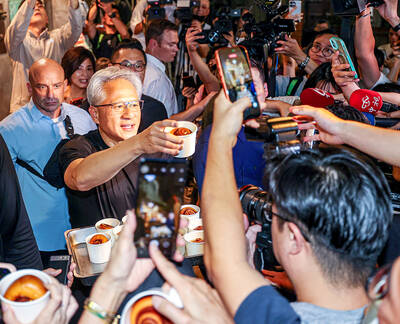
Nvidia Corp yesterday announced that CEO Jensen Huang (黃仁勳) would attend an employee meeting in Taipei tomorrow to celebrate the launch of the company’s Taiwan headquarters project. Huang would attend a gathering at the site of Nvidia’s planned headquarters in Beitou Shilin Technology Park (北投士林科技園區), the company said in a statement. After arriving in Taiwan on Saturday last week, Huang told reporters that he plans to meet with Quanta Computer Inc (廣達) chairman Barry Lam (林百里) and Taiwan Semiconductor Manufacturing Co (TSMC, 台積電) chairman C.C. Wei (魏哲家), and would attend the groundbreaking ceremony for Nvidia’s Taiwan headquarters tomorrow. Nvidia has not yet applied


 RSS
RSS