


Apple Inc and Samsung Electronic Co have ended a years-long patent battle over copied iPhone design with an undisclosed settlement, a US court filing on said on Wednesday.
The world’s two biggest smartphone makers reached a truce in their seven-year-old court battle one month after a federal court jury ordered Samsung to pay Apple about US$539 million for copying patented iPhone features.
That award was seen as a victory for Apple, which argued in court that design was essential to the iPhone.
Financial terms of the settlement were not revealed and neither company elaborated on the brief court order, which dismissed the litigation dating back to 2011.
“Whereas the court has been advised by the parties that the above-entitled action has been settled, all remaining claims and counterclaims in this case are hereby dismissed with prejudice,” US District Court Judge Lucy Koh wrote.
When contacted for comment, Apple referred to a statement released last month after the jury announced the damages award.
“This case has always been about more than money,” the statement read. “It is important that we continue to protect the hard work and innovation of so many people at Apple.”
South Korea-based Samsung declined to comment.
Apple’s lawsuit claimed that Samsung, now the world’s biggest handset maker, copied the design and other features of the iPhone as the smartphone market was exploding.
The three design patents in the case apply to the shape of the iPhone’s black screen with rounded edges and a bezel, and the rows of colorful icons displayed.
Two utility patents also involved apply to “bounce-back” and “tap-to-zoom” functions.
Separately, Apple is close to getting its first batch of organic light-emitting diode (OLED) screens from South Korea’s LG Display Co, people familiar with the matter said — a key step in the US company’s push to reduce the iPhone’s costs and its dependence on Samsung.
The initial volume is likely to be between 2 million and 4 million units — small relative to Apple’s sales, as LG continues to work on ramping up capacity, said one of the people, who asked not to be identified, as the matter is private.
However, that would help Apple gain leverage in price negotiations with Samsung, the sole supplier of OLED displays for the iPhone X and Apple’s primary rival in smartphones.
The expense of that component is a key reason that the iPhone X’s pricing in the US starts at US$1,000 and sales have not met initial expectations.
A successful supply deal would help Apple, as well as LG. The Cupertino, California-based company would be able to buy significant volumes from LG for next year’s iPhone model as it tries to fight off a slump in smartphone sales. LG needs a fresh source of revenue as it battles a slide in the price of liquid crystal displays.
“Securing a second supplier for OLED screens is crucial for Apple, as it will allow the company to reduce its reliance on Samsung, which is currently the sole supplier,” IHS Markit senior principal analyst Jerry Kang said.
“At the same time, it will help accelerate a broad adoption of OLED screens. More suppliers means more volume, and in turn, lower pricing,” he said.
Apple and LG Display declined to comment.
Additional reporting by Bloomberg
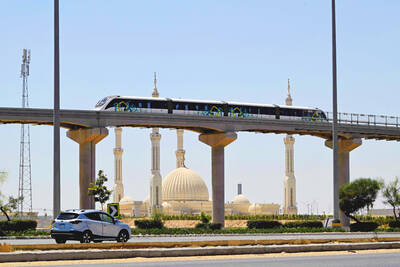
Cairo’s new monorail slices across the city skyline, running above the familiar chaos of blaring horns and aging buses’ exhaust fumes that mark rush hour below. The US$4.5 billion monorail, opened this month, is among Egypt’s most prominent new transport projects, part of a debt-funded infrastructure drive criticized for sapping state finances while bringing limited benefits to most of the country’s 109 million people. “It feels like you’re in a different country,” said Ramy Sayed, a restaurant manager, aboard a driverless Innovia 300 train. “No noise, no traffic, we’re not used to this.” The eastern line runs 56km from the bustling middle-class
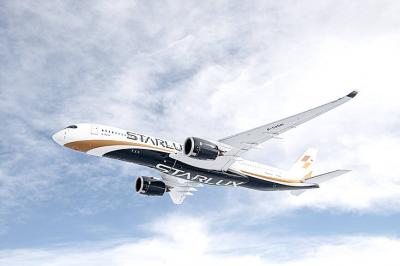
Starlux Airlines Co (星宇航空) today unveiled a long-haul network expansion plan at a shareholders’ meeting in Taipei, including direct flights to Barcelona, Spain, and Zurich, Switzerland, as well as a service connecting Taipei, Sydney and New Zealand. Starlux is to become the first Taiwanese carrier to offer non-stop services to the two European cities, while the inaugural oceanic route is expected to expand transit opportunities within the Australia-New Zealand market, Starlux said. Flight services to Chicago, Dallas, Washington and New York are under evaluation, the airline added. Prior to the shareholders’ meeting, the airline earlier this year announced that it would be
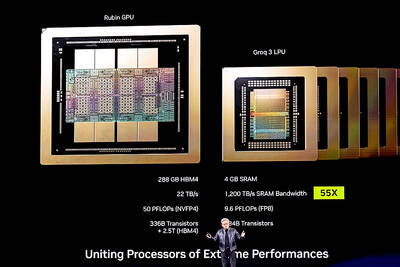
Taiwanese prosecutors suspect that three people successfully smuggled at least one shipment of Nvidia Corp artificial intelligence (AI) chips to China after first exporting them to Japan, people familiar with the matter said. The trio was detained last week by the Keelung District Prosecutors’ Office for allegedly falsifying documents related to exports of Super Micro Computer Inc servers containing advanced Nvidia chips, which the US has barred from sale to China without a license from Washington. The move marked Taiwan’s first public crackdown on AI chip diversion after years of pressure from the US to take a more active role in curtailing
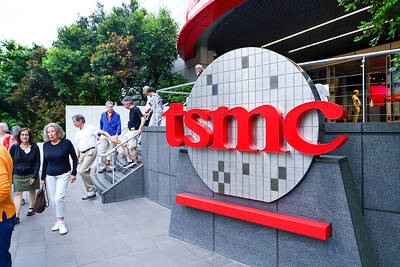
Taiwan Semiconductor Manufacturing Co (TSMC, 台積電) employee bonuses are likely to grow more than 30 percent this year, in line with the past few years as the company’s profits continue to set new records, an anonymous source cited TSMC chairman C.C. Wei (魏哲家) as saying yesterday. TSMC, the world’s largest contract chipmaker, is committed to taking care of its workers, the source said, citing Wei’s meeting with employees yesterday morning. Wei also expressed gratitude to employees for their contribution to the company’s improving bottom line, the source added. Since 2023, TSMC’s employee bonuses have grown at an annual rate of


 RSS
RSS