


TAXATION
Resistance to Australian cut
Australian Prime Minister Malcolm Turnbull faces a fresh blow in parliament this week, with the Senate yesterday poised to reject his government’s plans for a corporate tax cut after several independent lawmakers vowed to vote against the measure. The government has proposed to cut the corporate tax rate from 30 percent to 25 percent in a bid to boost the economy less than a year away from the next election. Although the government won backing for its centerpiece A$144 billion (US$106 billion) package of income tax cuts, lawmakers are resistant to extending tax breaks after a public inquiry exposed alleged misconduct in the financial sector.
GERMANY
Confidence ebbing
Business confidence ebbed this month to its lowest in more than a year, suggesting the mood among company executives in Europe’s biggest economy is darkening as the world edges toward a full-blown trade war. Activity in all four economic sectors measured by the Munich-based Ifo institute in the survey — manufacturing, services, trade and construction — fell, adding to signs the economy is cooling after a boom last year. Ifo said its business climate index fell to 101.8, the lowest level since May last year. The reading was slightly stronger than predicted in a Reuters consensus forecast of 101.7. “The tailwind enjoyed by the German economy is [easing],” Ifo head Clemens Fuest said. However, economists ruled out a recession and predicted the economy would continue to grow, albeit at a slower pace than last year’s 2.5 percent.
TRANSPORTATION
Uber in court in London
Uber yesterday went to court in the UK to overturn a decision stripping it of its license in London after being ruled unfit to run a taxi service in its most important European market. Regulator Transport for London (TfL) shocked the Silicon Valley firm in September last year by refusing to renew its license, citing failings in its approach to reporting serious criminal offences and to background checks on drivers. The appeal is due to be heard over three days and is to hear from witnesses including Uber’s UK chairman Laurel Powers-Freeling, UK head of cities Fred Jones and TfL’s Interim Director of Licensing Helen Chapman. The company is seeking an 18-month license to prove to London authorities that it has reformed.
TRANSPORTATION
Didi Chuxing in Melbourne
Chinese ride-sharing giant Didi Chuxing (滴滴出行) has intensified its drive for global business, yesterday launching in Melbourne as it joins rivals Uber, Taxify and Ola in Australia’s taxi market. Didi Chuxing’s latest expansion is part of attempts to rival US behemoth Uber. “Didi’s entry into Australia marks a new milestone in its outreach to global communities,” it said.
BANKING
Commonwealth streamlines
Commonwealth, Australia’s biggest bank, yesterday announced plans to spin off its wealth management and mortgage-broking arms as it tries to streamline operations and focus on core businesses. It is also considering offloading its general insurance business. The demerged business, CFS Group, is to include Commonwealth’s Colonial First State, Colonial First State Global Asset Management (CFSGAM), Count Financial, Financial Wisdom and Aussie Home Loans businesses. The new entity will list on the nation’s stock exchange next year.
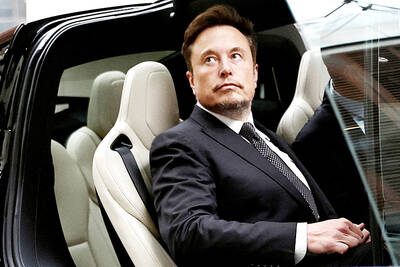
purpose: Tesla’s CEO sought to meet senior Chinese officials to discuss the rollout of its ‘full self-driving’ software in China and approval to transfer data they had collected Tesla Inc CEO Elon Musk arrived in Beijing yesterday on an unannounced visit, where he is expected to meet senior officials to discuss the rollout of "full self-driving" (FSD) software and permission to transfer data overseas, according to a person with knowledge of the matter. Chinese state media reported that he met Premier Li Qiang (李強) in Beijing, during which Li told Musk that Tesla's development in China could be regarded as a successful example of US-China economic and trade cooperation. Musk confirmed his meeting with the premier yesterday with a post on social media platform X. "Honored to meet with Premier Li
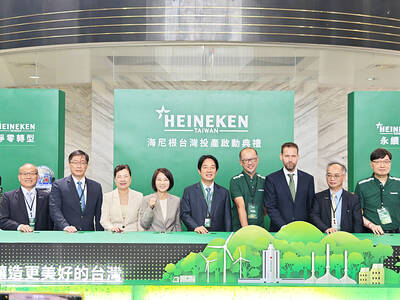
Dutch brewing company Heineken NV on Friday announced an investment of NT$13.5 billion (US$414.62 million) over the next five years in Taiwan. The first multinational brewing company to operate in Taiwan, Heineken made the statement at a ceremony held at its brewery in Pingtung County. It also outlined its efforts to make the brewery “net zero” by 2030. Heineken has been in the Taiwanese market for 20 years, Heineken Taiwan managing director Jeff Wu (吳建甫) said. With strong support from local consumers, the Dutch brewery decided to transition from sales to manufacturing in the country, Wu said. Heineken assumed majority ownership and management rights
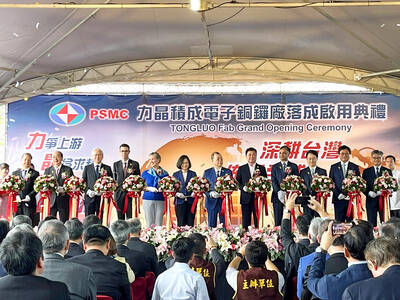
ARTIFICIAL INTELLIGENCE: The chipmaker last month raised its capital spending by 28 percent for this year to NT$32 billion from a previous estimate of NT$25 billion Contract chipmaker Powerchip Semiconductor Manufacturing Corp (力積電子) yesterday launched a new 12-inch fab, tapping into advanced chip-on-wafer-on-substrate (CoWoS) packaging technology to support rising demand for artificial intelligence (AI) devices. Powerchip is to offer interposers, one of three parts in CoWoS packaging technology, with shipments scheduled for the second half of this year, Powerchip chairman Frank Huang (黃崇仁) told reporters on the sidelines of a fab inauguration ceremony in the Tongluo Science Park (銅鑼科學園區) in Miaoli County yesterday. “We are working with customers to supply CoWoS-related business, utilizing part of this new fab’s capacity,” Huang said, adding that Powerchip intended to bridge

Microsoft Corp yesterday said that it would create Thailand’s first data center region to boost cloud and artificial intelligence (AI) infrastructure, promising AI training to more than 100,000 people to develop tech. Bangkok is a key economic player in Southeast Asia, but it has lagged behind Indonesia and Singapore when it comes to the tech industry. Thailand has an “incredible opportunity to build a digital-first, AI-powered future,” Microsoft chairman and chief executive officer Satya Nadella said at an event in Bangkok. Data center regions are physical locations that store computing infrastructure, allowing secure and reliable access to cloud platforms. The global embrace of AI


 RSS
RSS