


The latest round of strong earnings reports, including from Intel Corp and AbbVie Inc, along with continued weakness in the US dollar lifted each of the major Wall Street indices to closing records on Friday.
The three main indices notched their best four-week run since 2016.
Intel’s shares surged as high as US$50.15, their highest level since October 2000, and closed up 10.55 percent at US$50.08 after results indicated that the chipmaker’s shift to higher-margin data center business was working.
AbbVie’s shares jumped 13.77 percent after the drugmaker significantly boosted this year’s earnings forecast with help from US tax reform and said it hopes to accelerate dividend growth and share buybacks.
“We continue to see these positive steps in the right direction and definitely earnings are clearly justifying a lot of the recent move that we’ve had,” said Ryan Detrick, senior market strategist at LPL Financial in Charlotte, North Carolina.
Fourth-quarter earnings growth for the S&P 500 is estimated at 13.2 percent, according to Thomson Reuters data, up from 12 percent at the start of the year.
Of the 133 companies in the index that have reported through Friday, 79.7 percent have surpassed expectations.
The earnings enabled investors to shrug off a reading on economic growth that came in below expectations.
The US’ GDP increased at a 2.6 percent annual rate in the fourth quarter, the US Department of Commerce said in its advance GDP report, below the 3 percent forecast, as the strongest pace of consumer spending in three years resulted in a surge in imports.
“You have manufacturing and the consumer doing well at the same time and the globe is doing better, so that’s a path for future GDP gains, which has always provided a fertile backdrop for earnings gains,” said Brent Schutte, chief investment strategist at Northwestern Mutual Wealth Management in Milwaukee.
Weakness in the US dollar, which is supportive for large multinational companies, continued.
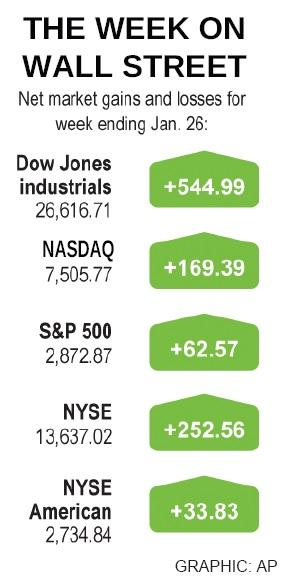
The Dow Jones Industrial Average on Friday rose 223.92 points, or 0.85 percent, to 26,616.71, the S&P 500 gained 33.62 points, or 1.18 percent, to 2,872.87 and the NASDAQ Composite added 94.61 points, or 1.28 percent, to 7,505.77.
For the week, the Dow rose 2.08 percent, the S&P 500 gained 2.22 percent and the NASDAQ advanced 2.31 percent.
Buoyed by AbbVie, the S&P healthcare index gained 2.17 percent, scored its best day since November 2016 and was the best performer among the 11 major S&P sectors.
Also lifting the index were gains in Pfizer Inc, up 4.78 percent after a European regulator recommended granting marketing approval to a diabetes drug developed by the company and Merck & Co, up 1.21 percent.
Starbucks Corp dropped 4.23 percent after it said global cafe sales growth this year would be at the low end of its forecast.
Advancing issues outnumbered declining ones on the New York Stock Exchange by a 1.2-to-1 ratio; on NASDAQ, a 1.54-to-1 ratio favored advancers.
The S&P 500 posted 125 new 52-week highs and two new lows; the NASDAQ Composite recorded 178 new highs and 22 new lows.
Volume on US exchanges was 6.58 billion shares, compared with the 6.81 billion average for the full session over the past 20 trading days.
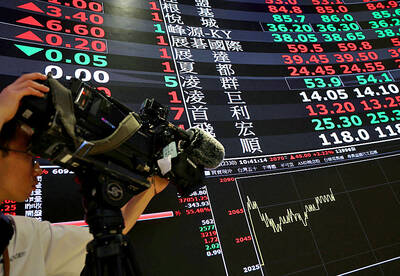
After several years flying high as Asia’s best Nvidia Corp proxy, Taiwan Semiconductor Manufacturing Co (TSMC, 台積電) is increasingly vying with other artificial intelligence (AI) stocks for investor attention. Stock traders are chasing a wider array of beneficiaries as mainstream usage of AI creates demand for hardware beyond the most-advanced chips TSMC makes for Nvidia. Subthemes from the deepening memory crunch to advances in robotics are also luring bids. At the same time, investment caps on single stocks are pushing funds to diversify, while retail investors long familiar with TSMC through its US depositary receipts are being offered a broader set of

Netherlands-based semiconductor equipment supplier ASML Holding NV yesterday said that it is planning to hire an additional 1,000 people in Taiwan this year in response to growing demand from clients. ASML had previously planned to recruit 600 people this year, but that the plan has been adjusted upward, ASML vice president and ASML Taiwan general manager Grace Wang (汪佳慧) told reporters. ASML has a workforce of more than 4,500 in Taiwan, accounting for about 10 percent of its global total, Wang said. This year’s recruitment campaign would focus on adding people in the customer support, manufacturing and supply chain domains to assist ASML

UNDER MICROSCOPE: Taiwan detained three people who allegedly conspired to buy servers in Taiwan and export them using fraudulent documentation, prosecutors said Nvidia Corp chief executive officer Jensen Huang (黃仁勳) on Saturday urged Super Micro Computer Inc to tighten up on compliance after Taiwan detained three people this week for allegedly making fraudulent declarations about artificial intelligence (AI) servers made by its US partner. The development marked the nation’s first crackdown on semiconductor smuggling, which grew after the US slapped restrictions on exports of high-end chips such as Nvidia AI accelerators to China. Nvidia is “rigorous” in explaining regulations to all of its partners, Huang told reporters after arriving in Taipei. “Ultimately Super Micro has to run their own company,” he said in response to

Nvidia Corp yesterday announced that CEO Jensen Huang (黃仁勳) would attend an employee meeting in Taipei tomorrow to celebrate the launch of the company’s Taiwan headquarters project. Huang would attend a gathering at the site of Nvidia’s planned headquarters in Beitou Shilin Technology Park (北投士林科技園區), the company said in a statement. After arriving in Taiwan on Saturday last week, Huang told reporters that he plans to meet with Quanta Computer Inc (廣達) chairman Barry Lam (林百里) and Taiwan Semiconductor Manufacturing Co (TSMC, 台積電) chairman C.C. Wei (魏哲家), and would attend the groundbreaking ceremony for Nvidia’s Taiwan headquarters tomorrow. Nvidia has not yet applied


 RSS
RSS