


A few years ago, Wang Yi (王翌) was living the American dream. He had graduated from Princeton, landed a job at Alphabet Inc’s Google and bought a spacious condo in Silicon Valley.
However, one day in 2011, he sat his wife down at the kitchen table and told her he wanted to move back to China. He was bored working as a product manager for the search giant and felt the pull of starting his own company in their homeland. Still, it was not easy persuading her to abandon balmy California for smog-choked Shanghai.
“We’d just discovered she was pregnant,” said Yi, now 37, recalling hours spent pacing their apartment. “It was a very uneasy few weeks before we made our decision, but in the end she came around.”
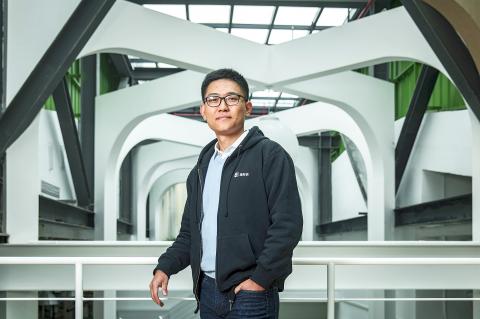
Photo: Bloomberg
His bet paid off: His popular English-teaching app Liulishuo (流利說), or LingoChamp, raised US$100 million in July last year, putting him in the growing ranks of successful Silicon Valley alumni lured back to China by the promise of a brighter future.
His decision is emblematic of an unprecedented trend with disquieting implications for Silicon Valley stalwarts from Facebook Inc to Google.
US-trained Chinese-born talent is becoming a key force in driving Chinese companies’ global expansion and the country’s efforts to dominate next-generation technologies such as artificial intelligence (AI) and machine learning.
Where college graduates once coveted a prestigious overseas job and foreign citizenship, many today gravitate toward career opportunities at home, where venture capital is plentiful and the government dangles financial incentives for cutting-edge research.
“More and more talent is moving over because China is really getting momentum in the innovation area,” said Ken Qi (祈瑞峰), a headhunter for Spencer Stuart and leader of its technology practice. “This is only the beginning.”
Chinese have worked or studied abroad and then returned home long enough that there is a term for them: “sea turtles.”
However, while a job at a US tech giant once conferred near-unparalleled status, homegrown companies — from giants like Tencent Holdings Ltd (騰訊) to up-and-comers like news giant Toutiao (今日頭條) — are now often just as prestigious.
Baidu Inc (百度) convinced ex-Microsoft Corp standout Qi Lu (陸奇) to helm its efforts in AI, making him one of the highest-profile returnees of recent years.
Alibaba Group Holding Ltd’s (阿里巴巴) coming-out party was a catalyst. The e-commerce giant pulled off the world’s largest initial public offering in 2014 — a record that stands — to drive home the scale and inventiveness of the country’s corporations.
Alibaba and Tencent count among the 10 most valuable companies in the world, in the ranks of Amazon.com Inc and Facebook.
Chinese venture capital rivals the US: Three of the world’s five most valuable start-ups are based in Beijing, not California.
Tech has supplanted finance as the biggest draw for overseas Chinese returnees, accounting for 15.5 percent of all who go home, according to a survey of 1,821 people conducted by think-tank Center for China & Globalization and jobs site Zhaopin.com (招聘) last year. That is up 10 percent from their previous poll in 2015.
Not all choose to abandon the Valley. Of the more than 850,000 AI engineers across the US, 7.9 percent are Chinese, according to a report last year from LinkedIn Corp.
That naturally includes plenty of ethnic Chinese without strong ties to China or any interest in working there.
However, there are more AI engineers of Chinese descent in the US than there are in China, even though they make up less than 1.6 percent of the US population.
Yet the search for returnees has spurred a thriving cottage industry. In WeChat (微信) and Facebook cliques, headhunters and engineers from the diaspora exchange banter and animated gifs.
Qi watches for certain markers: if you have scored permanent residency, are childless or the kids are prepping for college, expect a knock on your digital door.
Jay Wu has poached more than 100 engineers for Chinese companies over the past three years. The cofounder of Global Career Path Inc ran online communities for students before turning it into a career. The San Francisco resident now trawls more than a dozen WeChat groups for leads.
“WeChat is a good channel to keep tabs on what’s going on in the circle and also broadcast our offline events,” said the University of California, Berkeley, graduate who has hosted sessions for Alibaba and JD.com Inc (京東), as well as online travel service Ctrip.com International Ltd (攜程網).
Ditching Cupertino or Mountain View for Beijing can be a tough sell when China is undergoing its harshest Internet crackdown in history.
However, its tech giants hold three drawcards: faster growth in salaries, opportunity and a sense of home.
China’s Internet space is enjoying bubbly times, with compensation sometimes exceeding US peers’. One start-up was said to have hired an AI engineer for cash and shares worth as much as US$30 million over four years.
For engineers reluctant to relinquish US comforts, Chinese companies are going to them. Alibaba, Tencent, Didi Chuxing (滴滴出行) and Baidu are among those who have built or are expanding labs in Silicon Valley.
However, career opportunities are regarded as more abundant back home. While Chinese engineers are well-represented in the Valley, the perception is that comparatively fewer advance to the top rungs, a phenomenon labeled the “bamboo ceiling.”
“More and more Chinese engineers who have worked in Silicon Valley for an extended period of time end up finding it is much more lucrative for them career-wise to join a fast-rising Chinese company,” said Hans Tung, a managing partner at venture firm GGV Capital who has organized events to poach talent. “At Google, at LinkedIn, at Uber, at AirBnB, they all have Chinese engineers who are trying to figure out: ‘Should I stay, or should I go back?’”
More interesting than prospects for some might be the sheer volume of intimate data available and leeway to experiment in China.
Tencent’s now-ubiquitous WeChat, built by a small team in months, has become a poster-child for in-house creative license.
Modern computing is driven by crunching enormous amounts of data and generations of Chinese state surveillance has conditioned the public to be less concerned about sharing information than Westerners.
Local start-up SenseTime Group Ltd (商湯科技) has teamed with dozens of police departments to track everything from visages to races, helping the country develop one of the world’s most sophisticated and extensive surveillance machines.
China’s 751 million Internet users have thus become a massive petri dish. Big money and bigger data can be irresistible to those itching to turn theory into reality.
Xu Wanhong in 2010 left Carnegie Mellon University’s computer science doctorate program to work on Facebook’s news feed.
A chance meeting with a visiting team from Chinese start-up UCAR Technology Inc (神州優車) led to online friendships and in 2015, an offer to jump ship.
Today, he works at Kuaishou (快手), a video service said to be valued at more than US$3 billion, and commutes from 20km outside Beijing. It is a far cry from the breakfast bar and lush spaces of Facebook’s Menlo Park headquarters.
“I didn’t go to the US for a big house. I went for the interesting problems,” he said.
Then there are those for whom it is about human connection: No amount of tech can erase that Shanghai and San Francisco are separated by an 11-hour flight and an even wider cultural chasm.
Chongqing native Yang Shuishi grew up deifying the West, adopting the name Seth and landing a dream job as a software engineer on Microsoft’s Redmond campus.
However, suburban US did not suit a single man whose hometown has about 40 times Seattle’s population. While he climbed the ranks during subsequent stints at Google and Facebook, life in the US remained a lonely experience, and he landed back in China having soured on Western life.
“You’re just working as a cog in the huge machine and you never get to see the big picture. My friends back in China were thinking about the economy and vast social trends,” he said. “Even if I get killed by the air and live shorter for 10 years, it’ll still be better.”

US PROBE: The Information reported that the US Department of Commerce is investigating whether the firm made advanced chips for China’s Huawei Taiwan Semiconductor Manufacturing Co (TSMC, 台積電), the world’s largest contract maker of advanced chips, yesterday said it is a law-abiding company, and is committed to complying with all applicable laws and regulations including export controls. The Hsinchu-based chip giant issued the statement after US news Web site The Information ran a story saying that the US Department of Commerce has launched a probe into TSMC over whether it breached export rules by making smartphone or artificial intelligence (AI) chips for China’s Huawei Technologies Co (華為). “We maintain a robust and comprehensive export system for monitoring and ensuring compliance,” the statement said. “If we

DEMAND FOR AI CHIPS: Net income in the third quarter surged 31.2% quarter-on-quarter to NT$325.26 billion, the strongest quarterly return in the company’s history Taiwan Semiconductor Manufacturing Co (TSMC, 台積電), the world’s biggest contract chipmaker, yesterday raised its revenue forecast to annual growth of 30 percent this year, thanks to strong and sustainable demand for artificial intelligence (AI) processors for servers. It was the second upward adjustment from 25 percent year-on-year growth estimated three months ago, despite recent concerns about whether the AI boom could be another technology bubble. “The demand is real. It’s real. And I believe it is just the beginning of this demand. Alright, so one of my key customers said the demand right now is ‘insane,’” TSMC chairman and chief executive C.C.

Starbucks Corp might have the more recognizable name, but 7-Eleven’s City Cafe remains the king of Taiwan’s fresh coffee market, helped by the convenience store chain’s extensive market presence and product diversification. President Chain Store Corp (PCSC, 統一超商), which runs both the 7-Eleven and Starbucks store chains in Taiwan, established the City Cafe brand in 2004. The brand took off when actress Gwei Lun-mei (桂綸鎂) became its spokesperson in 2007. City Cafe’s sales exceeded NT$10 billion (US$311.69 million) for the first time in 2015, surpassing the revenue of Starbucks Taiwan, and rose to more than NT$17 billion last year, exceeding the NT$14.98

COUNTRY-BASED: Setting ceilings on sales of the technology would tighten limits that originally targeted China’s ambitions in artificial intelligence amid security risks US officials have discussed capping sales of advanced artificial intelligence (AI) chips from Nvidia Corp and other American companies on a country-specific basis, people familiar with the matter said, a move that would limit some nations’ AI capabilities. The new approach would set a ceiling on export licenses for some countries in the interest of national security, according to the people, who described the private discussions on condition of anonymity. Officials in the administration of US President Joe Biden focused on Persian Gulf countries that have a growing appetite for AI data centers and the deep pockets to fund them, the people


 RSS
RSS