


Working at Hazara, a restaurant in the Pakistani city of Quetta, is a potentially deadly political act: all of the greasy spoon’s employees are female members of a Shiite ethnic minority often targeted by extremists.
The outlet is named after the ethnic Hazara, who make up a large part of Pakistan’s Shiite minority, which accounts for about 20 percent of the country’s 207 million Sunni-majority population. The Hazara, whose Central Asian features make them easily recognizable, are a soft target for Sunni militants who consider them heretics.
The Shiite community’s presence is particularly strong in Quetta — the restive capital of impoverished Balochistan Province — that also serves as the headquarters of the Afghan Taliban, and where sectarian attacks are frequent.
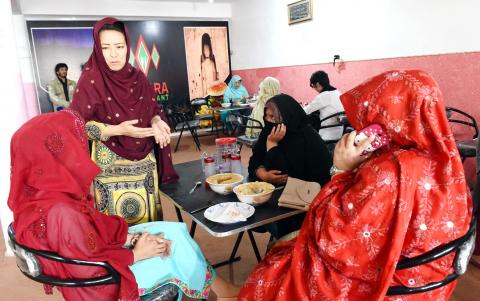
Photo: AFP
The eatery is located in Hazara Town, one of two neighborhoods in Quetta where the community is guarded by armed checkpoints. The protection is necessary: Hazaras — who make up about 500,000 of the city’s 2.3 million inhabitants — are living practically under siege.
In October, three Hazara vegetable vendors who ventured outside their enclave were shot in the head at point-blank range, just the latest in a series of attacks targeting the group.
They still live with the violent memory of two attacks in January and February 2013 that killed nearly 200 of their members.
Following the second, which hit a local market in Hazara Town, residents protested by refusing for several days to bury their dead — an emotional gesture in the Muslim world where the deceased must be buried on the same day or the next.
The events had a powerful effect on Hameeda Ali Hazara, a member of the local community, whose house adjoins the site of the first attack.
“I told myself that I had to help the victims,” Hameeda told Agence France-Presse.
She set up the restaurant Hazara, which opened two months ago, hoping to provide a way to help families and female victims of sectarian attacks.
She has three employees who are all victims of violence, including one who lost her husband during a bomb attack, Hameeda said.
Hazara Democratic Party Chairman Abdul Khaliq Hazara said between 1,500 and 2,000 members of the community have been murdered in Balochistan.
An additional 75,000 to 100,000 have fled violence elsewhere in the country or abroad, with some “drowning at sea” before reaching their destination, he said.
To the difficulty of being Hazara is added that of being a woman in very conservative community. In Pakistan, women account for just 25 percent of the workforce, International Labour Organisation data showed.
Women’s employment drops to 2 percent in the service sector in Balochistan, a place that operates largely according to patriarchal tribal customs.
The meager incomes available to women generally come from homemade embroidery or small-scale trading at markets.
“Opportunities to start a business or join a company are rare” for them, Hameeda said.
Her restaurant initiative also aims to push the staff to “seize work opportunities instead of staying home with a needle and thread,” she said.
A chance that Masooma — a cook and waitress at the eatery, as well as a student — grasps.
“I work here to earn money for my family, but also to pay my schooling,” she said.
“My family supports me in my decision to be employed here,” she added.
To prevent inappropriate behavior from customers unused to seeing women at work, Hameeda posted signs urging consumers to be “pleasant to waitresses and talk to them with due regard for moral values.”
Cameras have also been installed as a security measure and in a bid to prevent harassment.
“The atmosphere here is very quiet, anyone can come with their family,” said patron Pervaiz Ahmad, a local banker. “It’s a good idea to support women in business,” he added, detailing the menu: chicken and rice; hamburger and fries; salad; and sodas.
However, not everyone is of the same opinion.
Hameeda said she has been harassed and threatened by those who brand her initiative a “disgrace” and a breach of “honor.”
“I am continuously receiving threats on social media ... and phone calls asking me to shut this restaurant, because it is den of obscenity,” she said, adding that she has called on authorities to guarantee her security.
“Such things cannot discourage me,” she said. “I am the real face of my Hazara community and Balochistan.”


Taiwanese firms have increased investment in the Philippines in recent years as Manila’s ties with Washington deepen and global supply chains continue to shift away from China, an expert at the Chung-Hua Institution for Economic Research (CIER, 中華經濟研究院) said yesterday. The Philippines had not been among Taiwanese investors’ top choices in Southeast Asia, CIER Taiwan ASEAN Studies Center director Kristy Hsu (徐遵慈) said at a seminar in Taipei. However, Taiwan’s investment in the country has grown significantly since the COVID-19 pandemic, reaching US $257 million last year, a high in recent years, she said. Although Taiwan’s total investment in the Philippines still lags

Intel Corp regards Taiwan Semiconductor Manufacturing Co (TSMC, 台積電) as a longstanding partner, as the US chipmaker would continue outsourcing production of advanced chips to TSMC, Intel chief executive officer Lip-Bu Tan (陳立武) said yesterday. “I don’t look at people as competitors. I look at the collaboration... Nvidia is also, you know, a good friend,” Tan told a news conference following his keynote speech at the Computex trade show in Taipei. “It’s a very trusted partnership for us... We are a big, top customer for them, and we’re going to continue doing that,” he said, referring to TSMC, the world’s largest foundry

Hon Hai Precision Industry Co (鴻海精密) yesterday said it would work with US chipmaker Intel Corp to jointly develop and deploy next-generation artificial intelligence (AI) infrastructure and intelligent computing platforms in a move to capture booming demand for AI computing systems. Hon Hai, also known as Foxconn Technology Group (富士康), said in a statement that the partnership would combine its global manufacturing scale, system integration expertise and AI data center deployment capabilities with Intel’s strengths in processor architecture, silicon technologies and software ecosystem. The companies said they plan to work on equipment used in AI data centers, including server racks powered by

Artificial intelligence (AI) agents would supplant smartphones as the center of people’s digital lives, fundamentally reshaping personal devices and driving a major computing upgrade cycle, Qualcomm Inc CEO Cristiano Amon said yesterday. In his keynote speech for this year’s Computex trade show in Taipei, Amon said that the rise of "agentic AI" — AI systems capable of reasoning, planning and carrying out tasks autonomously — would transform how people interact with technology across phones, PCs, vehicles and wearable devices. Describing the technology as the next major evolution in computing, Amon said that "2026 is the year of agents.” For decades, smartphones have sat


 RSS
RSS