


Salaried workers in Taiwan are planning to embrace today’s “11.11 Global Shopping Festival,” saying their purchases during the 24-hour period in previous years surpassed their monthly average online spending, a survey released by online 1111 Job bank (1111人力銀行) showed yesterday.
According to the survey, conducted from Oct. 25 to Thursday, the average online spending by salaried workers in Taiwan on Singles’ Day in previous years was NT$4,283, beating the average monthly spending of NT$3,188 on online purchases.
The online shopping event originated in China in 2009, with Chinese e-commerce giant Alibaba Group Holding Ltd (阿里巴巴), when more consumers started shopping online with smartphones.

Photo: AFP
The event is now global and many other e-commerce operators including PChome Online Inc (網路家庭), Momo.com Inc (富邦媒體) and Yahoo Kimo Inc (雅虎奇摩) in Taiwan also offer discounts to attract consumers.
Local e-commerce operators even extend the event beyond 24 hours.
As part of the survey, 82 percent of respondents said they would buy something in the sale, which was scheduled to start at midnight.
About 60 percent of those who plan to take part said they researched product prices before the shopping spree, while 21 percent said they regularly make purchases during the annual shopping event.
The survey showed that salaried workers in Taiwan have a wide range of products on their shopping lists, in particular computers and computer products, electronics and communication products, as well as clothing, shoes, bags, cosmetics and home appliances.
The survey showed that on average, salaried workers spend about one hour a day shopping online.
The survey indicated that local salaried workers are attracted by certain promotional tactics by online vendors, such as free delivery, “buy one, get one free,” and coupons when purchases reach a certain amount.
The job bank said 90 percent of respondents believe prices are cheaper online than in physical stores, saying that the difference in price is as high as 9 percent on average.

Netherlands-based semiconductor equipment supplier ASML Holding NV yesterday said that it is planning to hire an additional 1,000 people in Taiwan this year in response to growing demand from clients. ASML had previously planned to recruit 600 people this year, but that the plan has been adjusted upward, ASML vice president and ASML Taiwan general manager Grace Wang (汪佳慧) told reporters. ASML has a workforce of more than 4,500 in Taiwan, accounting for about 10 percent of its global total, Wang said. This year’s recruitment campaign would focus on adding people in the customer support, manufacturing and supply chain domains to assist ASML
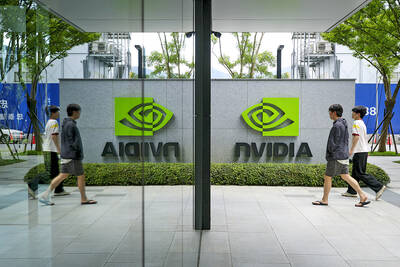
UNDER MICROSCOPE: Taiwan detained three people who allegedly conspired to buy servers in Taiwan and export them using fraudulent documentation, prosecutors said Nvidia Corp chief executive officer Jensen Huang (黃仁勳) on Saturday urged Super Micro Computer Inc to tighten up on compliance after Taiwan detained three people this week for allegedly making fraudulent declarations about artificial intelligence (AI) servers made by its US partner. The development marked the nation’s first crackdown on semiconductor smuggling, which grew after the US slapped restrictions on exports of high-end chips such as Nvidia AI accelerators to China. Nvidia is “rigorous” in explaining regulations to all of its partners, Huang told reporters after arriving in Taipei. “Ultimately Super Micro has to run their own company,” he said in response to

Nvidia Corp yesterday announced that CEO Jensen Huang (黃仁勳) would attend an employee meeting in Taipei tomorrow to celebrate the launch of the company’s Taiwan headquarters project. Huang would attend a gathering at the site of Nvidia’s planned headquarters in Beitou Shilin Technology Park (北投士林科技園區), the company said in a statement. After arriving in Taiwan on Saturday last week, Huang told reporters that he plans to meet with Quanta Computer Inc (廣達) chairman Barry Lam (林百里) and Taiwan Semiconductor Manufacturing Co (TSMC, 台積電) chairman C.C. Wei (魏哲家), and would attend the groundbreaking ceremony for Nvidia’s Taiwan headquarters tomorrow. Nvidia has not yet applied

Huawei Technologies Co (華為) said it has come up with a new pathway to shorten its gap with industry leader Taiwan Semiconductor Manufacturing Co (TSMC, 台積電), potentially achieving a breakthrough in making advanced semiconductors without cutting-edge equipment. Right now there is about a five-year gap between what TSMC is capable of and what Huawei, together with its manufacturing partner Semiconductor Manufacturing International Corp (中芯), can produce. Huawei is to start making 1.4-nanometer chips by 2031 with its own “LogicFolding” technology, Huawei semiconductor chief He Tingbo (何庭波) said in a rare public appearance during a chip conference yesterday, while TSMC has


 RSS
RSS