


The founder of a Chinese online peer-to-peer lender has been sentenced to life in prison on charges of defrauding investors of US$7.7 billion in one of China’s biggest financial scams.
Ezubo (e-租寶) was the biggest competitor in an informal finance industry that Chinese authorities allowed to flourish with little oversight over the past decade to support entrepreneurs who cannot get loans from state banks.
A series of lenders have collapsed as economic growth has slowed, leaving authorities struggling to defuse protests by depositors.

Photo: AP
Ezubo founder Ding Ning (丁寧) and his younger brother, Ding Dian (丁甸), on Tuesday were sentenced to life by the Beijing No. 1 Intermediate People’s Court for “fundraising fraud,” Xinhua news agency said.
Another 24 executives were sentenced to prison terms ranging from three to 15 years, it added.
Two companies affiliated with Ezubo were fined a total of 1.9 billion yuan (US$290 million), Xinhua said, adding that some defendants were also convicted of other offenses, including smuggling precious metals and illegal gun possession.
Regulators seized Ezubo in December 2015 on charges of taking deposits without a license. Xinhua said authorities have confiscated the company’s assets to repay depositors, but gave no indication of how much money was recovered.
Ding, 34, was a high-school dropout who worked at his mother’s hardware factory, where he gained experience running online sales, according to media reports.
With no technical or financial training, Ding launched Ezubo in July 2014 and opened marketing offices across China.
The company attracted deposits by promising returns of 9 to 14.6 percent, investigators said.
However, authorities say a former executive said that 95 percent of those borrowers were fictional entities created by Ezubo.
In a confession broadcast by state television in February last year, the executive called the company “a fraud... A typical Ponzi scheme.”
The court said that Ding and other defendants “inflicted huge losses on investors in many parts of China and disrupted the national financial management system,” Xinhua said.
Earlier, two businesswomen in southern China were sentenced to death in 2012 and 2013 in separate cases on charges of “illegal fundraising.” The penalty for the first was converted to a prison term following an outcry online that it was too severe.

Cairo’s new monorail slices across the city skyline, running above the familiar chaos of blaring horns and aging buses’ exhaust fumes that mark rush hour below. The US$4.5 billion monorail, opened this month, is among Egypt’s most prominent new transport projects, part of a debt-funded infrastructure drive criticized for sapping state finances while bringing limited benefits to most of the country’s 109 million people. “It feels like you’re in a different country,” said Ramy Sayed, a restaurant manager, aboard a driverless Innovia 300 train. “No noise, no traffic, we’re not used to this.” The eastern line runs 56km from the bustling middle-class
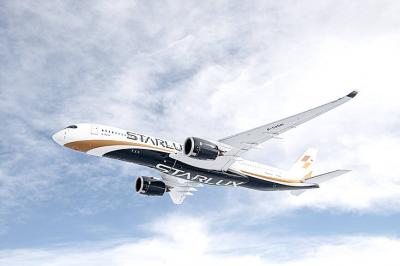
Starlux Airlines Co (星宇航空) today unveiled a long-haul network expansion plan at a shareholders’ meeting in Taipei, including direct flights to Barcelona, Spain, and Zurich, Switzerland, as well as a service connecting Taipei, Sydney and New Zealand. Starlux is to become the first Taiwanese carrier to offer non-stop services to the two European cities, while the inaugural oceanic route is expected to expand transit opportunities within the Australia-New Zealand market, Starlux said. Flight services to Chicago, Dallas, Washington and New York are under evaluation, the airline added. Prior to the shareholders’ meeting, the airline earlier this year announced that it would be

Taiwanese prosecutors suspect that three people successfully smuggled at least one shipment of Nvidia Corp artificial intelligence (AI) chips to China after first exporting them to Japan, people familiar with the matter said. The trio was detained last week by the Keelung District Prosecutors’ Office for allegedly falsifying documents related to exports of Super Micro Computer Inc servers containing advanced Nvidia chips, which the US has barred from sale to China without a license from Washington. The move marked Taiwan’s first public crackdown on AI chip diversion after years of pressure from the US to take a more active role in curtailing
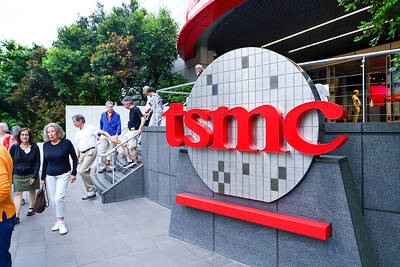
Taiwan Semiconductor Manufacturing Co (TSMC, 台積電) employee bonuses are likely to grow more than 30 percent this year, in line with the past few years as the company’s profits continue to set new records, an anonymous source cited TSMC chairman C.C. Wei (魏哲家) as saying yesterday. TSMC, the world’s largest contract chipmaker, is committed to taking care of its workers, the source said, citing Wei’s meeting with employees yesterday morning. Wei also expressed gratitude to employees for their contribution to the company’s improving bottom line, the source added. Since 2023, TSMC’s employee bonuses have grown at an annual rate of


 RSS
RSS