


When seven-year-old Fatmagul Ali picked her first tobacco leaves in 1967, growing the crop seemed like a license to print money. At the time, communist Bulgaria was one of the world’s largest cigarette exporters and a key supplier to the entire Soviet bloc.
Five decades later, Fatmagul and her husband, Fahim, are still hard at work in their small field in the southern Rhodope Mountains, close to the Greek border.
The couple are already bent low over the plants well before dawn, their hands tarred from plucking the sticky leaves in the glow of their headlamps.
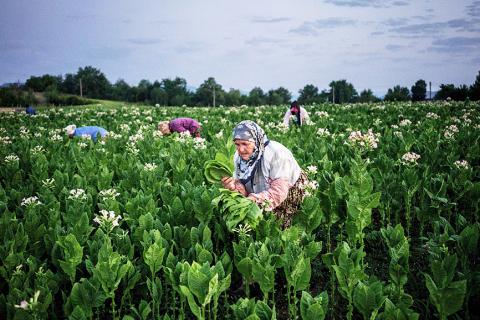
Photo: AFP
Row after row, they will spend hours repeating the same gesture before returning to their nearby village of Karchovkso, in the Muslim-majority Kirkovo region, to hang the leaves to dry.
Yet, these efforts will barely yield enough for survival.
“When you take into account the expenses, we’ll make only a couple of euros today,” 57-year-old Fahim said.
The fall of communism led to the disbanding of cooperative farms and a decline in tobacco production, slowly smoking out what was once Bulgaria’s most valuable asset.
With a kilogram of dried tobacco leaves costing about 2.50 euros (US$2.94), the couple will make only about 2,300 euros gross this year. They have taken up second jobs to make ends meet.
“We’re thinking about abandoning tobacco, there’s no point to it anymore,” Fahim said.
Although the Kirkovo region still boasts the EU’s largest number of tobacco growers per capita, the output is a far cry from the days when Bulgaria’s so-called “golden leaf” was an international mark of quality.
Tobacco was first introduced in Bulgaria under Ottoman rule, with production surging by the 19th century.
“It was a real currency, allowing Bulgaria to take out international bank loans,” Sofia-based economist Nikolay Valkanov told reporters.
Of the four grown varieties, the oriental type was by far the most valued thanks to its highly aromatic flavor.
Demand exploded during and after both world wars as an increasing number of soldiers and female factory workers took up smoking. Under Soviet rule, Bulgaria became Europe’s leading tobacco producer and, at its peak, exported about 100,000 tonnes annually in the 1970s and 1980s.
Today this has shriveled to 16,250 tonnes, official data showed.
While Bulgaria is still in the EU’s top five growers, it cannot compete with No. 1 producer Italy, which churns out close to 55,000 tonnes of dried tobacco leaves per year.
“The drop has been drastic,” said Tsvetan Filev, chairman of Bulgaria’s National Tobacco Growers’ Association.
“We haven’t been able to rebuild a competitive system after the dismantling of the planned economy,” he told reporters.
With the collapse of communism, large-scale irrigation systems stopped working, while the number of skilled workers dropped in rural areas as people migrated to cities and abroad.
The restitution of expropriated lands saw huge tobacco fields broken up into numerous small parcels and handed back to the original owners.
EU data from 2014 showed that Italy only had one-10th of Bulgaria’s 23,700 tobacco growers, but produced five times as much.
“The way that the Bulgarian sector is organized now — with numerous tiny farms, low yields, insufficient know-how, low education — leaves it without a future,” Valkanov said.
There is added pressure from neighboring Turkey, Greece and Macedonia, which have boosted their production and are threatening to push Bulgaria out of the market.
Many Bulgarians now head across the border to pick leaves in Greece to earn a decent wage.
“Once upon a time there were tobacco fields everywhere, and look at what’s left now,” said Hasansabri Mehmed, a regional chief of the association, pointing to the vast bushy plains around him.
There is also a political dimension to the issue.
The Movement for Rights and Freedoms (MRF) party that controls Kirkovo and its Muslim population has resisted government plans to convince people to turn to other crops.
“Growers are politically highly dependent on the MRF. Anything tobacco-related has to go through them,” Valkanov said.
Either way, observers have said the shallow and infertile fields of the Rhodope Mountains are suited to little else other than tobacco, leaving growers hinged on a dying trade.

Taiwanese firms have increased investment in the Philippines in recent years as Manila’s ties with Washington deepen and global supply chains continue to shift away from China, an expert at the Chung-Hua Institution for Economic Research (CIER, 中華經濟研究院) said yesterday. The Philippines had not been among Taiwanese investors’ top choices in Southeast Asia, CIER Taiwan ASEAN Studies Center director Kristy Hsu (徐遵慈) said at a seminar in Taipei. However, Taiwan’s investment in the country has grown significantly since the COVID-19 pandemic, reaching US $257 million last year, a high in recent years, she said. Although Taiwan’s total investment in the Philippines still lags

Intel Corp regards Taiwan Semiconductor Manufacturing Co (TSMC, 台積電) as a longstanding partner, as the US chipmaker would continue outsourcing production of advanced chips to TSMC, Intel chief executive officer Lip-Bu Tan (陳立武) said yesterday. “I don’t look at people as competitors. I look at the collaboration... Nvidia is also, you know, a good friend,” Tan told a news conference following his keynote speech at the Computex trade show in Taipei. “It’s a very trusted partnership for us... We are a big, top customer for them, and we’re going to continue doing that,” he said, referring to TSMC, the world’s largest foundry

Hon Hai Precision Industry Co (鴻海精密) yesterday said it would work with US chipmaker Intel Corp to jointly develop and deploy next-generation artificial intelligence (AI) infrastructure and intelligent computing platforms in a move to capture booming demand for AI computing systems. Hon Hai, also known as Foxconn Technology Group (富士康), said in a statement that the partnership would combine its global manufacturing scale, system integration expertise and AI data center deployment capabilities with Intel’s strengths in processor architecture, silicon technologies and software ecosystem. The companies said they plan to work on equipment used in AI data centers, including server racks powered by

Artificial intelligence (AI) agents would supplant smartphones as the center of people’s digital lives, fundamentally reshaping personal devices and driving a major computing upgrade cycle, Qualcomm Inc CEO Cristiano Amon said yesterday. In his keynote speech for this year’s Computex trade show in Taipei, Amon said that the rise of "agentic AI" — AI systems capable of reasoning, planning and carrying out tasks autonomously — would transform how people interact with technology across phones, PCs, vehicles and wearable devices. Describing the technology as the next major evolution in computing, Amon said that "2026 is the year of agents.” For decades, smartphones have sat


 RSS
RSS