


Designer Hed Mayner is not afraid to play with the totems of Israeli life, from a trench coat made from a military tent to a sleeveless beach top cut from a Jewish prayer shawl.
The 30-year-old from a hippyish village in northern Israel’s Galilee joyously mixed djellabas, jogging pants, jeans and PVC jackets in his debut Paris men’s fashion show this weekend. He started designing at 16, inspired by the collection of kimonos a neighbor in his forest community near the Lebanese border had brought home from her time in Japan.
“When you’re isolated from urban life, you have this fantasy of it that never really fits with reality and you can kind of develop this universe,” he told reporters of his eclectic influences.

Photo: AFP
His village of 40 families near Amuka is a pilgrimage site for Orthodox and Hasidic Jews who flock to the tomb of a famous rabbi to pray for a good marriage. This helped kindle his fascination with Orthodox Jewish clothing, although he was never religious himself.
“They wear tailored pieces but not in a sharp suited way,” said Mayner, whose parents are artists.
“You have the big shoulders, the jacket and the sleeves that are too long... I really like this idea of disproportion, but it’s still tailored and very structured,” he said. “They have these shops which sell one jacket in a million sizes.”
Orthodox Jews like their clothes to “really wrap the body” and hand them down from “from one kid to another,” he added.
Mayner said he drew much of his inspiration from the military and religious uniforms of the Jewish state’s diverse, though not always harmonious, communities.
“Israelis don’t see fashion in the same way Europeans see it. It is not something that is very important in everyday life. In Israel people are in uniforms,” and nowhere is this more true than in the contested holy city of Jerusalem, he said.
“I love Jerusalem, but it’s a very difficult place to live because it’s super intense,” he said. “You have craziness there all the time, you know the ‘Jerusalem syndrome,’ you really feel it. Society there is very uniformed, everybody is in uniform and it’s kind of multicultural to the extreme.”
“Israel is very split. You have the most secular people and very religious people,” he added
Mayner preferred to set up his studio in the more liberal beach-side city of Tel Aviv, with its creative and international outlook.
As well as French-style influences, “Tel Aviv is also linked to Berlin culture,” he said. “The city is half very old, half very new buildings and everything is under construction.”
“There is so much around and the idea of creating something is very strong,” he said, not only in fashion, but “from start-up people to industrial designers.”
Mayner’s clothes, however, are not are yet sold in his homeland, instead going to shops in Europe and the US — and being a fan of the Japanese designer Yohji Yamamoto, he is chuffed about how well they sell in Japan.
“I think the Japanese understand my clothes better than I do myself,” he said.

SECOND-RATE: Models distilled from US products do not perform the same as the original and undo measures that ensure the systems are neutral, the US’ cable said The US Department of State has ordered a global push to bring attention to what it said are widespread efforts by Chinese companies, including artificial intelligence (AI) start-up DeepSeek (深度求索), to steal intellectual property from US AI labs, according to a diplomatic cable. The cable, dated Friday and sent to diplomatic and consular posts around the world, instructs diplomatic staff to speak to their foreign counterparts about “concerns over adversaries’ extraction and distillation of US AI models.” Distillation is the process of training smaller AI models using output from larger, more expensive ones to lower the costs of training a powerful new
Shares of Taiwan Semiconductor Manufacturing Co (TSMC, 台積電) have repeatedly hit new highs, but an equity analyst said the stock’s valuation remains within a reasonable range and any pullback would likely be technical. The contract chipmaker’s historical price-to-earnings (P/E) ratio has ranged between 20 and 30, Cathay Futures Consultant Co (國泰證期) analyst Tsai Ming-han (蔡明翰) told Central News Agency. With market consensus projecting that TSMC would post earnings per share of about NT$100 (US$3.17) this year, supported by strong global demand for artificial intelligence (AI) applications, and the stock currently trading at a P/E ratio of below 25, Tsai said the valuation
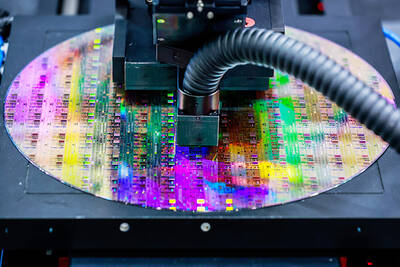
The artificial intelligence (AI) boom has triggered a seismic reshuffling of global equity markets, with Taiwan and South Korea muscling past European nations one by one. With its stock market now valued at nearly US$4.3 trillion, Taiwan surpassed the UK, Europe’s biggest market, earlier this month, data compiled by Bloomberg showed. South Korea is about US$140 billion away from doing the same. The tech-heavy Asian markets have shot past Germany and France in the past seven months. The shift is largely down to massive gains in shares of three companies that provide essential hardware for AI: Taiwan Semiconductor Manufacturing Co (TSMC, 台積電),

The US Department of Commerce last week ordered multiple chip equipment companies to halt shipments of certain tools to China’s second-largest chipmaker, Hua Hong Semiconductor Ltd (華虹半導體), its latest action to slow the country’s development of advanced chips, two people familiar with the matter said. The department sent letters to at least a handful of companies informing them of restrictions on tools and other materials destined for two Hua Hong facilities US officials believe make China’s most sophisticated chips, the people said. Top US chip equipment companies Lam Research Corp, Applied Materials Inc and KLA Corp, each of which has significant


 RSS
RSS