


ECONOMY
Money supply increases
The nation’s money supply increased last month, but the narrow gauge M1B — cash and cash equivalents — slowed to its lowest level in four years at 4.57 percent as people cut cash positions in favor of time deposits and insurance policies, the central bank said yesterday. The bank shrugged off concerns of a downturn in equity investment interest, saying the local bourse has benefited from continued foreign fund inflows. Foreign fund inflows totaled US$9.28 billion last quarter, higher than the US$6.55 billion recorded a year earlier, the bank said. The broad money gauge M2 — which includes foreign currency deposits, time deposits and M1B — advanced at 3.64 percent, slower than M1B, lending support to liquidity mobility, the bank said.
CEMENT MAKERS
Chia Hsin to sell TCCI stake
Chia Hsin Cement Corp (嘉泥) yesterday said its board has approved a plan to sell its stake in TCC International Holdings Ltd (TCCI, 台泥國際集團), a joint venture between the company and Taiwan Cement Corp (台灣水泥), to support TCCI’s privatization. The plan came as Taiwan Cement announced its proposal to privatize TCCI and delist its shares from the Hong Kong Stock Exchange. Taiwan Cement is the largest stakeholder in TCCI, owning a 63.05 percent stake, while Chia Hsin has a 9.7 percent stake, company data showed. Chia Hsin shareholders are to receive 0.42 Taiwan Cement shares for each TCCI common share, according to a company filing with the Taiwan Stock Exchange.
E-COMMERCE
Amazon opens Taiwan office
Amazon.com Inc yesterday launched its Taiwan office to help local companies explore opportunities in the global business-to-business market. The office is tasked with connecting Taiwanese businesses to Amazon’s 300 million active customers and 40,000 institutional clients worldwide, Amazon Global Selling Asia head Cindy Tai (戴竫斐) said yesterday. The US giant’s electronic commerce and logistics services are well suited to helping Taiwan’s export-oriented companies tap into the global market without setting up costly distribution deals, Tai said.
CHIPMAKERS
Novatek cuts its dividend
Novatek Microelectronics Corp (聯詠), which supplies chips that control flat-panel displays, yesterday announced a plan to distribute a cash dividend of NT$7 per share, lower than the NT$9 per share the company paid last year. That translates into a dividend yield of 6.31 percent when compared with the stock’s closing price of NT$111 yesterday. Last year, Novatek made NT$5 billion (US$165.2 million) in net profit, or earnings per share of NT$8.22, down from NT$6.4 billion, or earnings per share of NT$10.52, the previous year.
AIRLINES
TransAsia agrees sale
TransAsia Airways Corp (復興航空), which ended operations on Nov. 22 last year because of insurmountable financial woes, has reached an agreement for a buyer to conditionally acquire 11 of its aircraft for US$364 million, the airline said. However, the highest bidder for the 11-plane package consented to TransAsia selling any of the 11 airplanes to the second-highest bidder because the deal could take a long time to complete, the airline said in a statement released on Sunday. Based on that condition, TransAsia has decided to sell four A330s and A321s to the second-highest bidder, with whom it would sign a contract today, the statement said.
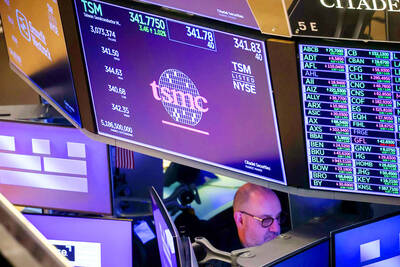
STRONG INTEREST: Analysts have pointed to optimism in TSMC’s growth prospects in the artificial intelligence era as the cause of the rising number of shareholders The number of people holding shares of chipmaker Taiwan Semiconductor Manufacturing Co (TSMC, 台積電) hit a new high last week despite a decline in its stock price, the Taiwan Depository and Clearing Corp (TDCC, 台灣集保) said. The number of TSMC shareholders rose to 2.46 million as of Friday, up 75,536 from a week earlier, TDCC data showed. The stock price fell 1.34 percent during the same week to close at NT$1,840 (US$57.55). The decline in TSMC’s share price resulted from volatility in global tech stocks, driven by rising international crude oil prices as the war against Iran continues. Dealers said
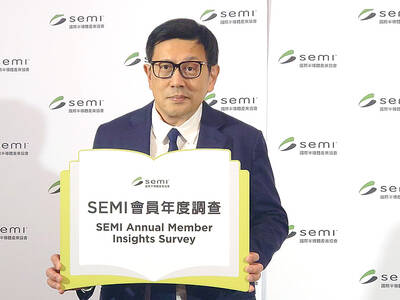
PRICE HIKES: The war in the Middle East would not significantly disrupt supply in the short term, but semiconductor companies are facing price surges for materials Taiwan’s semiconductor companies are not facing imminent supply disruptions of essential chemicals or raw materials due to the war in the Middle East, but surges in material costs loom large, industry association SEMI Taiwan said yesterday. The association’s comments came amid growing concerns that supplies of helium and other key raw materials used in semiconductor production could become a choke point after Qatar shut down its liquefied natural gas (LNG) production and helium output earlier this month due to the conflict. Qatar is the second-largest LNG supplier in the world and accounts for about 33 percent of global helium output. Helium is
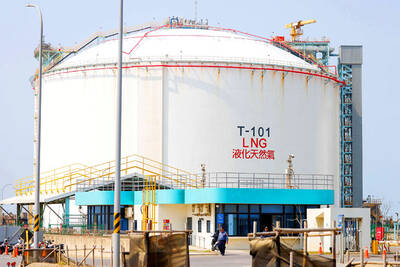
Taiwan’s natural gas supply remains stable through the end of May, despite rising concerns about potential disruptions to Qatari liquefied natural gas (LNG) supplies due to escalating conflicts in the Middle East, the Ministry of Economic Affairs said yesterday. The ministry in a statement said that Taiwan has completed preparations for natural gas supply and shipping schedules through the end of May. It has also made plans to increase natural gas imports from regions outside the Middle East in June to ensure a stable supply, it added. Taiwan sources natural gas from 14 countries and is not solely dependent on the Middle East,
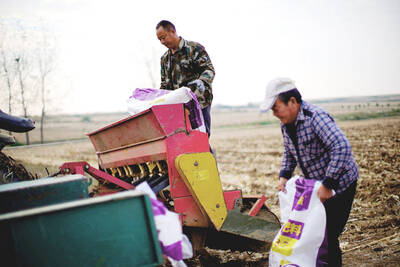
China is clamping down on fertilizer exports to protect its domestic market, industry sources said, putting an additional strain on global markets that were already grappling with shortages caused by the US-Israeli war on Iran. China is among the largest fertilizer exporters — shipping more than US$13 billion of it last year — and it has a history of controlling exports to keep prices low for farmers. Shipments through the war-blocked Strait of Hormuz account for about one-third of the sea-borne supply. This month, Beijing banned exports of nitrogen-potassium fertilizer blends and certain phosphate varieties, sources said. The ban, which has not


 RSS
RSS