


Twelve months ago the Virtual Reality (VR) World Congress in Bristol, England, was a sell-out show, with more than 750 attendees gawping over the latest VR hardware and production techniques.
This year’s event, which took place last week, attracted even more participants — more than 1,200 over three days — but the mood felt decidedly less upbeat. Virtual reality, it seems, has been mugged by reality.
Sales of VR hardware have fallen 40 percent behind forecasts, CCS Insight, a technology research group, said in a February report.
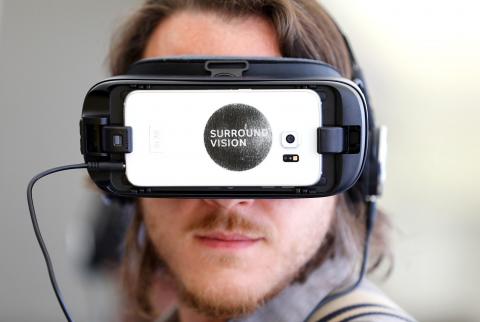
Photo: Bloomberg
The VR hardware that is selling has mostly been relatively inexpensive goggles that allow people to experience VR through their smartphones, such as Samsung Electronics Co’s Gear VR and Google’s Daydream, not higher-end, dedicated headsets such as those made by Sony Corp, Facebook Inc’s Oculus and HTC Corp (宏達電).
“Some people have said that 2016 was not a very good year for VR, that perhaps virtual reality is not where we would have hoped,” Roy Taylor, vice president for alliances at semiconductor manufacturer Advanced Micro Devices Inc, said in his keynote address at the conference, before going on to dispute the conclusion.
He listed a series of virtual-reality achievements last year, including the first uses of the technology for surgery and in a courtroom, as well as several significant VR games and films, and yet, talking to exhibitors at the conference, there was a distinct sense that virtual reality has entered the dreaded “trough of disillusionment.”
That is the bust part of the boom-and-bust in public expectations that precedes mass adoption of a new technology in research firm Gartner’s famous “hype cycle.”
“I think the problem was about hype and expectation versus reality,” said Stuart Gallop, chief executive officer of ARiVR, a UK company working on product placement for brand marketing within virtual reality environments such as games and movies.
Many working in VR have run up against the hard economic reality of trying to produce content for a technology that remains, at least for the moment, fairly niche.
Daniel Kihlgren Kallander, a developer and programmer for the Swedish virtual reality start-up Svrvive ABAB, said that his company lost money on its first VR game, also called Svrvive, which it released for HTC’s Vive platform last year.
“This is a very small market right now,” he said. “We need a bigger market to sustain ourselves. This is doubly true for those working on virtual-reality films, as opposed to computer games.”
Edward Saatchi, chief executive officer and cofounder of Oculus Story Studio, a VR movie studio owned by Facebook’s Oculus, compared early experiments in VR films with the transition from silent movies to talkies in the late 1920s, except, he said of those pioneers in sound: “At least they had a business model.”
As disappointment is setting in for virtual reality, expectations are building around its less glamorous cousin, augmented reality (AR), which is also sometimes called mixed reality, because it places digitally-rendered elements in the real observed environment.
Last year, Pokemon Go, which is an augmented-reality game played on smartphones, became a worldwide phenomenon.
Microsoft Corp launched its high-end AR headset, HoloLens, which has found customers mostly among industrial and business users — such as aeronautical engineers and architects.
Snap Inc’s AR photograph filters are one of the most popular features of its messaging service and Facebook has announced a big push into the field with its own AR camera filters.
Many now expect Apple Inc to introduce an augmented-reality product in the next year, which might help AR to leapfrog VR to achieve mass adoption.
“Apple has not made a play yet in this space and I think they will, and that it will be huge,” Gallop said.
Technology company ABI Research said that virtual reality generates about 50 percent more revenue than augmented reality, but that it relies heavily on hardware sales.
Augmented reality, by contrast, relies more on software and in many cases can be experienced by users with their smartphones.
ABI forecasts that AR revenues will surpass VR sales by 2019.
Virtual-reality true believers, like Taylor, are dismissive of the idea that AR might outrun VR as a blockbuster consumer technology.
Augmented reality requires too much training for the average consumer to learn how to integrate the digital images into the real world, Taylor said.
“Mixing the virtual world and the real world is less natural,” he said.
VR enthusiasts think the current “trough of disillusionment” is — as the Gartner model would predict — merely a temporary setback on the road to virtual reality becoming a mainstream technology — and a cash cow.
The question though, is how long the field will have to wallow in the trough.

Netherlands-based semiconductor equipment supplier ASML Holding NV yesterday said that it is planning to hire an additional 1,000 people in Taiwan this year in response to growing demand from clients. ASML had previously planned to recruit 600 people this year, but that the plan has been adjusted upward, ASML vice president and ASML Taiwan general manager Grace Wang (汪佳慧) told reporters. ASML has a workforce of more than 4,500 in Taiwan, accounting for about 10 percent of its global total, Wang said. This year’s recruitment campaign would focus on adding people in the customer support, manufacturing and supply chain domains to assist ASML

Starlux Airlines Co (星宇航空) today unveiled a long-haul network expansion plan at a shareholders’ meeting in Taipei, including direct flights to Barcelona, Spain, and Zurich, Switzerland, as well as a service connecting Taipei, Sydney and New Zealand. Starlux is to become the first Taiwanese carrier to offer non-stop services to the two European cities, while the inaugural oceanic route is expected to expand transit opportunities within the Australia-New Zealand market, Starlux said. Flight services to Chicago, Dallas, Washington and New York are under evaluation, the airline added. Prior to the shareholders’ meeting, the airline earlier this year announced that it would be

UNDER MICROSCOPE: Taiwan detained three people who allegedly conspired to buy servers in Taiwan and export them using fraudulent documentation, prosecutors said Nvidia Corp chief executive officer Jensen Huang (黃仁勳) on Saturday urged Super Micro Computer Inc to tighten up on compliance after Taiwan detained three people this week for allegedly making fraudulent declarations about artificial intelligence (AI) servers made by its US partner. The development marked the nation’s first crackdown on semiconductor smuggling, which grew after the US slapped restrictions on exports of high-end chips such as Nvidia AI accelerators to China. Nvidia is “rigorous” in explaining regulations to all of its partners, Huang told reporters after arriving in Taipei. “Ultimately Super Micro has to run their own company,” he said in response to

Nvidia Corp yesterday announced that CEO Jensen Huang (黃仁勳) would attend an employee meeting in Taipei tomorrow to celebrate the launch of the company’s Taiwan headquarters project. Huang would attend a gathering at the site of Nvidia’s planned headquarters in Beitou Shilin Technology Park (北投士林科技園區), the company said in a statement. After arriving in Taiwan on Saturday last week, Huang told reporters that he plans to meet with Quanta Computer Inc (廣達) chairman Barry Lam (林百里) and Taiwan Semiconductor Manufacturing Co (TSMC, 台積電) chairman C.C. Wei (魏哲家), and would attend the groundbreaking ceremony for Nvidia’s Taiwan headquarters tomorrow. Nvidia has not yet applied


 RSS
RSS