


With the number of commercial drones expected to soar into the millions in the next few years, operators whose unmanned aircraft malfunction or crash will be looking for places to get them fixed.
Some repair shops authorized by manufacturers to fix smaller drones are already having trouble keeping up with demand.
For several weeks, a California company had a note posted on its Web site referring specifically to the Phantom drone.
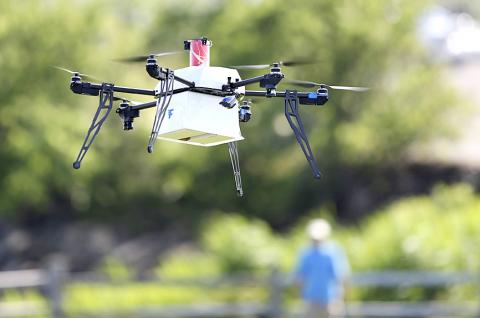
Photo: AP
“Temporarily not accepting any new repairs at this time due to high volume. Please check back soon,” it said.
While such waits might be frustrating for operators, it spells opportunity for repair shops keen to diversify and budding drone mechanics who could start lucrative careers repairing commercial drones without having to pay for a four-year college degree.
“I’m trying to hire two experienced drone technicians at US$20 an hour and I can’t find anybody,” New Jersey Drone Academy founder James Barnes said. “This gives kids in urban areas that can’t go to college now a chance to work at a trade and make decent money.”
Northland Community and Technical College in northwestern Minnesota has been teaching unmanned aircraft maintenance for larger military-type drones.
It is expanding its program to include smaller drone repair and school officials are promising a high-paying job after just one or two years.
“The reality is, the people coming out of the trade schools, the technical colleges, places like that, are the people out there getting jobs and they’re getting paid nicely to do it,” said Zack Nicklin, unmanned aircraft instructor at the school in Thief River Falls, Minnesota. “They’re making careers out of this.”
One of Nicklin’s students, Chris Rolfing, said he grew up taking machinery apart, seeing how it worked and putting it back together.
He signed up for drone maintenance and repair after serving four years in the military and hopes his skills can help local farmers.
“I grew up in a farming community and both of my grandpas were farmers so I would like to stay close to the agriculture business,” the 26-year-old said. “This spring I will be working with a few farmers doing some demo flights and getting my name out there to get my business started up.”
In addition to his repair business, Rolfing plans to do his own business doing aerial photography, 3D mapping, and agriculture analysis.
Unmanned aircraft owners basically have three options when their drones need tune-ups or repairs. They can send it back to the manufacturer, send it to a repair shop or fix it themselves.
Most of the smaller shops specialize in hobby grade or low-end commercial grade drones, specific to a few manufacturers. Those drones typically cost a few thousand dollars to buy, and about US$150 to fix, not including parts.
The more expensive commercial drones generally need repair experts, many of whom have backgrounds in manned aviation.
Robotic Skies is building a network of affiliated repair stations around the world. Company CEO Brad Hayden has more than 120 service stations under his umbrella, most of which work on higher-end drones that cost US$10,000 and up.
He said he plans to recruit more shops as needed.
“The industry is always short of avionics technicians. That’s kind of the way it is,” Hayden said. “Our intent is to bring in enough service centers to always meet the demand. We are built for a volume market.”
Thomas Swoyer, the head of the US’ first drone business park, Grand Sky, is looking at creating a repair depot at the North Dakota park for medium and large unmanned aircraft.
The only place to fix large unmanned aircraft now is on military bases and as more of them enter the market, Swoyer said they are going to “need a place to get retrofitted, upgraded and repaired.”
Barnes has an idea to turn used food vendor trucks into portable drone repair stations to move in and out of urban areas.
“I’m not sure we’re quite at the point where you would have them like your basic auto repair shop, with one on every corner. I think one day we will definitely be there,” Nicklin said.

Cairo’s new monorail slices across the city skyline, running above the familiar chaos of blaring horns and aging buses’ exhaust fumes that mark rush hour below. The US$4.5 billion monorail, opened this month, is among Egypt’s most prominent new transport projects, part of a debt-funded infrastructure drive criticized for sapping state finances while bringing limited benefits to most of the country’s 109 million people. “It feels like you’re in a different country,” said Ramy Sayed, a restaurant manager, aboard a driverless Innovia 300 train. “No noise, no traffic, we’re not used to this.” The eastern line runs 56km from the bustling middle-class
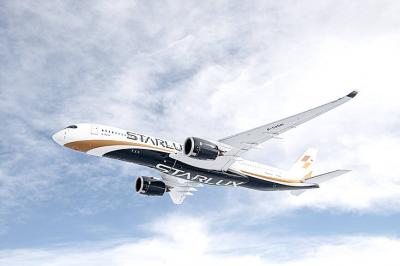
Starlux Airlines Co (星宇航空) today unveiled a long-haul network expansion plan at a shareholders’ meeting in Taipei, including direct flights to Barcelona, Spain, and Zurich, Switzerland, as well as a service connecting Taipei, Sydney and New Zealand. Starlux is to become the first Taiwanese carrier to offer non-stop services to the two European cities, while the inaugural oceanic route is expected to expand transit opportunities within the Australia-New Zealand market, Starlux said. Flight services to Chicago, Dallas, Washington and New York are under evaluation, the airline added. Prior to the shareholders’ meeting, the airline earlier this year announced that it would be

Taiwanese firms have increased investment in the Philippines in recent years as Manila’s ties with Washington deepen and global supply chains continue to shift away from China, an expert at the Chung-Hua Institution for Economic Research (CIER, 中華經濟研究院) said yesterday. The Philippines had not been among Taiwanese investors’ top choices in Southeast Asia, CIER Taiwan ASEAN Studies Center director Kristy Hsu (徐遵慈) said at a seminar in Taipei. However, Taiwan’s investment in the country has grown significantly since the COVID-19 pandemic, reaching US $257 million last year, a high in recent years, she said. Although Taiwan’s total investment in the Philippines still lags

Intel Corp regards Taiwan Semiconductor Manufacturing Co (TSMC, 台積電) as a longstanding partner, as the US chipmaker would continue outsourcing production of advanced chips to TSMC, Intel chief executive officer Lip-Bu Tan (陳立武) said yesterday. “I don’t look at people as competitors. I look at the collaboration... Nvidia is also, you know, a good friend,” Tan told a news conference following his keynote speech at the Computex trade show in Taipei. “It’s a very trusted partnership for us... We are a big, top customer for them, and we’re going to continue doing that,” he said, referring to TSMC, the world’s largest foundry


 RSS
RSS