


As US president-elect Donald Trump stokes talk of tariffs on Chinese goods, General Motors Co (GM) finds itself being investigated by the Asian nation for possible antitrust violations, according to people familiar with the matter.
China is looking at GM’s retail-pricing practices, which were also the subject of fines against Daimler AG and other automakers over the past two years.
Any action by China’s National Development and Reform Commission (NDRC), which is conducting the investigation, might be subject to changes, said the people, who asked not to be identified because the information is private.
Some dealerships in the SAIC-GM Co Ltd (上汽通用汽車) network were investigated over retail pricing practices, one of the people said.
The antitrust investigation comes amid strained China-US relations that have gotten tense after Trump proposed placing tariffs on Chinese goods.
The Chinese Communist Party-affiliated Global Times last month said a “tit for tat” retaliation could follow proposals by Trump for tariffs on the world’s largest trading nation, which had US$627 billion in US trade last year.
The Global Times wrote in an editorial that orders for Boeing Co planes could be replaced with models from Airbus Group SE, and that Apple Inc’s iPhone sales might suffer a setback.
GM fully respects local laws and regulations wherever it operates and does not comment on speculation, Irene Shen (沈燕飛), a company spokeswoman, said in an e-mail.
The commission did not immediately reply to a fax seeking comment, and representatives for SAIC Motor Corp (上海汽車) and the SAIC-GM joint venture were not immediately reachable for comment.
GM shares took a hit after the news, with the stock falling 3.8 percent to close at US$35.95 in New York on Wednesday.
SAIC dropped 4 percent to 23.01 yuan as of 11:04am yesterday in Shanghai trading, headed for the biggest decline in five months.
Trump said in a Fox News Sunday interview on Sunday that the US’ “one China” policy regarding Taiwan will hinge on cutting a better deal on trade. He told a crowd in Iowa last week that China would soon have to “play by the rules.”
China has used its antitrust laws to lean on foreign companies and help the competitive position of its domestic industry, said Stuart Malawer, a professor of law and international trade at George Mason University in Fairfax, Virginia.
“The Chinese government wants to protect its own companies,” Malawer said in a telephone interview. “The antitrust laws have been used periodically to target foreign auto companies. In the last few weeks, the Chinese government has taken a more aggressive position because of Trump’s proclamations.”
Last year, China fined Daimler’s Mercedes-Benz unit US$56 million for monopolistic pricing practices. In 2014, the government fined Volkswagen AG and Fiat Chrysler Automobiles NV for similar practices as well as a dozen parts makers.
The parts firms were fined US$200 million collectively.
Retail sales by GM in China rose 8.6 percent this year through October to 3.06 million vehicles, trailing only Volkswagen among foreign automakers. Its German rival boosted deliveries 11 percent to 3.2 million.
The China Daily on Wednesday reported that the government would soon penalize a US automaker for price fixing. The report did not name the automaker or the size of the penalty.
Trump is likely to discuss reported Chinese penalties against US automakers when he meets with his pick for US Department of Commerce secretary, Wilbur Ross, according to spokesmen Sean Spicer and Jason Miller.

Taiwanese firms have increased investment in the Philippines in recent years as Manila’s ties with Washington deepen and global supply chains continue to shift away from China, an expert at the Chung-Hua Institution for Economic Research (CIER, 中華經濟研究院) said yesterday. The Philippines had not been among Taiwanese investors’ top choices in Southeast Asia, CIER Taiwan ASEAN Studies Center director Kristy Hsu (徐遵慈) said at a seminar in Taipei. However, Taiwan’s investment in the country has grown significantly since the COVID-19 pandemic, reaching US $257 million last year, a high in recent years, she said. Although Taiwan’s total investment in the Philippines still lags

Intel Corp regards Taiwan Semiconductor Manufacturing Co (TSMC, 台積電) as a longstanding partner, as the US chipmaker would continue outsourcing production of advanced chips to TSMC, Intel chief executive officer Lip-Bu Tan (陳立武) said yesterday. “I don’t look at people as competitors. I look at the collaboration... Nvidia is also, you know, a good friend,” Tan told a news conference following his keynote speech at the Computex trade show in Taipei. “It’s a very trusted partnership for us... We are a big, top customer for them, and we’re going to continue doing that,” he said, referring to TSMC, the world’s largest foundry
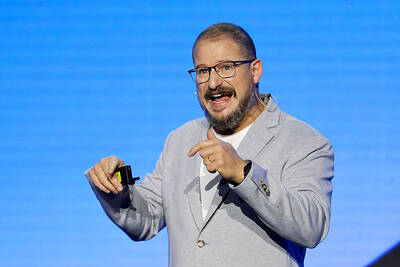
Artificial intelligence (AI) agents would supplant smartphones as the center of people’s digital lives, fundamentally reshaping personal devices and driving a major computing upgrade cycle, Qualcomm Inc CEO Cristiano Amon said yesterday. In his keynote speech for this year’s Computex trade show in Taipei, Amon said that the rise of "agentic AI" — AI systems capable of reasoning, planning and carrying out tasks autonomously — would transform how people interact with technology across phones, PCs, vehicles and wearable devices. Describing the technology as the next major evolution in computing, Amon said that "2026 is the year of agents.” For decades, smartphones have sat
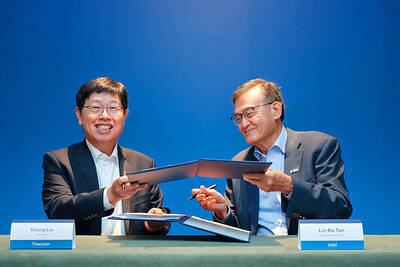
Hon Hai Precision Industry Co (鴻海精密) yesterday said it would work with US chipmaker Intel Corp to jointly develop and deploy next-generation artificial intelligence (AI) infrastructure and intelligent computing platforms in a move to capture booming demand for AI computing systems. Hon Hai, also known as Foxconn Technology Group (富士康), said in a statement that the partnership would combine its global manufacturing scale, system integration expertise and AI data center deployment capabilities with Intel’s strengths in processor architecture, silicon technologies and software ecosystem. The companies said they plan to work on equipment used in AI data centers, including server racks powered by


 RSS
RSS