


Austria is one Europe’s richest countries, yet the hills are alive not with optimism but with worries about the economy, boosting the far-right candidate ahead of Sunday’s presidential election.
For example, at a job center in Vienna’s fifth district, manager Astrid Mayer is busy.
“Things are getting worse every year,” Mayer told reporters. “The figures speak for themselves. I’ve been here for 15 years and I’ve never seen it like this.”
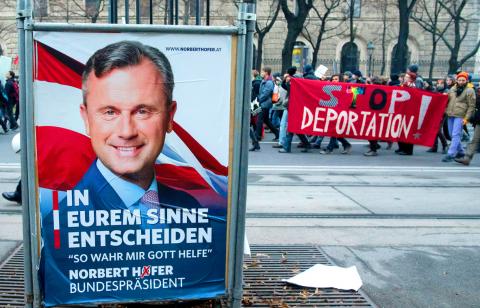
Photo: AFP
When Mayer started, the jobless rate was “three point something,” she said.
Now it is 8.6 percent. Adjusted to compare with the rest of the EU, it is 6.3 percent, no longer the lowest in the bloc.
Doris Blei is one of the lucky ones. The 48-year-old has found a new job after being laid off by her bank.
“Lots of banks are reducing headcount. It’s hard, particularly when you get older,” she told reporters as she lined up.
Even those in work do not necessarily have it easy. About 400,000 people are classified as the “working poor” — in employment but unable to get by.
Austria is on the crossroads between Italy, Germany and the EU’s newer eastern members. Bordering eight countries, it lives off tourism, agriculture and, most importantly, selling goods abroad.
Like Germany, the Alpine nation of 8.7 million people boasts a raft of world-beating exporters. Glock guns, Novomatic gaming machines and energy drink Red Bull are all Austrian, as is motorbike maker KTM.
“Austria is one of the biggest winners of the EU, the euro and EU enlargement,” KTM chief executive officer Stefan Pierer said.
Close to 98 percent of KTM’s products — the firm has an alliance with India’s Bajaj Auto — are exported, half to outside the EU.
However, cracks in the Austrian model are beginning to show. Working hours are too rigid, non-wage labor costs are too high and the bureaucracy is dizzying, Pierer said.
“It’s awful, demoralizing,” he said.
Austria’s competitiveness rankings are far from glowing and investment is mostly just to keep things ticking over, not for the future.
“Out of every 10 euros invested, eight go into renovating existing plants and only two into new projects,” said Franz Schellhorn, of think-tank Agenda Austria.
Austrian Chancellor Christian Kern — who spent 20 years working in industry — said he is aware that life has gottem harder.
However, his promises to jumpstart the unhappy “grand coalition” with the center-right and launch a “New Deal” package of reforms have so far disappointed, critics said.
Nonetheless, Schellhorn said that by international standards, Austrians live well.
Growth has picked up and unemployment fallen this year. The government has cut some taxes.
“People have in fact never had it so good,” Schellhorn told reporters. “But there is a feeling that things are getting worse.”
Just 23 percent of Austrians are optimistic about the future, a recent Imas survey showed.
Like populists elsewhere, the Freedom Party (FPOe) has tapped into this pessimism.
The party portrays itself as being on the side of ordinary Austrian workers against jobs-killing immigration and globalization.
“Austrian jobs should first be for Austrians, not for EU foreigners and definitely not for the many economic migrants,” FPOe Austrian presidential candidate Norbert Hofer said.
The opposition party’s economic policies — slash taxes, splurge on infrastructure — strongly resemble those of US president-elect Donald Trump.
While this might boost growth, like Trump the FPOe is suspicious of trade deals and it is ambivalent about the EU, particularly the free movement of labor.
The message is bearing fruit in the race for the largely ceremonial presidency, with Hofer neck-and-neck in polls with independent candidate Alexander Van der Bellen.
Van der Bellen, a staunchly pro-EU economics professor, also bemoans the lack of reforms.
However, Hofer depicts him as being from the same out-of-touch elite as the government.
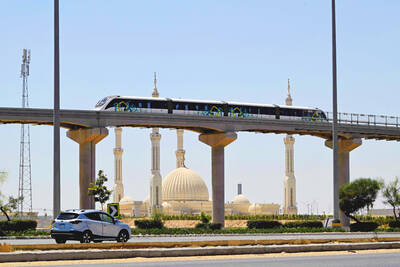
Cairo’s new monorail slices across the city skyline, running above the familiar chaos of blaring horns and aging buses’ exhaust fumes that mark rush hour below. The US$4.5 billion monorail, opened this month, is among Egypt’s most prominent new transport projects, part of a debt-funded infrastructure drive criticized for sapping state finances while bringing limited benefits to most of the country’s 109 million people. “It feels like you’re in a different country,” said Ramy Sayed, a restaurant manager, aboard a driverless Innovia 300 train. “No noise, no traffic, we’re not used to this.” The eastern line runs 56km from the bustling middle-class

Taiwanese firms have increased investment in the Philippines in recent years as Manila’s ties with Washington deepen and global supply chains continue to shift away from China, an expert at the Chung-Hua Institution for Economic Research (CIER, 中華經濟研究院) said yesterday. The Philippines had not been among Taiwanese investors’ top choices in Southeast Asia, CIER Taiwan ASEAN Studies Center director Kristy Hsu (徐遵慈) said at a seminar in Taipei. However, Taiwan’s investment in the country has grown significantly since the COVID-19 pandemic, reaching US $257 million last year, a high in recent years, she said. Although Taiwan’s total investment in the Philippines still lags
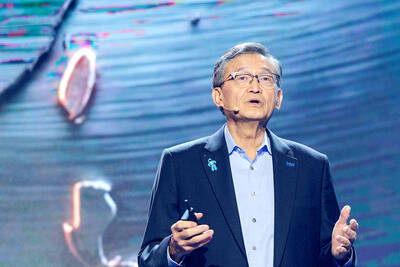
Intel Corp regards Taiwan Semiconductor Manufacturing Co (TSMC, 台積電) as a longstanding partner, as the US chipmaker would continue outsourcing production of advanced chips to TSMC, Intel chief executive officer Lip-Bu Tan (陳立武) said yesterday. “I don’t look at people as competitors. I look at the collaboration... Nvidia is also, you know, a good friend,” Tan told a news conference following his keynote speech at the Computex trade show in Taipei. “It’s a very trusted partnership for us... We are a big, top customer for them, and we’re going to continue doing that,” he said, referring to TSMC, the world’s largest foundry
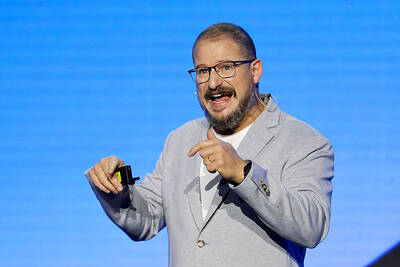
Artificial intelligence (AI) agents would supplant smartphones as the center of people’s digital lives, fundamentally reshaping personal devices and driving a major computing upgrade cycle, Qualcomm Inc CEO Cristiano Amon said yesterday. In his keynote speech for this year’s Computex trade show in Taipei, Amon said that the rise of "agentic AI" — AI systems capable of reasoning, planning and carrying out tasks autonomously — would transform how people interact with technology across phones, PCs, vehicles and wearable devices. Describing the technology as the next major evolution in computing, Amon said that "2026 is the year of agents.” For decades, smartphones have sat


 RSS
RSS