


Bayer AG’s exploration of a potential bid for Monsanto Co triggered speculation that the German company might need to sell some assets to help fund its quest to create the world’s largest supplier of seeds and farm chemicals.
Bayer has held preliminary discussions internally and with advisers on an offer for Monsanto, which has a market value of about US$43 billion, people with knowledge of the matter said on Thursday.
A deal would give Bayer — whose products range from blood thinner Xarelto to consumer products including aspirin to pest-control treatments for farmers — brands such as Roundup, the world’s best-selling herbicide, and more than 2,000 seed varieties.
Bayer could shed its stake in its plastics unit and its animal health business to make the acquisition work, said Colin Isaac, a chemical analyst with Atlantic Equities in London.
“If Bayer is ready to put up the billions, then voila! That’s the real issue here,” said Lutz Krafft, a former Bayer executive who is now a senior agricultural adviser at consulting firm ChemAdvice GmbH. “The effects on Bayer’s balance sheet and the integration of the company are the two challenges.”
Combining the two businesses is not likely to raise significant antitrust hurdles by itself, but could intensify global scrutiny of the handful of companies engaged in unprecedented consolidation across the crop-chemicals industry.
Competition regulators are already investigating the US$130 billion merger between Dow Chemical Co and DuPont Co, while national security officials in the US weigh China National Chemical Corp’s (中國化工) bid to acquire Syngenta AG of Switzerland for US$43 billion.
Bayer and St Louis-based Monsanto together would have had annual revenue of US$67 billion last year, with 37 percent from pharmaceuticals — including over-the-counter products and diagnostics — and 39 percent from crop chemicals.
“It’s a very ambitious deal for either company,” Isaac said in a telephone interview on Thursday. “Historically, these have been fairly conservative institutions.”
Germany’s second-largest company could pay for some of the deal in cash with 15 billion euros (US$17.02 billion) raised in debt, Jeremy Redenius, an analyst at Sanford C. Bernstein & Co, said in a note on Thursday. It could also issue additional shares and sell assets including the animal health unit, he said.
If Bayer acquires Monsanto, it could position itself as a life sciences business, Isaac said.
Bayer has already started down that path, with the sale of a stake in its plastics business, Covestro AG, through an initial public offering last year, and the acquisition of Merck & Co’s over-the-counter medicines in 2014.
Since Jan. 1, the company has been organized under three divisions — pharmaceuticals, consumer health and crop sciences.

Netherlands-based semiconductor equipment supplier ASML Holding NV yesterday said that it is planning to hire an additional 1,000 people in Taiwan this year in response to growing demand from clients. ASML had previously planned to recruit 600 people this year, but that the plan has been adjusted upward, ASML vice president and ASML Taiwan general manager Grace Wang (汪佳慧) told reporters. ASML has a workforce of more than 4,500 in Taiwan, accounting for about 10 percent of its global total, Wang said. This year’s recruitment campaign would focus on adding people in the customer support, manufacturing and supply chain domains to assist ASML

UNDER MICROSCOPE: Taiwan detained three people who allegedly conspired to buy servers in Taiwan and export them using fraudulent documentation, prosecutors said Nvidia Corp chief executive officer Jensen Huang (黃仁勳) on Saturday urged Super Micro Computer Inc to tighten up on compliance after Taiwan detained three people this week for allegedly making fraudulent declarations about artificial intelligence (AI) servers made by its US partner. The development marked the nation’s first crackdown on semiconductor smuggling, which grew after the US slapped restrictions on exports of high-end chips such as Nvidia AI accelerators to China. Nvidia is “rigorous” in explaining regulations to all of its partners, Huang told reporters after arriving in Taipei. “Ultimately Super Micro has to run their own company,” he said in response to
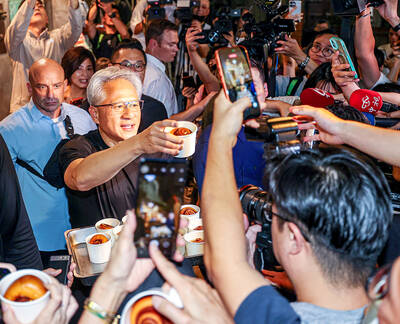
Nvidia Corp yesterday announced that CEO Jensen Huang (黃仁勳) would attend an employee meeting in Taipei tomorrow to celebrate the launch of the company’s Taiwan headquarters project. Huang would attend a gathering at the site of Nvidia’s planned headquarters in Beitou Shilin Technology Park (北投士林科技園區), the company said in a statement. After arriving in Taiwan on Saturday last week, Huang told reporters that he plans to meet with Quanta Computer Inc (廣達) chairman Barry Lam (林百里) and Taiwan Semiconductor Manufacturing Co (TSMC, 台積電) chairman C.C. Wei (魏哲家), and would attend the groundbreaking ceremony for Nvidia’s Taiwan headquarters tomorrow. Nvidia has not yet applied
Huawei Technologies Co (華為) said it has come up with a new pathway to shorten its gap with industry leader Taiwan Semiconductor Manufacturing Co (TSMC, 台積電), potentially achieving a breakthrough in making advanced semiconductors without cutting-edge equipment. Right now there is about a five-year gap between what TSMC is capable of and what Huawei, together with its manufacturing partner Semiconductor Manufacturing International Corp (中芯), can produce. Huawei is to start making 1.4-nanometer chips by 2031 with its own “LogicFolding” technology, Huawei semiconductor chief He Tingbo (何庭波) said in a rare public appearance during a chip conference yesterday, while TSMC has


 RSS
RSS