


Taipei-based real-estate developer Taroko Development Corp (大魯閣開發) yesterday opened its new Taroko Park (大魯閣草衙道) shopping center in Kaohsiung, with the aim of generating NT$5 billion (US$154.24 million) in sales in the first year, the company said.
The shopping center aims to provide visitors with a fun-filled shopping experience with several sports and entertainment attractions, such as a carousel in the front plaza, as well as a go-kart racing track which is a miniature copy of Japan’s renowned Suzuka circuit, the company said.
Unlike its peers, the company said that Taroko Park would derive a majority 61 percent of its revenue from recreation and dining attractions, with department store sales making up the remainder.
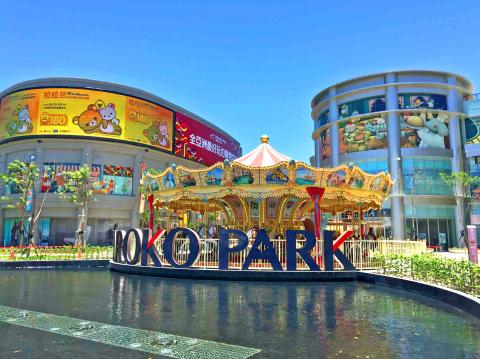
Photo: CNA
“I belive we have made the first precedent in Asia with our operational allocation,” a company official said, adding that capital investment in the project totaled about NT$5.3 billion.
The shopping mall has attracted 220 international fashion and sportswear brands, and also houses a shop selling official merchandise of the Lamigo Monkeys professional baseball team, the company said.
Developed as a joint build- operate-transfer project for the Kaohsiung Rapid Transit Corp (KRTC, 高雄捷運公司) and the Kaohsiung City Government, the shopping center is located near to the Caoya Station (草衙), south of the city’s airport.
Taroko’s lease with KRTC is 25 years, and is to be extended for another 10 years with the original landowner — the Kaohsiung City Government — with a guarantee of priority right of renewal for two more 10-year contracts, the company said.
The mall was built under close cooperation between the KRTC and Kaohsiung City Government, in a bid to attract tourists and create job opportunities in the region.
“Taroko Park’s entertainment and shopping offerings are expected to attract 12 million visitors annually,” Taroko Development chairman Jeff Tsai (蔡明璋) said last week, adding that the mall is also expected to generate about 5,000 jobs in Kaohsiung, as well as boost ridership of the city’s metro system by 6 million.
Kaohsiung Mayor Chen Chu (陳菊) yesterday made her way to the opening ceremony via the metro.
Taroko Development, a subsidiary of Taroko Textile Corp (大魯閣纖維), has been determined to enter the nation’s shopping center industry since it was established in 2011.
The company made its foray into the retail sector when it took over the Mode Mall (新時代購物中心) in Taichung from Fubon Life Insurance Co (富邦人壽) last year.
Taroko has also announced tentative plans to launch a new shopping mall in Hsinchu County by the third quarter of next year.

Taiwanese firms have increased investment in the Philippines in recent years as Manila’s ties with Washington deepen and global supply chains continue to shift away from China, an expert at the Chung-Hua Institution for Economic Research (CIER, 中華經濟研究院) said yesterday. The Philippines had not been among Taiwanese investors’ top choices in Southeast Asia, CIER Taiwan ASEAN Studies Center director Kristy Hsu (徐遵慈) said at a seminar in Taipei. However, Taiwan’s investment in the country has grown significantly since the COVID-19 pandemic, reaching US $257 million last year, a high in recent years, she said. Although Taiwan’s total investment in the Philippines still lags

Intel Corp regards Taiwan Semiconductor Manufacturing Co (TSMC, 台積電) as a longstanding partner, as the US chipmaker would continue outsourcing production of advanced chips to TSMC, Intel chief executive officer Lip-Bu Tan (陳立武) said yesterday. “I don’t look at people as competitors. I look at the collaboration... Nvidia is also, you know, a good friend,” Tan told a news conference following his keynote speech at the Computex trade show in Taipei. “It’s a very trusted partnership for us... We are a big, top customer for them, and we’re going to continue doing that,” he said, referring to TSMC, the world’s largest foundry
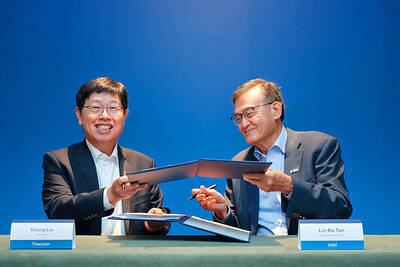
Hon Hai Precision Industry Co (鴻海精密) yesterday said it would work with US chipmaker Intel Corp to jointly develop and deploy next-generation artificial intelligence (AI) infrastructure and intelligent computing platforms in a move to capture booming demand for AI computing systems. Hon Hai, also known as Foxconn Technology Group (富士康), said in a statement that the partnership would combine its global manufacturing scale, system integration expertise and AI data center deployment capabilities with Intel’s strengths in processor architecture, silicon technologies and software ecosystem. The companies said they plan to work on equipment used in AI data centers, including server racks powered by

Artificial intelligence (AI) agents would supplant smartphones as the center of people’s digital lives, fundamentally reshaping personal devices and driving a major computing upgrade cycle, Qualcomm Inc CEO Cristiano Amon said yesterday. In his keynote speech for this year’s Computex trade show in Taipei, Amon said that the rise of "agentic AI" — AI systems capable of reasoning, planning and carrying out tasks autonomously — would transform how people interact with technology across phones, PCs, vehicles and wearable devices. Describing the technology as the next major evolution in computing, Amon said that "2026 is the year of agents.” For decades, smartphones have sat


 RSS
RSS