


Mostly young, male audiophiles throng a Singapore hotel ballroom, intently assessing headphones, earbuds and in-ear monitors — priced from US$50 to as much as US$10,000.
Alongside are banks of dedicated digital audio players (DAPs), with an entire wall of the expo showcasing the king of DAPs: iriver.
Less than five years ago, the South Korean firm was staring at bankruptcy, its low-end MP3 players no match for Apple’s iPod and the rise of the music-playing smartphone.
However, after some missteps and a name change, Astell & Kern has created a small, but lucrative market for those wanting to hear music as it sounds in the studio or concert hall.
This is the business of high-resolution (high-res) audio (HRA), a niche that smartphone makers, music companies and even telecoms carriers hope will, if not move to the mainstream, at least sprinkle some of its fat margins on their bottom lines.
“Now, people are interested in US$3,000 players,” Astell & Kern vice president James Lee said. “Before, they would think US$300 players were crazy. Now, US$1,000 is the average price.”
And that is small change compared with the US$55,000 price tag on a pair of Sennheiser Orpheus HE 1 electrostatic headphones resting on a marble-mounted amplifier on show for selected guests in a room on the hotel’s 34th floor.
Consumer demand for HRA is being fed in part by lifestyle shifts. We commute longer, live in smaller apartments and use “smarter” phones and streaming services, like Spotify.
Americans spend 24 hours a week listening to music, market consultancy Nielsen said.
Also, there are fewer constraints on audio quality. A decade ago, a “lossy” MP3 format — where file compression meant reduced quality — made sense when US$30 would buy enough space for only about 500 songs. Now, the same price would get you enough flash memory for 32,000 songs.
The growth in listening to music is having a knock-on effect on Bluetooth speakers, headphones and other audio accessories. Last year, Americans spent more on headphones for the first time than they did on physical music, such as CDs.
This has stirred hardware makers. Apple’s purchase of headphones and music streaming company Beats for US$3 billion in 2014 has overshadowed efforts by other manufacturers to offer audio accessories and features.
A year earlier, Sony dusted off its Walkman brand as a high-end audio range, and has since added portable speakers and headphones. Samsung Electronics has its Level series of headphones and speakers, while LG Electronics last month launched its LG phone with an optional Hi-Fi module, made in partnership with Bang & Olufsen.
Others, too, hope clearer, richer audio will help them differentiate, adding separate audio processors to improve the playback of music on their phones.
They are helped by specialist chipmakers like ESS Technology Inc, whose digital audio converters are in phones made by Xiaomi Corp (小米), Lenovo Group Ltd (聯想) and Meizu Technology Corp (魅族), as well as the LeTV and Vivo brands.
Telecoms carriers are also taking note, hoping to lock in users or boost revenue: Singapore Telecommunications launched a service in February offering four separate streaming apps, including Spotify.
When iriver’s owners decided to sell the company in 2014, it was South Korean carrier SK Telecom that offered the most compelling bid, Lee said, adding that “Telcos think this market will grow.”
Much of the surge in interest in HRA is in Asia.
Onkyo, a Japanese music download service, has offered hi-res music since 2004. The country accounted for more than one-fifth of all spending on HRA, including home hi-fi, last year, according to GfK, a research company.
China, too, is growing fast, overtaking Japan as iriver’s main market in October last year.
Tianjin-based Hifiman Electronics, a maker of headphones costing up to US$3,000, is seeing its margins squeezed by pretenders.
“Customers and distributors tell me that users get a little bit confused,” Hifiman director of international sales Riccardo Yeh said.
The HRA market still has an early-stage, almost amateur feel. The dozens of companies making headphones, from Vietnam to Romania, are usually home-spun, crowdfunded or self-financed, and rarely employ more than a few staff, said Jude Mansilla, who runs a Web site and organized the Singapore expo.
Peter Cooney, an analyst who follows the HRA space, said: “The industry is very keen, but for the mass market, the question is: Is the demand there?”

Netherlands-based semiconductor equipment supplier ASML Holding NV yesterday said that it is planning to hire an additional 1,000 people in Taiwan this year in response to growing demand from clients. ASML had previously planned to recruit 600 people this year, but that the plan has been adjusted upward, ASML vice president and ASML Taiwan general manager Grace Wang (汪佳慧) told reporters. ASML has a workforce of more than 4,500 in Taiwan, accounting for about 10 percent of its global total, Wang said. This year’s recruitment campaign would focus on adding people in the customer support, manufacturing and supply chain domains to assist ASML
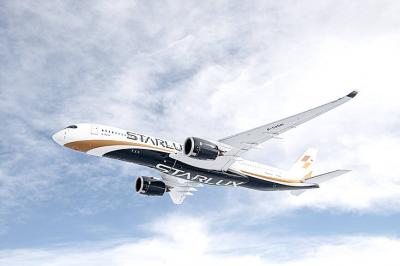
Starlux Airlines Co (星宇航空) today unveiled a long-haul network expansion plan at a shareholders’ meeting in Taipei, including direct flights to Barcelona, Spain, and Zurich, Switzerland, as well as a service connecting Taipei, Sydney and New Zealand. Starlux is to become the first Taiwanese carrier to offer non-stop services to the two European cities, while the inaugural oceanic route is expected to expand transit opportunities within the Australia-New Zealand market, Starlux said. Flight services to Chicago, Dallas, Washington and New York are under evaluation, the airline added. Prior to the shareholders’ meeting, the airline earlier this year announced that it would be
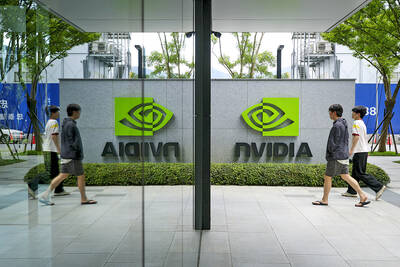
UNDER MICROSCOPE: Taiwan detained three people who allegedly conspired to buy servers in Taiwan and export them using fraudulent documentation, prosecutors said Nvidia Corp chief executive officer Jensen Huang (黃仁勳) on Saturday urged Super Micro Computer Inc to tighten up on compliance after Taiwan detained three people this week for allegedly making fraudulent declarations about artificial intelligence (AI) servers made by its US partner. The development marked the nation’s first crackdown on semiconductor smuggling, which grew after the US slapped restrictions on exports of high-end chips such as Nvidia AI accelerators to China. Nvidia is “rigorous” in explaining regulations to all of its partners, Huang told reporters after arriving in Taipei. “Ultimately Super Micro has to run their own company,” he said in response to

Nvidia Corp yesterday announced that CEO Jensen Huang (黃仁勳) would attend an employee meeting in Taipei tomorrow to celebrate the launch of the company’s Taiwan headquarters project. Huang would attend a gathering at the site of Nvidia’s planned headquarters in Beitou Shilin Technology Park (北投士林科技園區), the company said in a statement. After arriving in Taiwan on Saturday last week, Huang told reporters that he plans to meet with Quanta Computer Inc (廣達) chairman Barry Lam (林百里) and Taiwan Semiconductor Manufacturing Co (TSMC, 台積電) chairman C.C. Wei (魏哲家), and would attend the groundbreaking ceremony for Nvidia’s Taiwan headquarters tomorrow. Nvidia has not yet applied


 RSS
RSS